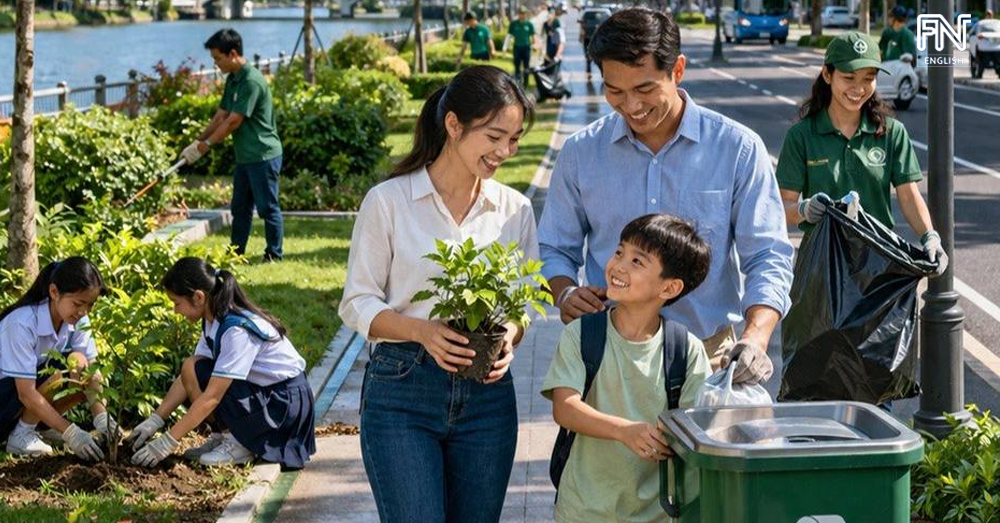

(Phnom Penh): Have you ever noticed how you feel when you walk along a clean, tree-lined street or sit in a well-maintained public park?
Without realizing it, you breathe a little deeper.
Your shoulders relax. You feel calmer, safer, and happier. You slow down and appreciate the beauty around you.
A clean environment has a remarkable ability to lift the human spirit.
This is no coincidence.
Our surroundings have a powerful influence on our thoughts, emotions, and behavior. The environment we live in does not merely surround us, it shapes us.
Clean roads, beautiful parks, tidy neighborhoods, and well-maintained public spaces create more than attractive communities.
They nurture healthier minds, stronger relationships, and more compassionate societies.
Psychologists have long understood that physical surroundings influence mental well-being.
When streets are clean and public spaces are cared for, people experience lower levels of stress and anxiety.
Natural beauty, orderly surroundings, and clean air provide a sense of comfort and stability.
In contrast, areas filled with litter, neglect, and pollution often create feelings of discomfort, frustration, sadness, and even hopelessness.
Cleanliness communicates something important.
It tells us that people care.
It tells us that this community values itself.
It tells us that someone believes this place, and the people who live here, are worth protecting.
That message has a profound psychological impact. It encourages trust, respect, and optimism.
People naturally respond to their surroundings. When public spaces are clean, individuals are more likely to keep them clean.
When parks are beautiful, families are more likely to visit them. When streets are free of litter, citizens are more inclined to respect public property and care for their neighborhoods.
Good environments encourage good behavior.
The opposite is also true.
Neglected surroundings often invite further neglect. Litter attracts more litter.
Graffiti invites more vandalism. Broken public spaces can gradually reduce people’s sense of responsibility and community pride.
Over time, physical disorder can influence social behavior, weakening trust and discouraging community participation.
Children are especially sensitive to the environments in which they grow.
A child raised in clean surroundings develops an appreciation for beauty, order, and responsibility.
Parks become classrooms where they learn to respect nature.
Tree-lined streets become places for exercise and friendship.
Public spaces become reminders that communities thrive when everyone contributes.
These early experiences shape lifelong values.
Children who learn to care for their environment often grow into adults who care for society.
Clean environments also strengthen social relationships.
People are more likely to walk outdoors, greet neighbors, exercise, gather in parks, and participate in community activities when public spaces are clean and welcoming.
These everyday interactions build trust, reduce loneliness, and create stronger communities.
A clean environment does more than improve physical health, it strengthens the bonds between people.
There is also a deep emotional connection between beauty and hope.
When people see flowers blooming along sidewalks, trees providing shade, clean rivers flowing peacefully, and public spaces cared for with pride, they begin to believe that positive change is possible.
Hope grows where people see evidence that their community is improving.
That hope becomes contagious.
One person plants a tree.
Another picks up litter.
A family beautifies their home.
A neighborhood organizes a clean-up day.
Slowly, individual actions become shared values, and shared values become a culture.
A clean environment also teaches an important lesson about respect.
When we care for public spaces, we show respect for strangers we may never meet.
We leave clean parks for children we do not know.
We protect clean roads for travelers we will never see.
We plant trees whose shade we may never enjoy. These quiet acts of kindness reveal the very best of human nature.
Governments can build roads and parks. They can provide waste collection and enforce environmental laws.
But they cannot create pride or compassion by decree.
Those qualities grow in the hearts of citizens.
Every piece of litter placed in a bin is more than an act of cleanliness, it is an act of respect.
Every flower planted is more than decoration, it is an expression of hope.
Every clean public space is more than beautiful, it is a reflection of a society that values dignity, harmony, and shared responsibility.
Ultimately, the environment we create becomes the environment that shapes us.
If we want calmer minds, healthier communities, kinder neighbors, and happier children, we must begin by creating surroundings that inspire those qualities.
A clean road does more than connect places, it connects people. A clean park does more than beautify a city, it nourishes the human spirit.
A clean environment is not simply a reflection of a healthy society; it is one of the forces that creates one.
Let us care for our roads, our parks, our rivers, and every public space, not only because the environment needs us, but because our hearts, our minds, and our communities flourish when we live in places that reflect hope, respect, and pride.
=FRESH NEWS