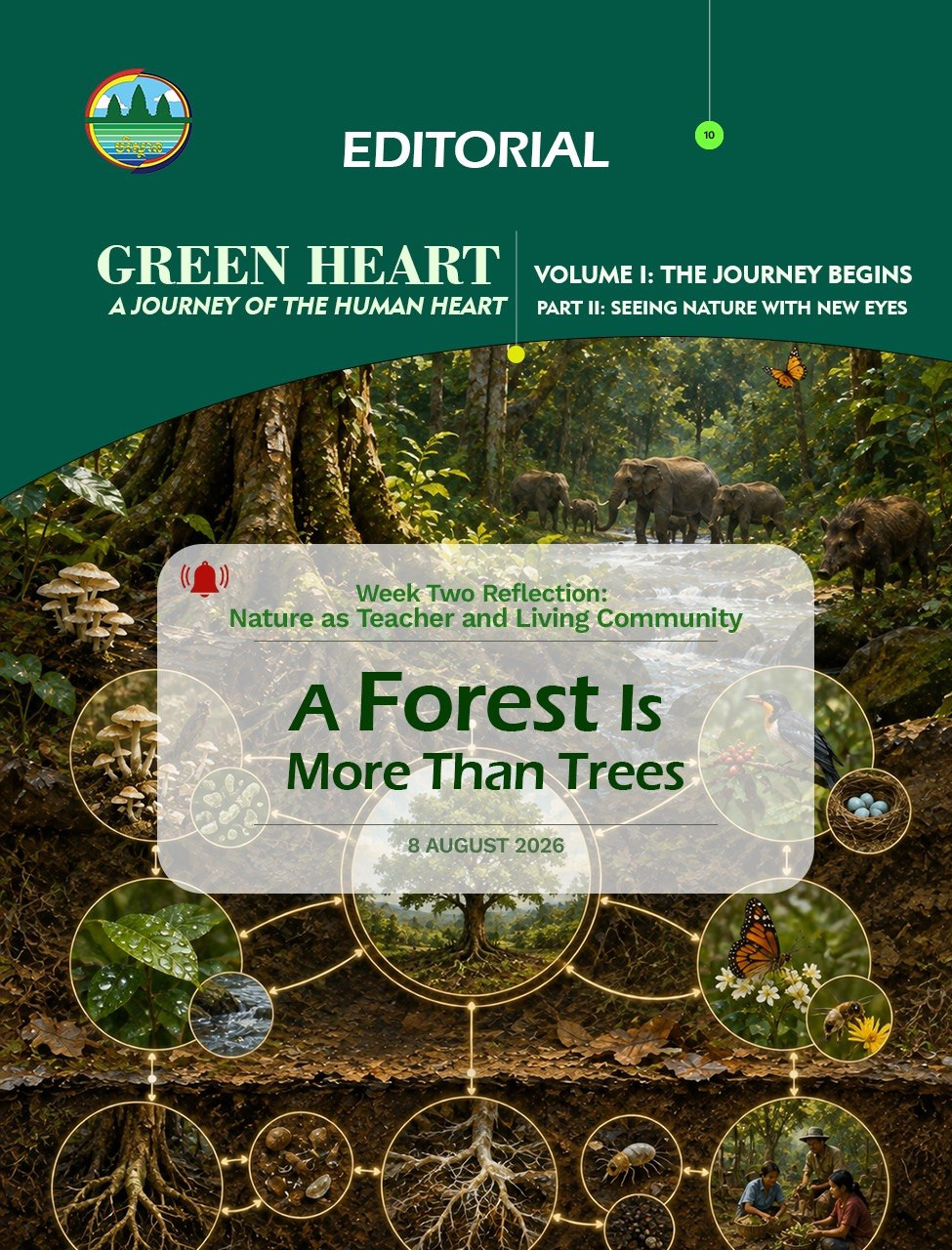

(Phnom Penh): If we look at a forest from far away, trees dominate the view. Their crowns form a green surface, and their trunks shape the paths below. It is easy to think that a forest is simply a large number of trees. But a forest is the relationships among living and nonliving parts of a place.
“A forest is not a crowd of trees; it is a community of relationships.”
Sunlight reaches the canopy and filters downward. Leaves fall and are broken apart by fungi, insects, and microorganisms. Their nutrients return to the soil. Roots hold ground and interact with water. Birds, mammals, reptiles, amphibians, and insects find food or shelter at different heights. Each forest has its own climate, species, history, and pattern.
Remove enough relationships and the place may no longer function as it once did, even if some trees remain. A plantation of one tree species can provide useful products and may offer certain environmental benefits, but it does not automatically contain the same variety of habitats and interactions as a naturally diverse forest.
This distinction teaches us to look beyond numbers. Planting trees is valuable when the right species are planted in suitable places and cared for. Protecting existing forests is also essential because mature ecological relationships take time to develop. Restoration is not only putting stems into soil; it is helping a living community recover.
A forest also includes people. Communities may depend on forests for food, water, materials, livelihoods, cultural practices, and spiritual meaning. Wise protection listens to local knowledge and seeks a balance that supports both ecosystems and human dignity.
When we walk through a forest, many of its workers remain unseen. Organisms beneath our feet recycle matter. Pollinators move between flowers. Predators and prey influence one another. Water enters soil, evaporates, and moves through plants. No conductor stands at the center, yet countless processes continue together.
This can change the way we understand protection. Saving one beautiful tree matters, but so does protecting soil, water, wildlife, and connection between habitats. We care for the relationships that allow the forest to remain a forest.
The next time you see a green landscape, ask not only, “How many trees are there?” Ask, “Who lives here? What connects them? What does this place need to remain healthy?” The answer will reveal a world far richer than a collection of trunks.
Buddhist Reflection
Interdependence teaches that nothing exists entirely by itself. A forest makes this truth visible. Each life depends upon conditions and influences other lives. Recognizing this web can reduce arrogance and awaken a wish to protect the whole community, including parts too small to notice.
Today’s Reflection
What important part of a forest might be missed if I look only at the trees?
Today’s Action
Create a simple forest web on paper. Connect a tree to at least five partners, such as soil, water, fungi, insects, birds, or people, and label what they exchange.
Today’s Pledge
Today I will protect relationships, not only appearances, and remember that every healthy forest is a community.
When we protect nature, we protect all beings, including ourselves.
=FRESH NEWS