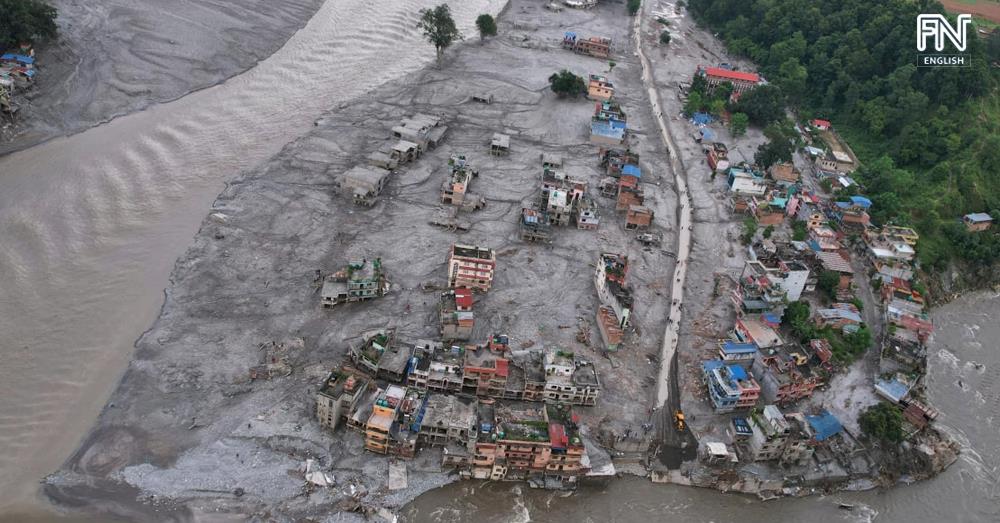

(Phnom Penh): On the morning of August 26, 2026, 24-year-old Nepali laborer Bibek Kumal was digging a toilet pit about 1.5 meters deep outside a newly built house in Bidur, Nuwakot District, Bagmati Province, Nepal.
Suddenly, he heard a loud noise.
Four co-workers above him shouted for him to climb out and run. Kumal scrambled from the pit and started fleeing. But the torrent reached him before he could escape.
Speaking to Reuters from his hospital bed at the National Trauma Centre in Kathmandu, Kumal recalled that the flood came with a deafening roar that sounded like an earthquake. A violent mass of water, mud and debris swept him away.
Then his body became caught against a mango tree. He survived.
Kumal told Reuters that without the tree, he believed he would have been swept away to his death. He suffered injuries to his legs and was later taken to Kathmandu for treatment.
But Kumal's survival does not mean that a mango tree was somehow strong enough to withstand the full force of the torrent. A tree directly struck by a massive flow of water, mud, rocks and debris could itself be broken or uprooted.
Whether an object can withstand such a flow depends on several factors, including its location, the speed and force of the flow, and the conditions immediately surrounding it.
According to the principles of fluid mechanics, the force exerted by flowing water on an object rises sharply as the speed of the flow increases. In simplified terms, if the speed doubles, the drag force on an object can increase by roughly four times, assuming other factors remain unchanged.
This means that a person caught in the fastest part of a torrent may experience dramatically different forces from someone carried toward an area where the flow is slower.
There is not enough information to determine exactly where the mango tree that stopped Kumal stood within the flood path, or precisely how much force it sustained. What can be established from Kumal's account to Reuters is that after he had been swept away, the tree became an obstacle that prevented him from being carried farther downstream.
His case therefore does not show that “a mango tree was stronger than the flood.” Instead, it illustrates how location, flow conditions and the presence of something capable of stopping a person's movement at a critical moment can make the difference between survival and death.
And Kumal was not the only person to survive the disaster.
As of Monday, August 31, 2026, authorities reported that the disaster across Nepal and Tibet had killed at least 919 people, while another 4,793 remained missing. Nepal accounted for 903 deaths and 4,247 missing people, while 16 people had died and 546 were missing in Tibet.
Nepali authorities had reported on Sunday that at least 7,514 people had been rescued, as search-and-rescue operations continued.
Two People Side by Side, Two Different Fates
Another survivor was 68-year-old Keshav Prasad Baral. His wife was beside him when the disaster struck, but she was swept away by the flood and mud and remained missing when he gave his account.
Baral described a huge mass of mud rushing directly toward them, growing higher as it approached.
As the mud reached their home, he tried to grab his wife's hand and take her to higher ground. He could not hold on to her, and she was swept away.
Baral survived.
About four to five hours later, a helicopter arrived to rescue him. His wife, however, had still not been found when he spoke about what had happened.
“My wife is somewhere under the mud. She is gone,” he said.
Baral's account illustrates the extreme unpredictability of a flash flood: two people inside the same home, facing the same disaster at almost the same moment, can experience entirely different outcomes.
In disasters of this magnitude, a difference of only a few meters, a few seconds, or the ability to reach higher ground can dramatically alter a person's chances of survival.
Reuters also reported the survival of 11-year-old Rihana Lamichhane, who was injured while crossing floodwaters after her school had been closed because of the disaster.
Trapped in Mud for Hours — and Still Alive at 97
Another remarkable survival story involved 97-year-old Guna Maya Bohra.
Follow-up reporting that traced her family said she lived in the Kabilash area of Nuwakot District, which was devastated by water, mud and debris.
Bohra was not rescued immediately.
She remained trapped in mud for approximately eight to nine hours, while destroyed homes, damaged roads and debris made it difficult for rescuers to reach the area.
Her grandson told The National that family members eventually noticed a slight movement: the elderly woman was moving her head. She was still alive.
Relatives and rescuers worked to free her from the mud and debris. Because ambulances could not reach the site, heavy machinery was used to clear access. After she was freed, Bohra was placed in the front bucket of a heavy machine and carried across the mud-covered area to safety before being transferred for medical treatment in Kathmandu.
What makes her survival particularly remarkable is that she endured hours trapped in mud and escaped without suffering critical injuries.
Many people around her were not as fortunate. Some of her relatives and other residents of the area were still missing when her family spoke to reporters.
Students Survive as Teachers Act Before the Flood Arrives
A different lesson in survival emerged from a school in Dhading District.
The Associated Press reported on August 31 that many students survived when floodwaters struck their school.
Some of the children were already outside their classrooms for their lunch break as the danger approached. Teachers also moved quickly to get students out before floodwaters swept into the area.
The case highlights a crucial distinction: unlike Kumal, who was already being swept away when the mango tree stopped him, these students benefited from getting out of danger before the flood reached them.
The Associated Press reported that at least 69 schools in flood-affected areas had been destroyed or damaged, disrupting the education of nearly 19,000 children.
Thousands Were Rescued — But Not All Were Swept Away by the Torrent
Thousands of people were rescued or evacuated from affected areas in Nepal and Tibet. But those figures should not be interpreted to mean that every person counted as “rescued” had been directly swept away by the violent torrent and survived, as Kumal did.
The totals include people evacuated from danger zones, those stranded after roads were cut off, tourists and others transported to safety by helicopters or rescue teams.
That distinction makes Kumal's experience particularly striking. He was not simply in an affected area. He had already been swept away by the torrent before a mango tree stopped his body from being carried farther downstream.
Conclusion: What Can We Learn From Those Who Survived?
The stories of those who survived the Nepal–Tibet disaster are more than accounts of extraordinary escapes from death. Together, they offer lessons about the factors that can increase a person's chances of survival when disaster strikes.
Why could Bibek Kumal survive a torrent powerful enough to destroy homes, roads and bridges?
The answer is not that a mango tree was stronger than the flood.
Kumal survived under a particular combination of circumstances: where he was carried, the force of the flow at that location, and the presence of a tree that stopped him from being swept farther away.
The experience of 68-year-old Keshav Prasad Baral demonstrates that two people standing close to each other and facing the same disaster at the same time can suffer profoundly different outcomes.
The survival of 97-year-old Guna Maya Bohra shows why search-and-rescue efforts should not be abandoned simply because devastation is severe. Even after hours trapped in mud and debris, a survivor may still be waiting to be found.
The students in Dhading, meanwhile, offer perhaps the most important lesson of all: getting people out of harm's way before the flood arrives is far safer than depending on chance once they have been caught in it.
The lesson from these survivors is therefore not that people should “find a tree to hold on to” when a flood comes. Once a person has been swept into a violent torrent, the ability to control what happens next becomes extremely limited. Survival may depend on location, timing, surrounding objects and sheer chance.
A mango tree helped save Bibek Kumal. But for the thousands of people who live along mountain valleys and river systems, the protection far more reliable than waiting for luck is early detection of danger, timely warnings and evacuation to safe ground before the torrent arrives.