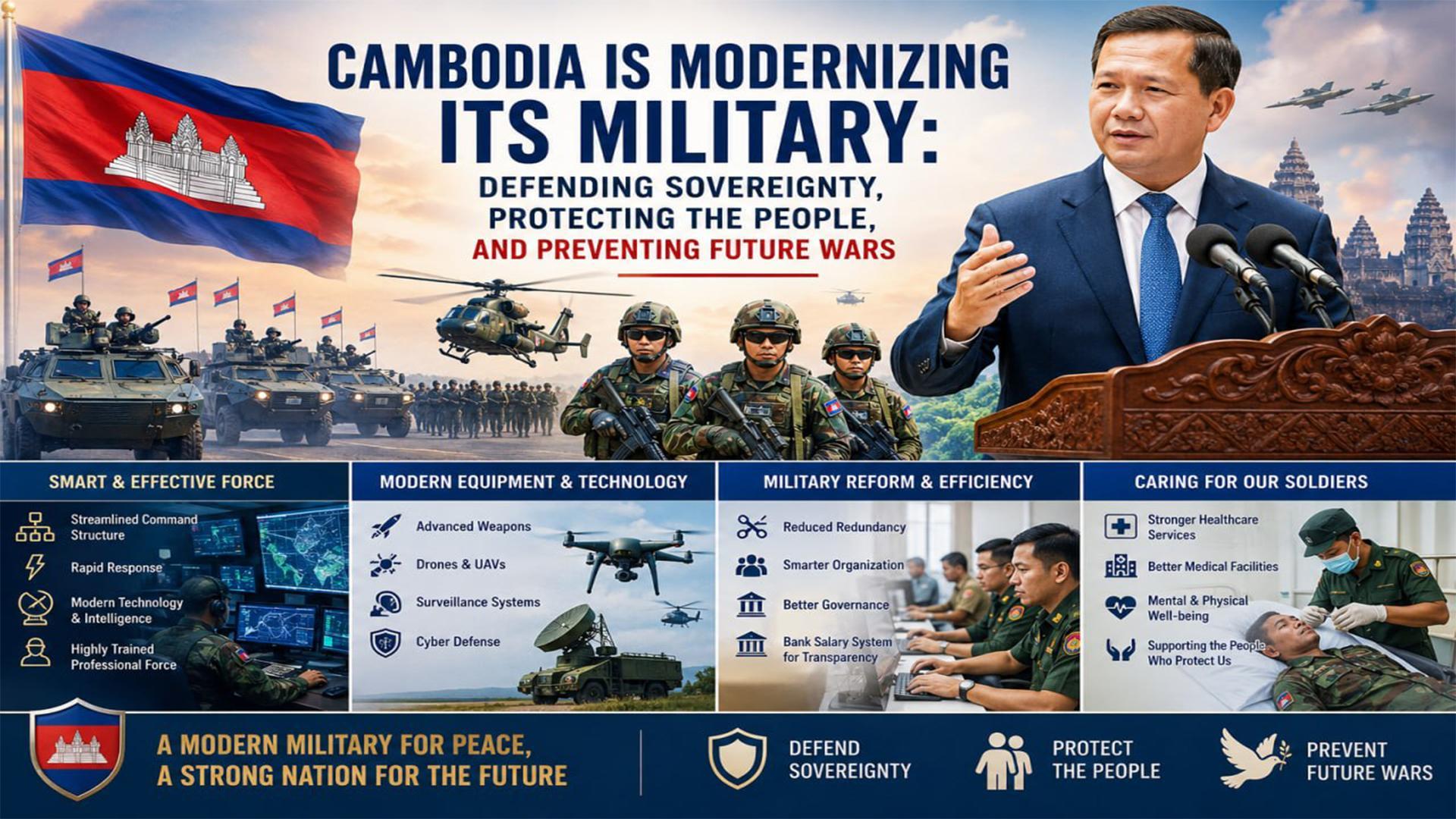

(Phnom Penh): When Cambodian Prime Minister Hun Manet declared that strengthening the national defense sector is not merely a “temporary campaign” but a long-term national mission, some observers may have viewed the statement as little more than routine administrative reform. In reality, however, the Prime Minister’s remarks reflect a profound transformation in Cambodia’s defense philosophy and military doctrine.
Hun Manet made clear that Cambodia no longer seeks a military that is “large in numbers but weak in effectiveness.” Instead, the country is pursuing the development of a leaner yet stronger force — one with clearer command structures, modern technology, stronger governance, and faster operational responsiveness to emerging security challenges.
In essence, Cambodia is attempting to transform its military from a “traditional force” into a “modern military.”
From a Large Army to a Smarter and Faster Military
One of the most significant themes in Hun Manet’s remarks was his call to “reduce the head while strengthening the body.” This phrase encapsulates a major defense reform philosophy.
The Prime Minister explained that Cambodia plans to eliminate redundant departments, merge overlapping offices, and streamline administrative structures that no longer serve practical military needs.
In modern warfare, nations can no longer rely solely on large troop numbers. Contemporary conflicts are increasingly determined by speed, technology, intelligence capabilities, command efficiency, and rapid response capacity.
For this reason, the Cambodian government has begun reducing overlapping structures, downsizing unnecessary offices, and eliminating bureaucratic inefficiencies. These reforms are not intended to weaken national defense capabilities, but rather to remove “heavy and slow structures” that can undermine operational effectiveness.
From 6,000 Personnel to 600: This Is Not Symbolic Reform
Hun Manet revealed that the Royal Cambodian Armed Forces High Command is undergoing one of the most significant structural reforms in Cambodia’s military history.
According to the Prime Minister, the High Command once consisted of approximately 6,000 personnel. That number has already been reduced to just over 2,000, and future reforms aim to reduce it further to around 600 personnel.
This means Cambodia is not simply conducting an ordinary personnel reduction. Rather, it is restructuring its military command system — transforming a heavy, complex, and overlapping bureaucracy into a leaner, faster, and more efficient command structure.
In modern security environments, warfare does not wait for slow administrative procedures or lengthy chains of command. Contemporary conflict depends on rapid decision-making, accurate intelligence, and immediate operational response. A sluggish or overly complicated command structure can result not only in the loss of battlefield advantage, but potentially in the loss of soldiers’ lives.
Cambodia is therefore attempting to build what might be described as “a smaller head with faster hands” — reducing bureaucracy while strengthening operational capability.
This reflects a broader shift from “a military large in numbers” toward “a military intelligent in systems,” which increasingly mirrors modern defense reform trends around the world.
The 2025 War Changed Cambodia’s Security Thinking
Cambodia’s current defense reforms cannot be separated from the lessons of the 2025 conflict.
The large-scale military aggression launched by Thailand against Cambodian territory not only caused destruction on the battlefield, but also fundamentally reshaped Cambodia’s understanding of modern warfare and national defense.
As Cambodia faced attacks involving F-16 fighter jets, drones, and advanced weapon systems, it became increasingly clear that 21st-century warfare differs dramatically from traditional conflicts centered primarily on troop numbers and ground operations.
Recent global conflicts — including the Russia–Ukraine war and the confrontation involving the United States, Israel, and Iran — have demonstrated that superiority no longer belongs simply to the side with the largest army. Advantage increasingly depends on advanced technology, effective intelligence systems, rapid command capability, and fast strategic decision-making.
Modern warfare is increasingly a battle of “information speed” and “technological superiority” before it becomes a battle of manpower. A single drone can conduct surveillance or strike operations faster than hundreds of troops. A delayed or overly bureaucratic command system can lose critical opportunities within minutes.
For this reason, Hun Manet emphasized that Cambodia’s defense reforms cannot rely merely on increasing troop numbers. Instead, reform must focus on training, modernization of equipment, restructuring command systems, and strengthening governance throughout the armed forces.
In short, Cambodia is attempting to build “a military for modern warfare,” rather than a force designed for outdated forms of conflict.
Defending Territory Must Also Mean Protecting Soldiers’ Lives
Another important aspect of Hun Manet’s remarks — one that may receive less public attention — is his strong emphasis on the health and welfare of military personnel.
The Prime Minister’s call to strengthen military clinics, improve medical supplies, and enhance healthcare services demonstrates that Cambodia no longer views soldiers merely as combat personnel, but as individuals whose safety, wellbeing, and long-term support are essential components of national defense.
This represents a significant evolution in defense thinking.
In the past, many countries focused heavily on purchasing weapons and expanding troop numbers while paying insufficient attention to the health and welfare of military personnel. However, modern warfare has shown that military strength cannot depend solely on advanced weaponry. Without strong healthcare systems, physical and psychological support, and effective welfare structures, long-term combat readiness inevitably weakens.
A modern military therefore requires not only aircraft, drones, and advanced weapons, but also robust healthcare systems, efficient management structures, and improved quality of life for soldiers.
In this context, Cambodia is seeking to build not only “a military capable of fighting,” but also “a military with stronger human wellbeing.”
Salary Payments Through Banks: Governance Reform Within the Military
Hun Manet’s remarks regarding the payment of soldiers’ salaries through the banking system may appear to concern routine administrative modernization. In reality, however, they signal a deeper effort to modernize military governance itself.
In modern warfare, military strength cannot depend solely on tanks or weapons systems. It also requires management systems that are transparent, efficient, and trustworthy.
The shift toward bank-based salary payments is therefore not simply about convenience for military personnel. It is part of a broader governance reform effort aimed at:
- reducing bureaucratic complexity,
- improving transparency and accountability,
- ensuring accurate and timely salary payments, and
- strengthening personnel management throughout the armed forces.
More importantly, this reform reflects Cambodia’s effort to transition away from older manual administrative systems toward a more modern and digitalized structure capable of better oversight and management efficiency.
Hun Manet also stressed the importance of maintaining “a balance between management efficiency and military confidentiality,” indicating that Cambodia seeks to modernize its military administration without compromising national security.
In other words, Cambodia’s military reform is no longer focused solely on weapons — it is increasingly centered on modern systems of governance and management, which are now essential foundations of modern military institutions.
From the Win-Win Monument to a Modern Military
A central theme running throughout Hun Manet’s remarks is the importance of national memory.
The Prime Minister instructed officials to engrave scenes depicting the suffering caused by war, the heroism of Cambodian armed forces, and the unity of the Cambodian people onto the Win-Win Monument. He also called for memorial structures honoring soldiers and security personnel who sacrificed their lives defending national sovereignty.
These initiatives are not merely ceremonial commemorations. They are political and security messages directed toward future generations.
The message is clear: Cambodia does not want the suffering of war to be forgotten. Nations that forget the consequences of war risk allowing conflict to return once again.
The Win-Win Monument has long symbolized the end of Cambodia’s civil war and the achievement of national reconciliation. But in the aftermath of the 2025 conflict, it is increasingly becoming a symbol of sovereignty, national defense, and the reminder that peace cannot be taken for granted.
At the same time, Hun Manet emphasized that memory alone is not enough. A nation cannot preserve peace if it lacks the ability to defend itself.
Cambodia is therefore pursuing two parallel strategies: preserving peace through peaceful resolution and diplomacy, while simultaneously building a modern military capable of responding to contemporary threats.
From the Win-Win Monument to military modernization, Cambodia is attempting to send a clear message:
“A nation that wishes to preserve peace must possess both historical memory and the capacity to defend its future.”
Conclusion: Cambodia Is Building “A Military for Peace”
The central message of Hun Manet’s remarks during the 19th National Veterans and Retirees Day on May 12, 2026, is that Cambodia does not want war to return to its soil.
However, in a world where security challenges are becoming increasingly complex and warfare is increasingly technology-driven, Cambodia also recognizes that national defense cannot be neglected.
Preserving peace cannot rely solely on patience or calls for dialogue. It also requires a strong, modern military capable of responding to evolving threats.
Hun Manet made clear that military strength in the 21st century can no longer be measured simply by troop numbers or bureaucratic size. A modern military must possess structural reform, strong governance, advanced technology, efficient command systems, and rapid-response capabilities.
Moreover, a strong military must also prioritize the welfare and wellbeing of its personnel. Soldiers are not merely combat assets; they are valuable national resources that require protection, support, and care.
Ultimately, Cambodia is attempting to build “a military for peace,” not “a military for war.” The final objective of defense modernization is not to initiate conflict, but to deter war, defend national sovereignty, and ensure that the Cambodian people can continue living in lasting peace.