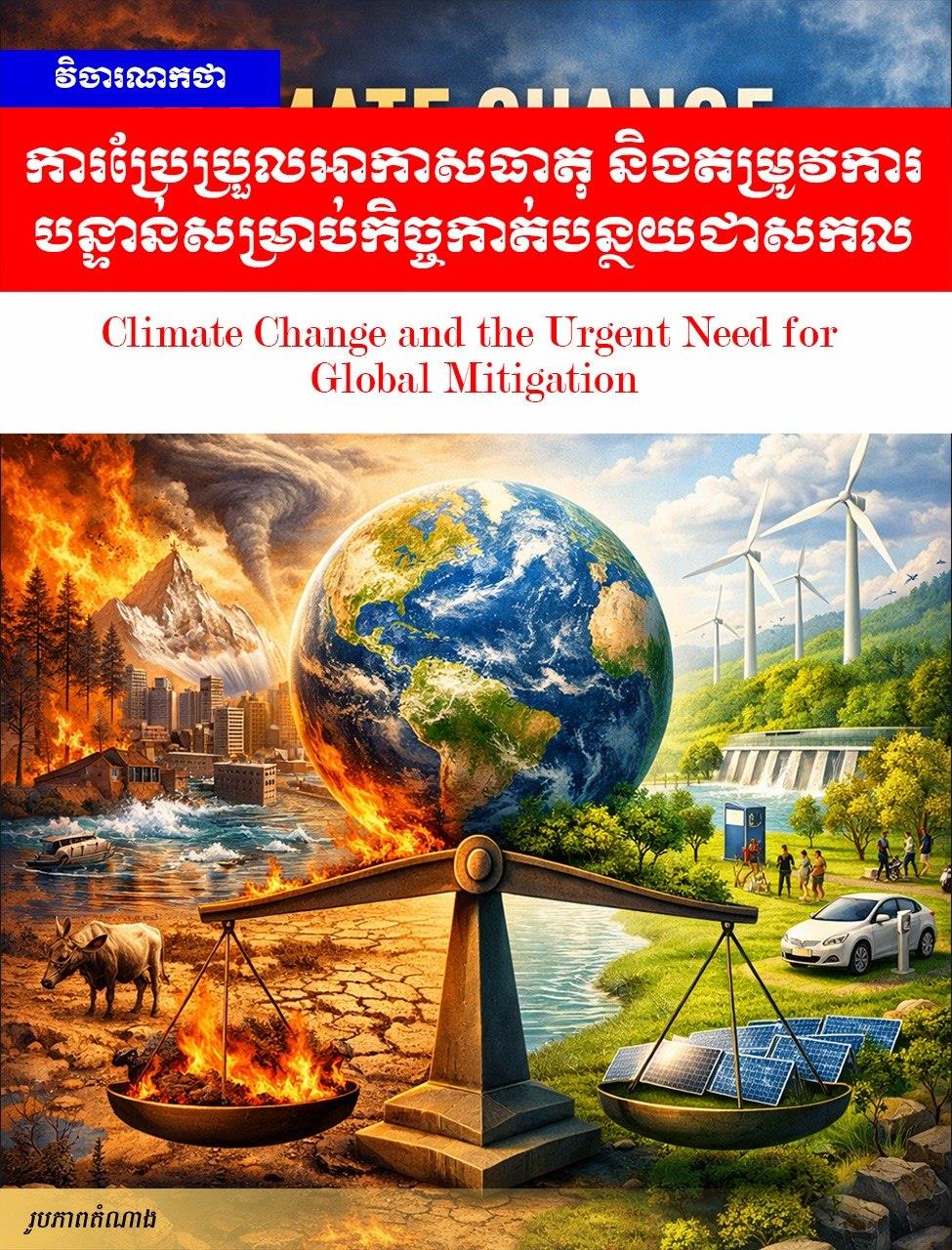

(Phnom Penh): Climate change has emerged as one of the defining challenges of the 21st century. Across the globe, rising temperatures, prolonged droughts, devastating floods, stronger storms, melting glaciers, wildfires, and sea-level rise are affecting ecosystems, economies, and human lives at an unprecedented scale.
The climate crisis is no longer a distant warning from scientists; it is a global reality already reshaping the world.
Yet while climate change presents enormous risks, it also presents humanity with a critical choice: whether to continue on a path of environmental degradation or to pursue meaningful mitigation efforts that protect the planet and future generations.
Climate change mitigation refers to actions aimed at reducing greenhouse gas emissions and limiting the severity of global warming. At its core, mitigation is about addressing the root causes of climate change rather than only reacting to its consequences. It is a global effort to reduce humanity’s environmental footprint and transition toward a more sustainable future.
The primary driver of climate change remains the excessive emission of greenhouse gases from human activities, particularly the burning of fossil fuels such as coal, oil, and natural gas. Industrial production, transportation, deforestation, unsustainable agriculture, waste mismanagement, and pollution all contribute significantly to rising atmospheric carbon dioxide and methane levels.
For decades, economic growth in many parts of the world depended heavily on intensive resource extraction and fossil fuel consumption. While these activities contributed to industrial development and modernization, they also accelerated environmental destruction and destabilized the global climate system.
Today, the impacts are visible everywhere. Heatwaves are becoming more frequent and intense. Water scarcity threatens millions of people. Agricultural productivity is declining in vulnerable regions. Forests and biodiversity are under pressure. Oceans are warming and becoming more acidic. Small island nations face existential threats from rising seas, while many communities around the world experience increasing economic and humanitarian losses from climate-related disasters.
Mitigation is therefore no longer optional. It is essential for global survival, stability, and prosperity.
One of the most important mitigation strategies is the transition to clean and renewable energy. Solar, wind, hydroelectric, and other renewable energy sources offer alternatives to fossil fuels while reducing carbon emissions. Advances in green technology are making renewable energy increasingly affordable and accessible for countries at different stages of development.
Energy efficiency is equally critical. Improving industrial systems, transportation, buildings, and infrastructure can significantly reduce energy consumption while supporting sustainable economic growth. Electric vehicles, public transportation systems, and smart urban planning are becoming important tools in reducing emissions from rapidly growing cities.
Protecting forests and natural ecosystems is another essential component of climate mitigation. Forests, mangroves, wetlands, and oceans act as natural carbon sinks by absorbing greenhouse gases from the atmosphere. Deforestation not only releases massive amounts of carbon dioxide but also weakens biodiversity and ecological resilience. Reforestation and ecosystem restoration therefore play a crucial role in combating climate change.
Sustainable agriculture and waste management are also increasingly important. Reducing food waste, promoting climate-smart farming, improving soil conservation, and limiting open burning can help lower emissions while strengthening food security and environmental health.
However, climate mitigation is not solely a technological challenge. It is also a political, economic, and behavioral challenge.
Global cooperation remains essential because climate change does not recognize national borders.
Emissions produced in one region affect the entire planet. International agreements such as the Paris Agreement reflect the understanding that collective action is necessary to limit global warming and avoid catastrophic environmental consequences.
At the same time, climate justice must remain central to mitigation efforts. Many developing nations contribute relatively little to global emissions yet suffer disproportionately from climate impacts. Wealthier nations with historically high emissions therefore carry an important responsibility to support vulnerable countries through climate financing, technology transfer, and capacity-building initiatives.
Public participation is equally important. Governments alone cannot solve the climate crisis. Businesses, communities, and individuals all play a role in reducing environmental harm. Sustainable consumption, responsible waste disposal, reduced energy use, and environmental awareness contribute to broader climate mitigation goals.
Young people around the world are increasingly demanding stronger climate action, recognizing that the decisions made today will shape the future they inherit. Their voices reflect a growing global understanding that environmental protection is not opposed to economic development, but rather essential to long-term human survival and prosperity.
Climate change mitigation ultimately represents more than reducing emissions. It reflects humanity’s willingness to act responsibly toward nature and future generations. It is a recognition that unlimited exploitation of natural resources without environmental balance carries severe consequences for civilization itself.
The path forward will require innovation, cooperation, discipline, and long-term vision. The costs of mitigation may appear significant, but the costs of inaction are far greater. Delayed action will only deepen environmental damage, economic disruption, food insecurity, displacement, and human suffering.
In the end, climate change mitigation is not simply about protecting the environment. It is about protecting human life, global stability, economic resilience, and the future of civilization. The decisions humanity makes today will determine whether future generations inherit a world of escalating crisis or a planet capable of sustaining peace, prosperity, and life itself.
=FRESH NEWS