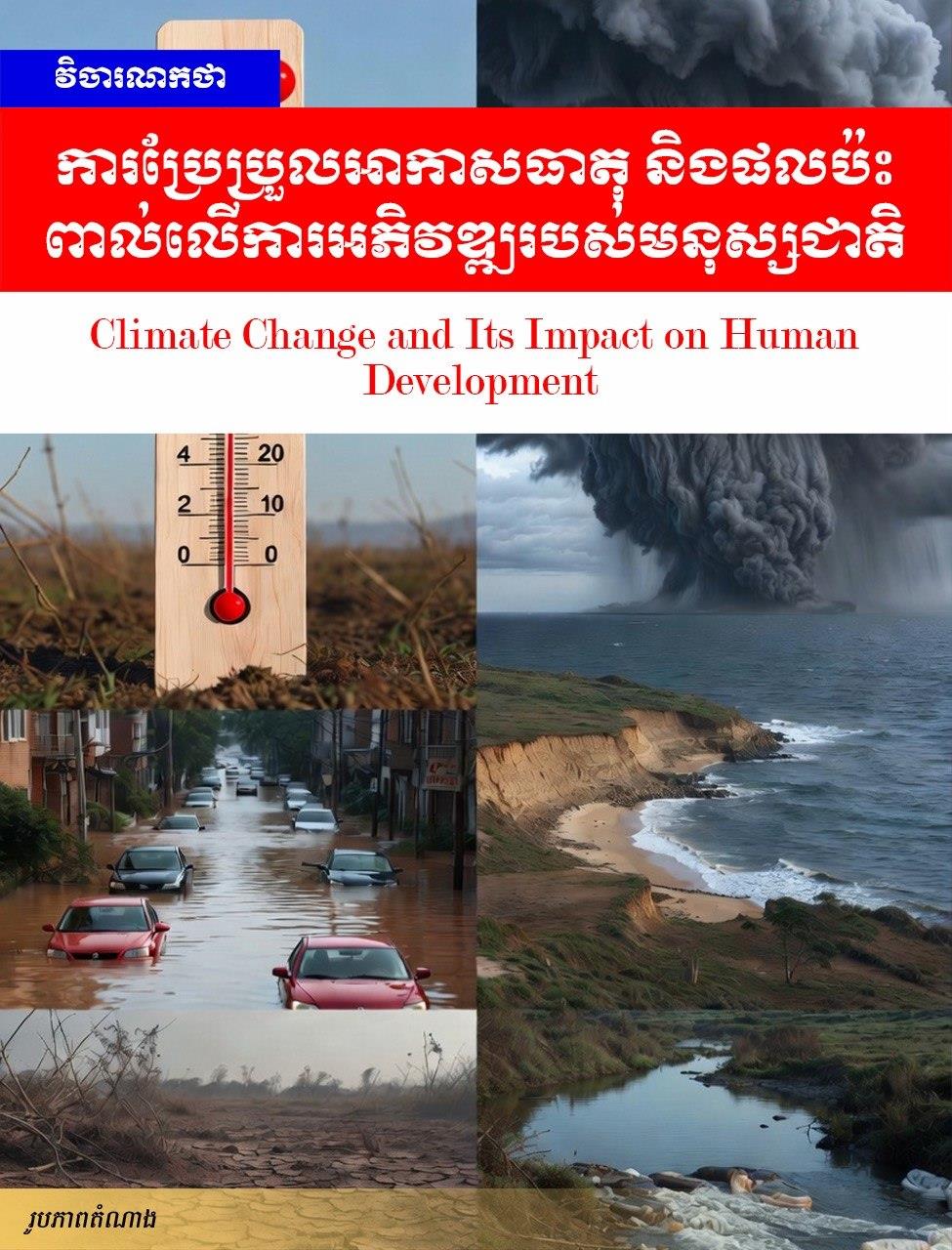

(Phnom Penh): Climate change is no longer only an environmental concern. It has become one of the greatest challenges to human development in the modern world.
Rising temperatures, floods, droughts, storms, sea-level rise, and environmental degradation are increasingly affecting human health, education, economic growth, food security, and social stability across the globe.
Human development is built upon the ability of people to live healthy, productive, and secure lives. It depends on access to food, water, healthcare, education, employment, and safe living conditions.
Yet climate change is placing growing pressure on all of these foundations simultaneously.
One of the most immediate impacts is on public health. Extreme heat, air pollution, water contamination, and climate-related disasters increase the spread of diseases and threaten vulnerable populations, especially children and the elderly.
Heat waves and poor environmental conditions are already causing rising health risks in many parts of the world.
Food security is also increasingly threatened. Droughts, floods, changing rainfall patterns, and soil degradation reduce agricultural productivity and damage fisheries.
In many developing countries, where millions rely on farming for income and survival, climate change directly threatens livelihoods and increases poverty and malnutrition.
Water scarcity is another growing concern. Melting glaciers, prolonged droughts, and changing weather patterns are reducing freshwater availability in many regions.
Competition over limited water resources can intensify economic hardship, migration, and social tensions.
Climate change also affects education and economic opportunity. Natural disasters damage schools, infrastructure, and transportation systems, disrupting learning and economic activities.
Families affected by environmental crises are often forced to prioritize survival over education, especially in vulnerable communities.
The economic costs are substantial. Climate-related disasters destroy homes, roads, industries, and public infrastructure, slowing development progress and increasing inequality.
Poorer nations, despite contributing less to global greenhouse gas emissions, often suffer the greatest impacts due to limited financial and technological resources for adaptation.
Climate migration is becoming another major global challenge. Rising sea levels, droughts, and environmental degradation are forcing people to leave their homes in search of safety and opportunity.
This movement places additional pressure on cities, economies, and social systems.
At the same time, climate change is exposing the close relationship between environmental sustainability and human progress.
Development cannot remain sustainable if forests are destroyed, water systems polluted, biodiversity weakened, and natural resources exhausted. Protecting the environment is therefore no longer separate from human development; it is essential to it.
Addressing these challenges requires both mitigation and adaptation. Reducing greenhouse gas emissions through renewable energy, cleaner industries, sustainable agriculture, forest protection, and responsible waste management remains critical.
At the same time, countries must strengthen healthcare systems, climate-resilient infrastructure, water management, disaster preparedness, and education systems.
International cooperation is equally important. Climate change is a global problem that requires shared responsibility, climate financing, technology transfer, and support for vulnerable nations and communities.
Ultimately, climate change is forcing humanity to reconsider the meaning of development itself.
True progress cannot be measured only by economic growth or industrial expansion if environmental destruction undermines human health, security, and future stability.
In the end, climate change is not simply a threat to nature. It is a threat to human dignity, opportunity, and the future of civilization.
The decisions made today will determine whether future generations inherit a world of growing inequality and environmental crisis, or a more resilient, sustainable, and equitable future for all.
=FRESH NEWS