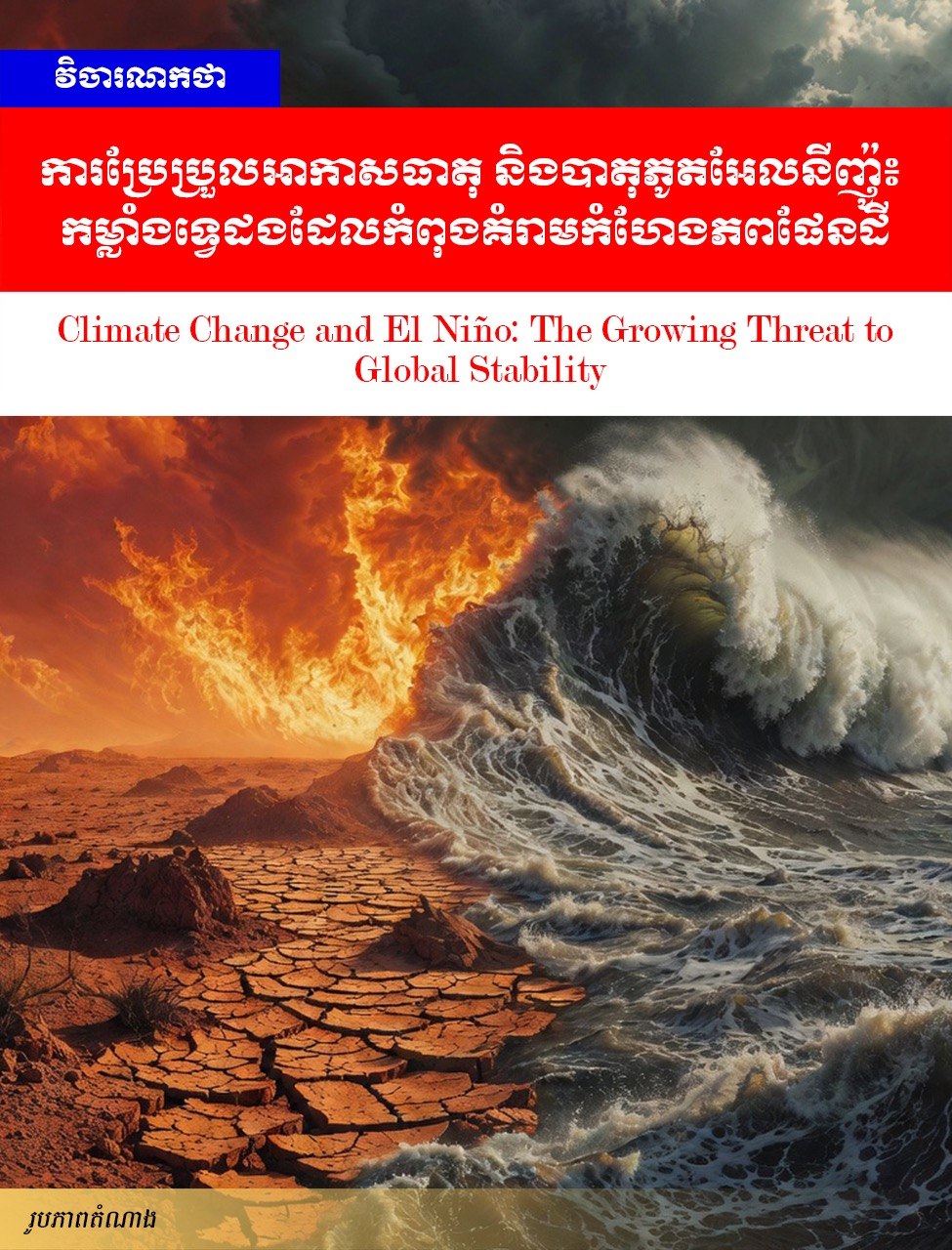

(Phnom Penh): Climate change and El Niño are now increasingly intertwined forces shaping the future of the planet. What was once considered a naturally recurring climate phenomenon is becoming more intense, more disruptive, and more dangerous in a warming world.
Across continents, scientists, governments, farmers, and coastal communities are witnessing how rising global temperatures amplify the destructive power of El Niño events, turning periodic climate variability into a growing global crisis.
El Niño is a natural climate pattern that occurs when surface waters in the central and eastern Pacific Ocean become unusually warm. This warming alters atmospheric circulation, shifts rainfall patterns, disrupts ocean currents, and influences weather systems across the globe.
Historically, El Niño has always existed. It has brought drought to some regions, floods to others, weakened fisheries, intensified wildfires, and disrupted agriculture for centuries.
But climate change is changing the equation.
The Earth today is significantly warmer than it was during previous generations of El Niño cycles. Oceans absorb more than 90 per cent of the excess heat trapped by greenhouse gases, and this additional oceanic heat acts like fuel for El Niño events.
When El Niño develops in an already overheated ocean, its impacts can become stronger, longer-lasting, and more unpredictable.
Recent global events demonstrate this alarming relationship. The powerful El Niño episodes of 1997–1998, 2015–2016, and 2023–2024 coincided with record-breaking global temperatures, devastating droughts, catastrophic floods, coral bleaching, crop failures, and widespread wildfires.
In many parts of Southeast Asia, Africa, and Latin America, prolonged heat and drought reduced water availability, damaged food production, and increased energy insecurity. Meanwhile, other regions experienced destructive storms and severe flooding.
Climate change does not necessarily “create” El Niño, but it strengthens its consequences.
A warmer atmosphere holds more moisture, which means storms associated with El Niño can produce heavier rainfall and more destructive floods. At the same time, hotter temperatures accelerate evaporation, worsening drought conditions in already vulnerable regions.
Forests become drier and more susceptible to wildfire. Rivers shrink. Agricultural lands lose productivity. Fisheries decline as warming oceans disrupt marine ecosystems.
The relationship between climate change and El Niño also reveals a dangerous feedback loop. El Niño itself can temporarily raise global temperatures because heat stored in the Pacific Ocean is released into the atmosphere.
When combined with long-term global warming caused by fossil fuel emissions, deforestation, industrial pollution, and environmental degradation, the result can push temperatures to unprecedented extremes.
This is no longer simply a scientific debate. It is a humanitarian, economic, and environmental challenge affecting billions of people.
Small island nations face rising sea levels and stronger coastal erosion. Farmers struggle with changing rainfall seasons and unpredictable harvests. Cities face heatwaves that threaten public health and strain electricity systems.
Coral reefs, among the most sensitive ecosystems on Earth, suffer mass bleaching during strong El Niño years, undermining biodiversity, fisheries, and tourism industries.
The poorest nations often suffer the greatest consequences despite contributing the least to greenhouse gas emissions. Communities dependent on agriculture, fisheries, and natural resources are especially vulnerable because their livelihoods depend directly on climate stability.
The growing intensity of El Niño events should therefore serve as a global warning. Climate change is no longer a distant threat of the future; it is actively amplifying natural climate systems today.
Humanity is witnessing the collision between natural climate variability and human-induced global warming.
The solution requires more than emergency responses after disasters occur.
The world must address the root causes of climate change by reducing greenhouse gas emissions, accelerating renewable energy transitions, protecting forests and oceans, improving water management, and strengthening climate resilience in vulnerable communities.
Equally important is investment in scientific monitoring and early warning systems. Better forecasting allows governments to prepare for droughts, floods, food shortages, disease outbreaks, and wildfire risks associated with El Niño.
International cooperation is essential because climate systems do not recognise national borders.
Ultimately, the relationship between climate change and El Niño reminds humanity of a simple truth: the atmosphere, oceans, forests, and ecosystems of the Earth are deeply interconnected. When human activity disrupts one part of the planetary system, the consequences ripple across the globe.
El Niño was once viewed as a temporary climate event. In the era of climate change, it is becoming a force multiplier for global instability.
The question facing humanity is no longer whether climate change influences El Niño, but whether the world will act quickly enough to prevent these combined forces from reshaping life on Earth in increasingly destructive ways.
=FRESH NEWS