
(Phnom Penh): El Niño is often described through its consequences, droughts, floods, heatwaves, crop failures, wildfires, and economic disruption. Yet behind these visible impacts lies a deeper and more important question: what causes El Niño? Understanding its origins is essential not only for climate science but also for humanity’s ability to prepare for increasingly unstable environmental conditions in the modern era.
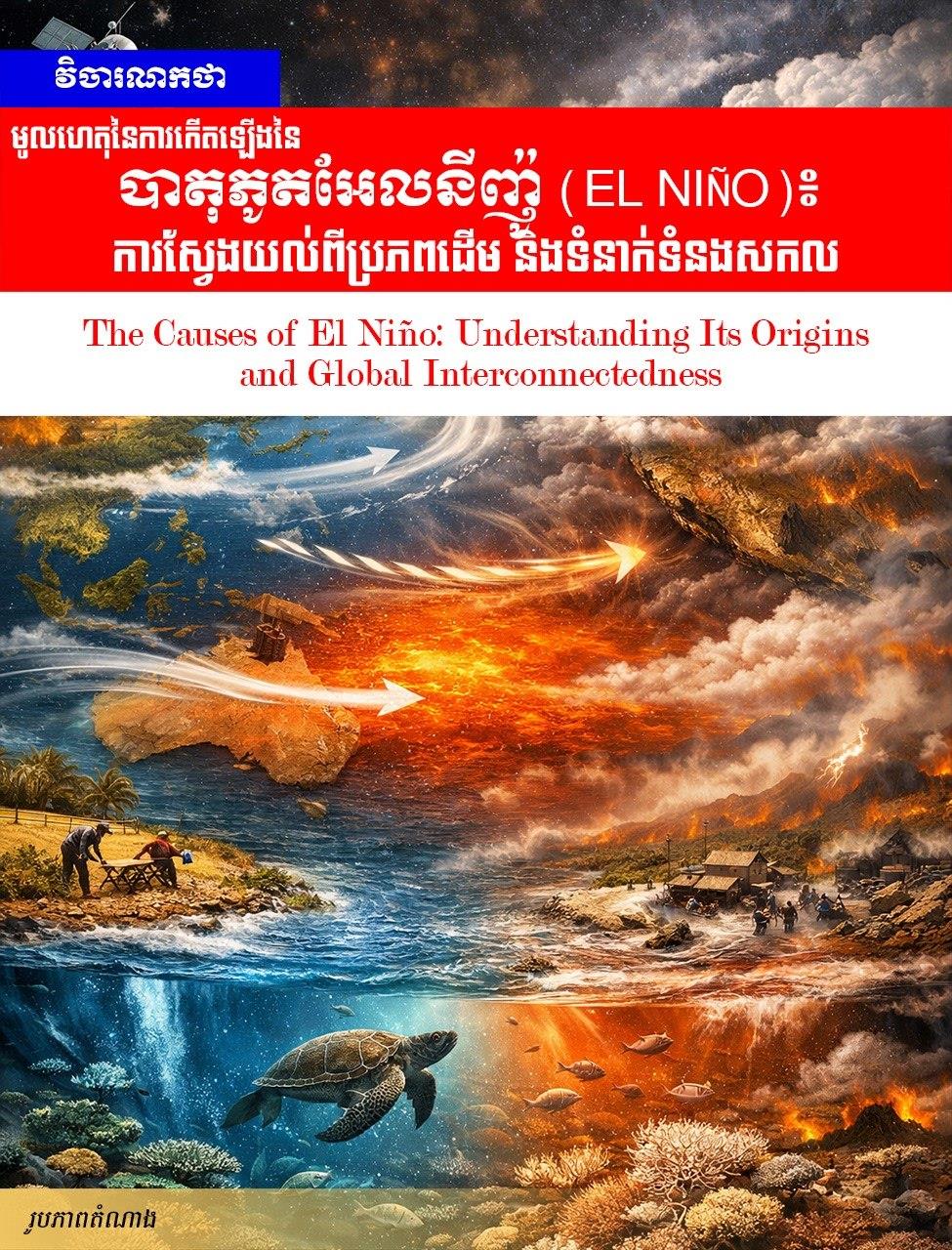
At its core, El Niño is born from a disruption in the natural balance between the Pacific Ocean and the atmosphere above it. Under normal conditions, strong trade winds blow from east to west across the tropical Pacific Ocean, pushing warm surface waters toward Southeast Asia and Australia.
This movement allows colder, nutrient-rich water to rise from the deep ocean near the western coast of South America, a process known as upwelling.
This natural system supports fisheries, regulates rainfall, and helps maintain global climate stability.
However, during an El Niño event, the trade winds weaken or sometimes even reverse direction. As a result, warm water that is normally concentrated in the western Pacific begins spreading eastward toward the central and eastern Pacific Ocean.
The upwelling of cold water near South America weakens significantly, and sea surface temperatures in the Pacific rise above average.
This warming may appear geographically limited, but its effects are global.
The Pacific Ocean is the largest ocean on Earth and acts as a major engine of the planet’s climate system. When its temperatures shift, atmospheric circulation patterns also change. Rainfall moves away from some regions and intensifies in others.
Storm tracks alter. Droughts emerge in certain continents while floods devastate others. In essence, El Niño is the result of a temporary but powerful rearrangement of oceanic and atmospheric energy.
Scientists continue to study why trade winds weaken in some years and not others. The causes involve highly complex interactions between ocean temperatures, atmospheric pressure systems, and natural climate variability.
Small changes in wind patterns can trigger feedback mechanisms that allow warm water to spread further east, which in turn weakens the trade winds even more. This self-reinforcing cycle can eventually develop into a full El Niño event.
One of the key atmospheric components involved is known as the Southern Oscillation, a fluctuation in air pressure between the eastern and western Pacific.
Together, the oceanic warming and atmospheric pressure changes form what scientists call the El Niño–Southern Oscillation, or ENSO, one of the most influential climate systems on Earth.
Importantly, El Niño itself is a natural phenomenon that has existed for thousands of years. It is not directly caused by human activity.
However, climate change is increasingly influencing the conditions in which El Niño develops. Rising global temperatures caused by greenhouse gas emissions are warming the oceans overall, potentially intensifying the impacts associated with El Niño events.
A warmer ocean contains more heat energy. A warmer atmosphere holds more moisture. Together, these conditions can amplify the droughts, floods, storms, and heatwaves linked to El Niño cycles.
While scientists are still researching exactly how climate change affects the frequency and intensity of El Niño events, there is growing concern that future episodes may become more extreme.
This relationship between natural climate variability and human-induced warming highlights a critical reality: humanity is now altering the background conditions of the Earth’s climate system itself.
The consequences are profound. El Niño can disrupt global agriculture, increase food prices, damage fisheries, intensify wildfires, reduce water supplies, and threaten public health.
Developing nations often suffer disproportionately because their economies depend heavily on climate-sensitive sectors such as farming, fisheries, and natural resources.
Yet the causes of El Niño also reveal something deeper about the planet.
Earth’s climate functions through interconnected systems where oceans, atmosphere, winds, and ecosystems continuously interact. A shift in Pacific Ocean temperatures can influence weather patterns thousands of kilometres away.
Nature operates through balance, and when that balance changes, the effects ripple across the globe.
This understanding should inspire not fear, but responsibility. Scientific research, climate monitoring, early warning systems, and international cooperation are essential for helping societies prepare for El Niño’s impacts.
At the same time, addressing climate change remains vital to reducing future climate instability.
Ultimately, the cause of El Niño is more than a scientific explanation about ocean temperatures and wind patterns. It is a reminder of the extraordinary complexity and interconnectedness of the Earth itself.
In a century increasingly shaped by environmental uncertainty, understanding these natural systems may become one of humanity’s greatest responsibilities.
=FRESH NEWS