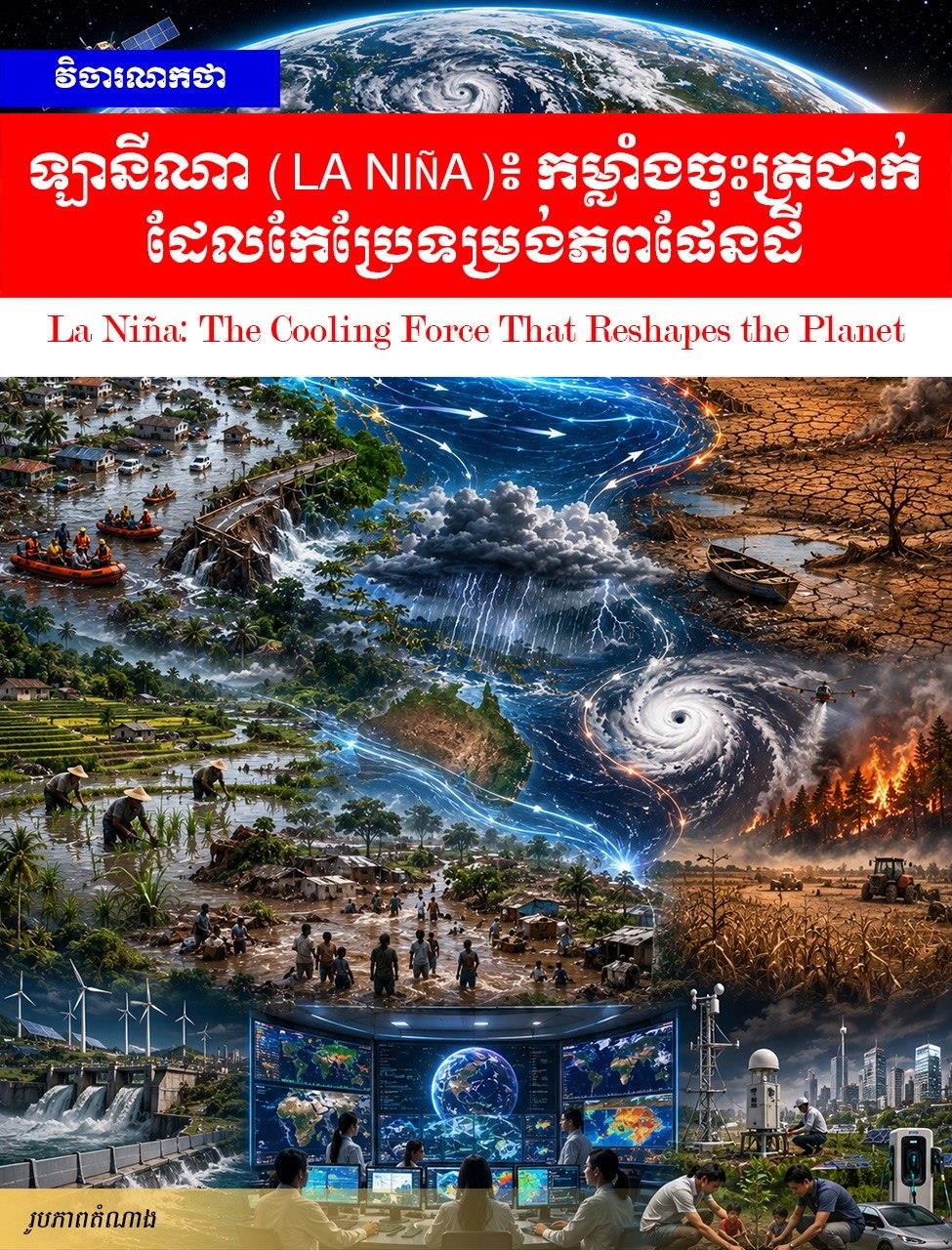

(Phnom Penh): While much global attention is often directed toward El Niño and its devastating droughts and heatwaves, its lesser-discussed counterpart, La Niña, is equally powerful in shaping the Earth’s climate system. La Niña is not merely a cooling event in the Pacific Ocean; it is a global atmospheric phenomenon capable of influencing rainfall, storms, agriculture, fisheries, economies, and ecosystems across continents.
Understanding the causes of La Niña is therefore essential in an age increasingly defined by climate uncertainty.
La Niña begins in the tropical Pacific Ocean, where ocean waters and atmospheric systems are closely connected. Under normal conditions, trade winds blow steadily from east to west across the Pacific, pushing warm surface water toward Southeast Asia and Australia.
In response, colder, nutrient-rich water rises from deep ocean layers along the western coast of South America in a process known as upwelling.
This balance between ocean temperatures, winds, and atmospheric pressure helps regulate weather systems around the world.
During a La Niña event, this natural system intensifies. Trade winds become stronger than normal, pushing even more warm surface water toward the western Pacific. As warm water moves westward, colder deep water rises more aggressively in the eastern and central Pacific Ocean.
Sea surface temperatures in these regions become cooler than average, sometimes across vast areas of the Pacific.
This cooling changes atmospheric circulation patterns globally.
The strengthened trade winds and cooler Pacific waters alter the movement of moisture and heat through the atmosphere. Rainfall increases in some regions while drought develops in others. Storm tracks shift. Monsoon systems strengthen in parts of Asia and Australia, often bringing heavier rainfall and flooding.
Meanwhile, some parts of the Americas experience drier conditions and increased wildfire risks.
The causes of La Niña are deeply linked to the interaction between the ocean and atmosphere — a system scientists call the El Niño–Southern Oscillation, or ENSO. Changes in atmospheric pressure between the eastern and western Pacific influence wind strength, which then affects ocean temperatures.
In turn, those ocean temperature changes reinforce atmospheric patterns. This continuous feedback loop can eventually develop into a full La Niña event.
Unlike sudden natural disasters such as earthquakes or hurricanes, La Niña develops gradually over months. Yet its impacts can persist for years and affect billions of people worldwide.
Importantly, La Niña itself is a natural climate phenomenon that has existed for centuries. It is not directly caused by human activity. However, modern climate change is increasingly influencing the environmental conditions surrounding these natural cycles. Warmer global temperatures may intensify the hydrological extremes associated with La Niña, leading to heavier rainfall, stronger storms, more severe flooding, and greater climate instability.
A warmer atmosphere can hold more moisture, meaning that rainfall during La Niña years may become more intense. Floods that once occurred every few decades may now occur more frequently and with greater destructive power.
In vulnerable regions, excessive rainfall can damage agriculture, destroy infrastructure, spread disease, and displace communities.
At the same time, La Niña can temporarily cool average global temperatures because cooler Pacific waters absorb more atmospheric heat. But this temporary cooling should not create complacency about climate change.
The long-term warming trend driven by greenhouse gas emissions continues to accelerate beneath these short-term natural fluctuations.
The causes and impacts of La Niña reveal an important truth about the Earth: the planet functions as a highly interconnected system. Oceans influence winds.
Winds influence rainfall. Rainfall affects agriculture, biodiversity, economies, and human survival.
A temperature shift in one part of the Pacific Ocean can ultimately influence food prices, water security, and disaster risks on the other side of the world.
This interconnectedness demands stronger international cooperation, scientific investment, and climate preparedness. Governments must improve forecasting systems, strengthen infrastructure resilience, protect ecosystems, and support vulnerable communities facing climate-related risks.
Scientific understanding of La Niña is not merely academic; it is essential for global stability and sustainable development.
Ultimately, the cause of La Niña is more than a story of cooler ocean waters and stronger winds. It is a reminder that humanity lives within a complex planetary system governed by delicate balances between ocean, atmosphere, and environment.
As climate change intensifies global instability, understanding these natural climate forces becomes not only a scientific necessity but a moral responsibility for the future of humanity.
=FRESH NEWS