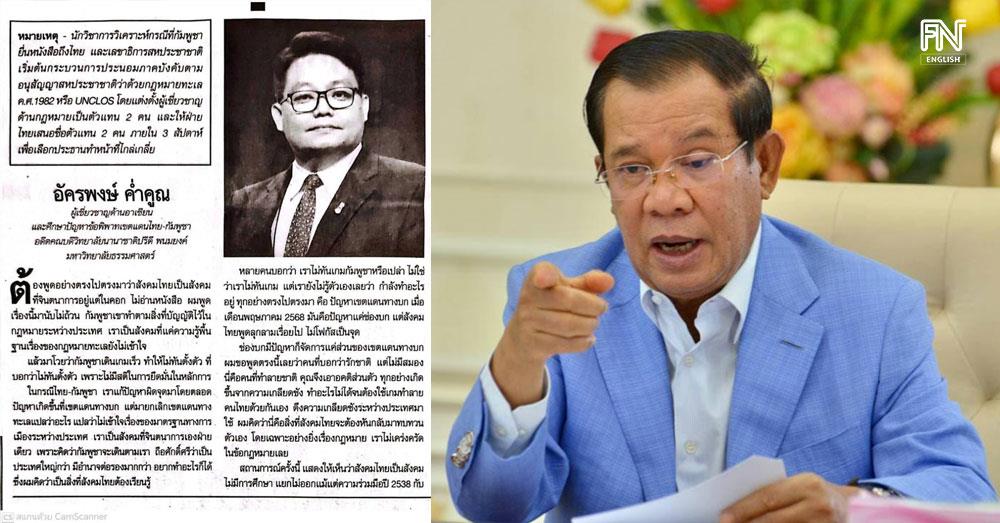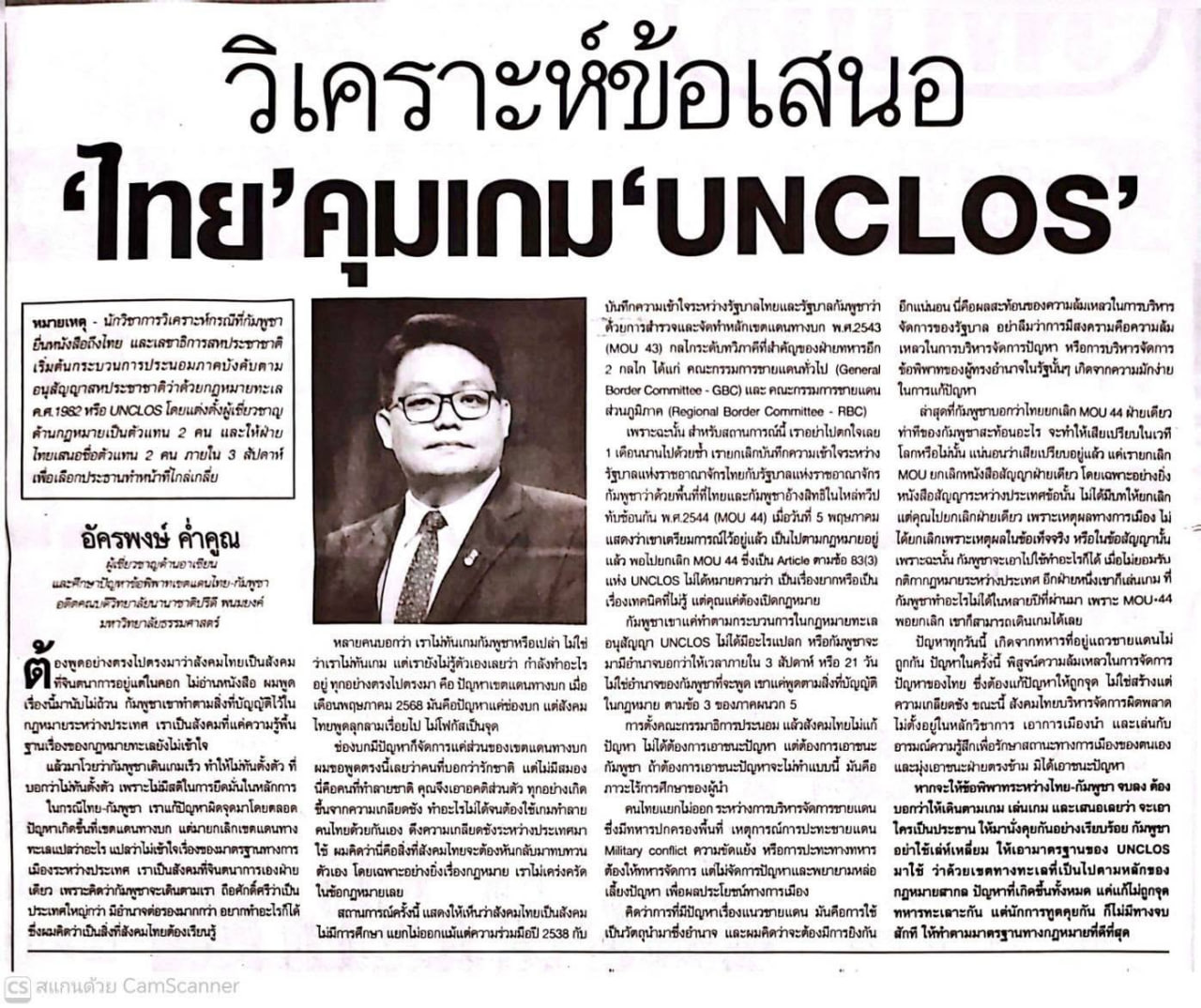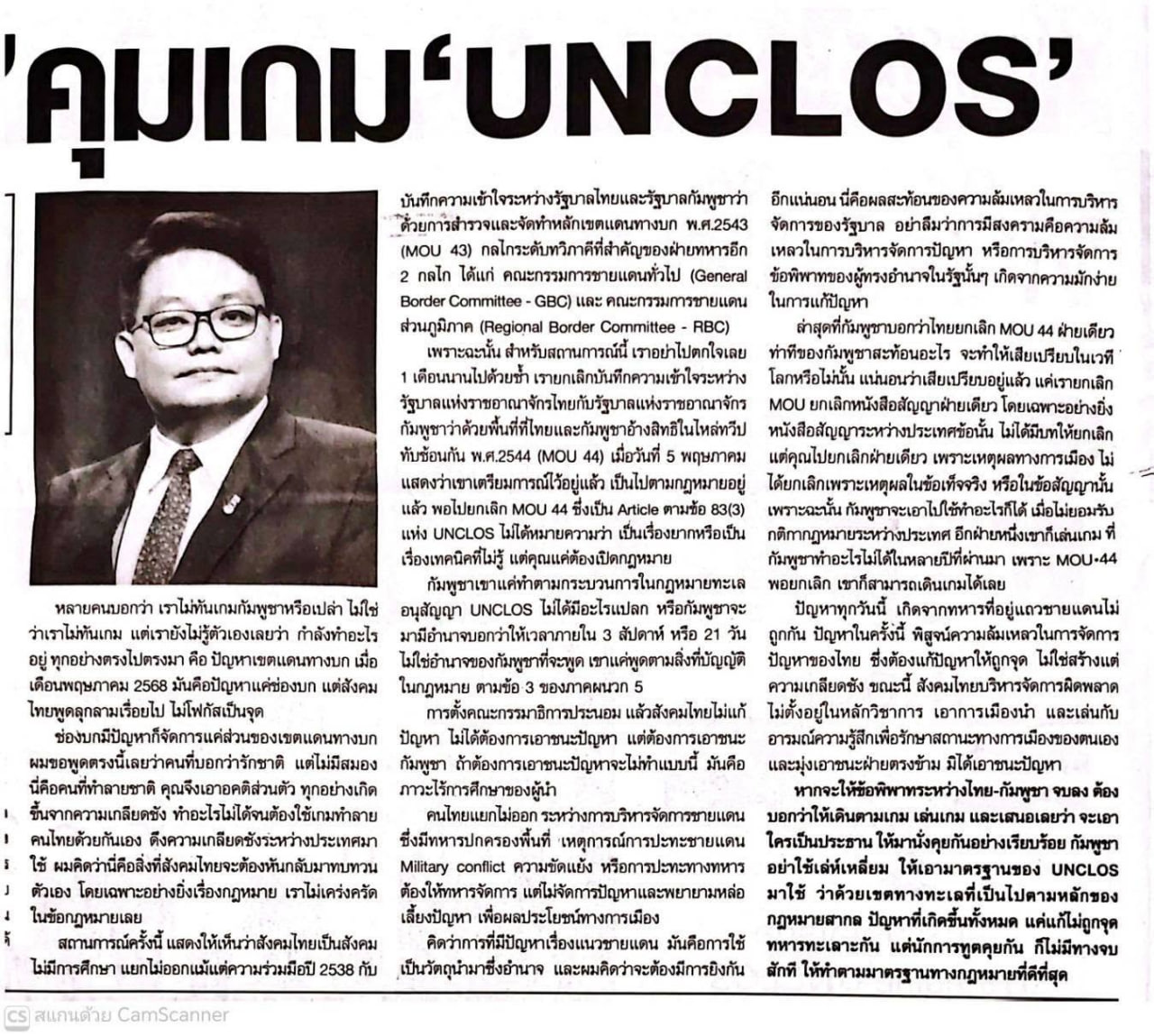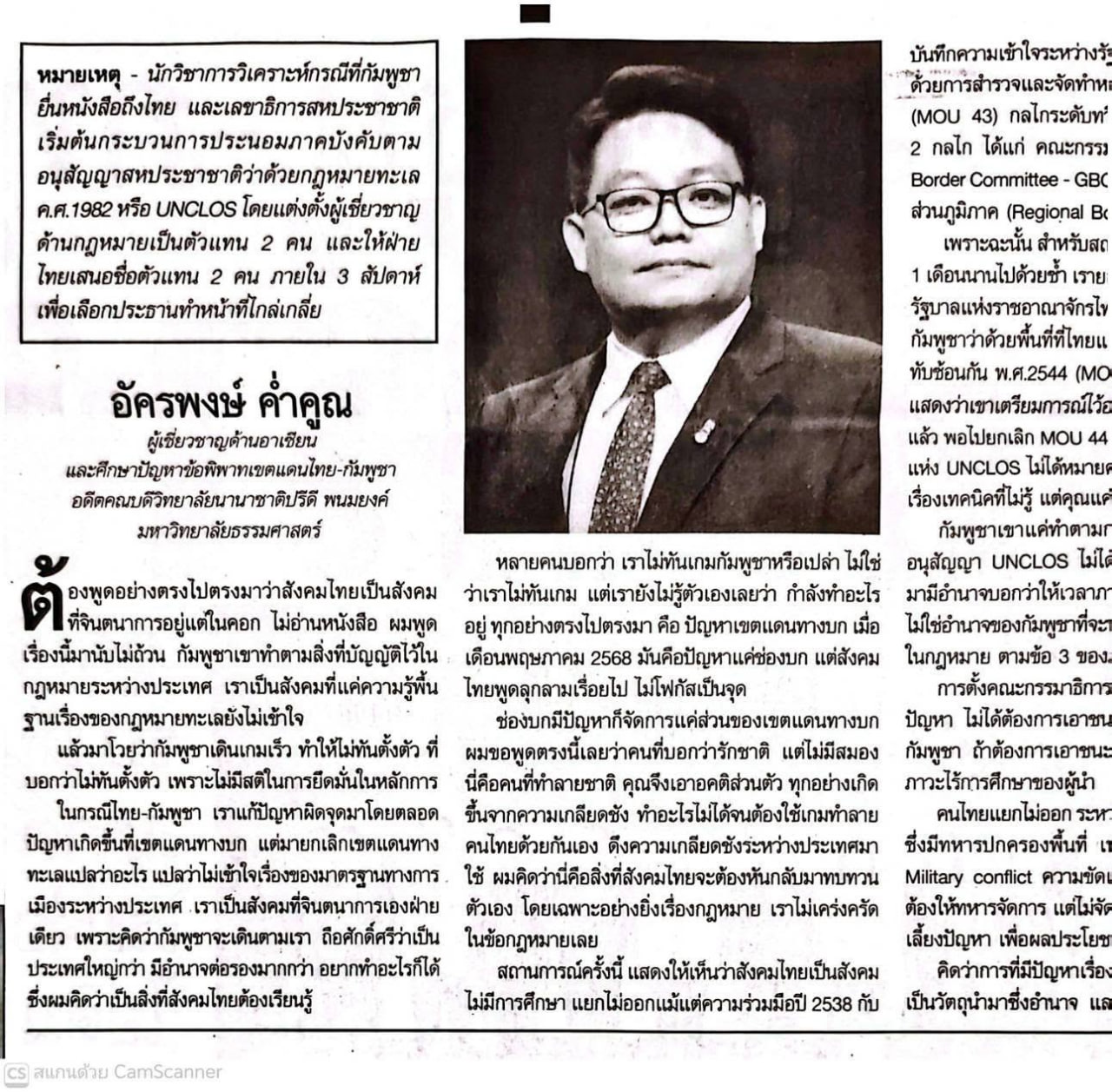

(Phnom Penh): On Monday morning (Jun. 8), Samdech Techo Hun Sen, President of the Senate and Acting Head of State of Cambodia, shared an analytical article by Professor Akaraphong Khamkhun, an expert on ASEAN affairs and Thailand-Cambodia border studies, titled “Analysis of the Proposal: Thailand Controls the UNCLOS Game.”
In a post on his official social media platform, Samdech Techo Hun Sen said he was interested in the professor’s analysis, which argued that parts of Thai society “live in a world of imagination and read too few books.”
Samdech Techo added that he wanted to share an unofficial translation of the article so that people in both Cambodia and Thailand could better understand its contents.
“I will not add any further commentary and will leave it to the people of both countries to reflect on what Professor Akaraphong Khamkhun has written,” he wrote.
Read full article below:
“Analysis of the Proposal: Thailand Controls the UNCLOS Game," published on the Facebook account of Akkharaphong Khamkhun on 7 June 2026.
"A Thai political science expert analysed the case in which Cambodia sent a letter to the Thai side and to the Secretary General of the United Nations to initiate the compulsory conciliation proceedings under the 1982 United Nations Convention on the Law of the Sea (UNCLOS). Cambodia appointed two legal experts as its representatives and gave Thailand three weeks to nominate two representatives, after which a chairperson would be selected to lead the conciliation process.
Professor Akaraphong Khamkhun, an expert on ASEAN affairs and Thailand–Cambodia border dispute studies, bluntly stated that Thai society lives in imagination and does not read much.
I have said these countless times already. Cambodia is simply acting in accordance with international law, while Thai society still lacks even a basic understanding of maritime law.
Then they complained that Cambodia is moving faster in the game, making Thailand unprepared. Thailand’s lack of preparation stems from its failure to adhere consistently to principles and from addressing the wrong issues regarding Thailand-Cambodia case.
While the dispute originated on the land border, Thailand responded by announcing the cancellation of a maritime boundary agreement. What does that mean? It means that we do not yet understand international political standards at all.
We are a society that imagines things on our own because we think Cambodia will follow us, relying on the pride that we are a larger country with greater bargaining power and can do whatever we want.
This is a lesson that Thai society must learn. Many people ask whether we are falling behind Cambodia in the game. It is not that we are falling behind in the game, but that we ourselves are not even aware of what we are doing.
The land border issue that arose in May 2025 was limited to the Chong Bok area. Still, Thai society has continuously expanded the discussion far beyond that, without focusing on the specific issue. I will say this directly: those who shout "patriotism" but lack intelligence are, in fact, the real destroyers of the nation.
They have used personal bias and hatred as a foundation. When they fail to achieve results, they turn to strategies that promote hostility between the Thai people themselves by using hatred between countries as a tool.I believe this is something Thai society must critically reflect on, especially regarding legal matters, where international legal standards are not being properly respected at all.
The current situation shows that Thai society lacks understanding and cannot even properly distinguish between the 1995 cooperation framework, the Memorandum of Understanding on land border surveying and demarcation between the governments of Thailand and Cambodia in 2000 (MOU 43), and other key bilateral military mechanisms, including the General Border Committee (GBC) and the Regional Border Committee (RBC).
Therefore, in this situation, there is no need to panic. Thailand announced the unilateral cancellation of the 2001 Memorandum of Understanding between the Government of Thailand and the Government of Cambodia on the overlapping claims area in the sea (MOU 44), which on May 5, showed that the Cambodian side had prepared in advance and implemented the law correctly.
When Thailand announced the cancellation of MOU 44, Article 83 (3) of UNCLOS does not contain any technical complexity that Thailand could not understand; it simply requires reading the law.
Cambodia is merely following the procedures set out in the Law of the Sea under UNCLOS. There is nothing unusual about it. The fact that Cambodia set a three-week timeframe is also not an act of unilateral authority; it is stated in accordance with the law, based on paragraph 3 of Annex V concerning the establishment of a conciliation commission.
In contrast, Thai society refuses to resolve the problem. It is not trying to win the issue itself, but trying to win against Cambodia. If the goal were truly to solve the problem, Thailand would not act this way. This is a sign of weak leadership.
The public still cannot distinguish between border management under military responsibility and actual military conflict at the border.
The military conflict must be handled by the military. Still, the government refuses to address the root cause of the problem and instead tries to prolong the conflict for political gain.
They believe that keeping border disputes unresolved can be used as a political tool to strengthen power. I believe there will inevitably be armed clashes again. This reflects a failure of governance. War is a symbol of the failure of those in power to properly manage disputes within a state, arising from negligence and disregard in addressing problems.
Finally, when Cambodia claims that Thailand unilaterally cancelled MOU 44, what does this say about Cambodia's position? Will it cause Thailand to suffer losses on the international stage? The answer is yes; it is already a loss.
When a country unilaterally cancels an MOU or international treaty, especially one that lacks termination provisions and does so for domestic political reasons rather than on factual or contractual grounds, it inevitably creates consequences.
Therefore, Cambodia can leverage this weakness strategically. When one side refuses to recognise international legal norms, the other will inevitably respond strategically in turn. What Cambodia was unable to do for many years was constrained by MOU 44. Still, once it is cancelled, Cambodia can immediately proceed further.
The current problem stems from military personnel along the border who do not get along. This situation reflects the Thai side's failure to properly manage the issue, which must be addressed at its root rather than fomenting hatred.
At present, Thai society is being governed and managed incorrectly, not based on scientific principles, but by mixing politics with emotional manipulation of the public to maintain political power and gain an advantage over the other side, rather than solving the problem itself.
If the Thailand-Cambodia dispute is to be resolved, it must follow a rules-based approach, and a proper chairperson must be selected so that discussions can be conducted in an orderly manner. Cambodia must also avoid manipulation and adhere strictly to UNCLOS, which requires maritime disputes to be resolved in accordance with international law.
All these problems arise from the mismanagement of the issue. Soldiers clash at the border, but diplomats are made to negotiate, which will never resolve the problem. It must follow the best international legal standards and established international practices.”
=FRESH NEWS