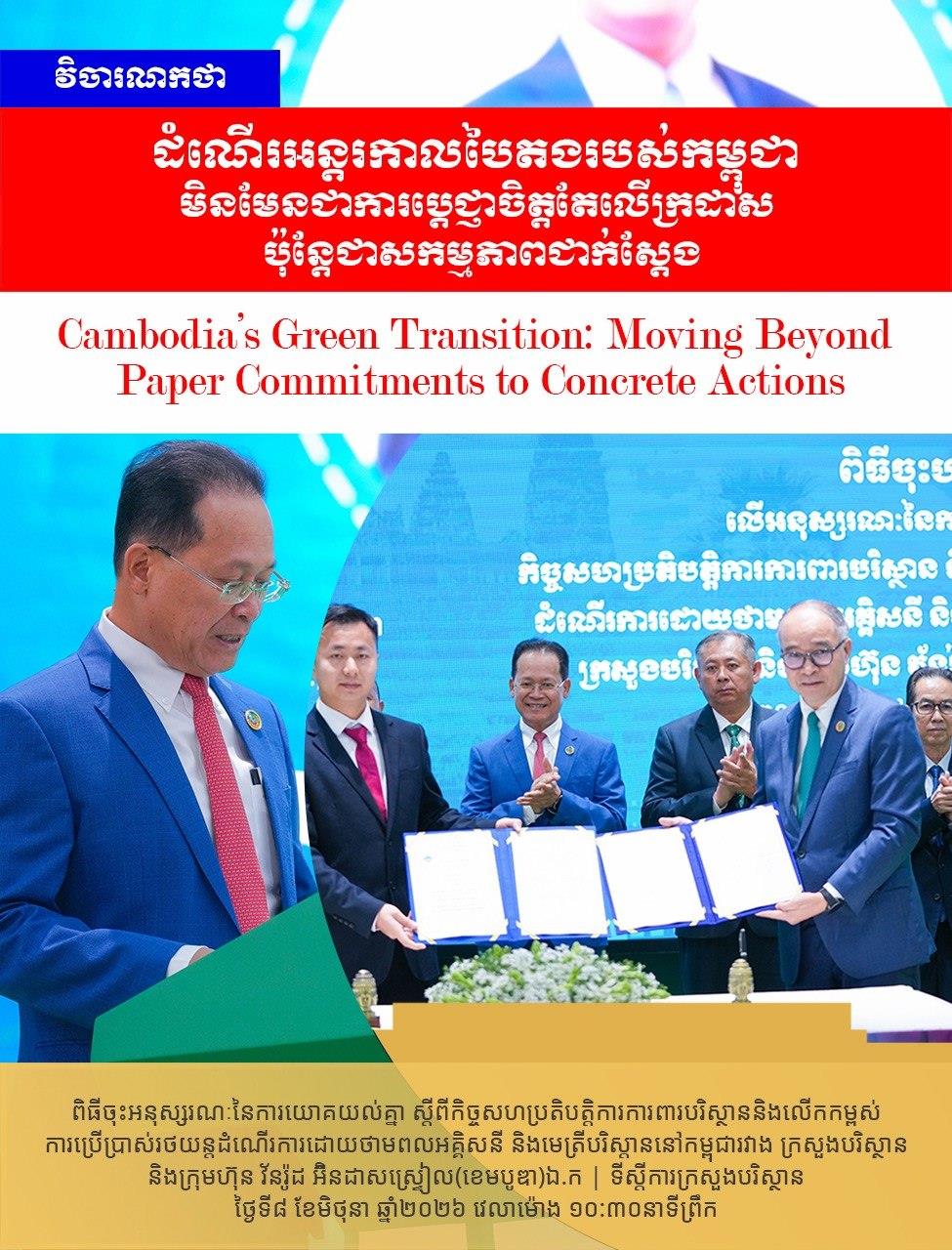

(Phnom Penh): The promotion of Electric Vehicles (EVs) and eco-friendly technologies in Cambodia is far from a passing trend; it is a vital strategic leap in the nation's journey toward a clean, green, and sustainable future. In this sense, the signing of the Memorandum of Understanding (MoU) between the Ministry of Environment and its private sector partners is not mere bureaucratic paperwork.
Rather, it stands as a powerful testament to the shared resolve of the Royal Government and the private sector to tackle a pressing global crisis, climate change, by accelerating the transition toward carbon neutrality.
Climate change is no longer a distant threat. It actively disrupts daily lives through soaring temperatures, erratic droughts, flash floods, and severe ecological imbalances. According to scientific research, the primary sources of greenhouse gas emissions stem from six key sectors: energy (electricity and heat production), industry, transportation, agriculture, land use and forestry, and waste management.
In the face of these challenges, the 7th-mandate Royal Government, under the visionary leadership of Cambodian Prime Minister Hun Manet, has introduced the "Pentagonal Strategy" Phase I (2023–2028).
This strategy places environmental protection and climate action squarely at the core of national development to navigate global shifts and secure the Cambodia 2050 vision.
To operationalise this vision, the Ministry of Environment launched the "Circular Strategy on Environment (2023–2028)." Driven by three strategic pillars, "Cleanliness, Greenness, and Sustainability," the policy aims to achieve carbon neutrality by 2050 while maintaining maximum forest cover.
These strategies have evolved far beyond theoretical blueprints to become tangible social movements:
- Under the "Cleanliness" Pillar: Millions of Cambodians have been mobilised through key campaigns, including "Today, I Will Not Use Plastic Bags!", "Clean Cambodia, Khmer Can Do It!", and "Plastic-Free National Roads." This has fostered a profound shift in public behaviour and cultivated a deep sense of environmental responsibility among citizens.
- Under the "Greenness" Pillar: The "Green Sprout" campaign has been actively distributing millions of saplings annually from five regional nurseries to citizens and institutions. This initiative expands green cover while simultaneously supporting community-based livelihoods, empowering local populations to take ownership of natural resource protection.
Today, Cambodia takes yet another significant step forward by expanding its efforts into the energy and transport sectors, both of which are major sources of carbon emissions.
The commitment to scaling up electric vehicles is not just about keeping pace with technological innovations; it represents a highly effective environmental solution to curb greenhouse gas emissions, improve air quality, and reduce reliance on fossil fuels. This latest collaboration and MoU will act as a catalyst to drive public awareness and stimulate investments in sustainable transit and green innovation.
On the international stage, Cambodia has signaled its unwavering resolve. In its updated Nationally Determined Contribution (NDC 3.0) submitted to the United Nations, the country set an ambitious target to slash greenhouse gas emissions by 55 per cent by 2035, in alignment with its Long-Term Strategy for Carbon Neutrality (LTS4CN).
This bold move makes Cambodia the first nation in the ASEAN region to declare a comprehensive roadmap toward achieving Net-Zero emissions by 2050.
However, these monumental goals cannot be achieved by the government alone. It strictly demands active participation and concrete investments from the private sector, development partners, civil society, academic institutions, and every individual citizen.
Now is the time for businesses and industries to pivot toward clean technologies and sustainable supply chains, and for every citizen to embrace low-carbon living.
Every single electric vehicle on the road, every tree planted, every kilogram of waste reduced, and every investment made in clean energy serves as the driving force propelling Cambodia closer to its sustainable development goals.
Together, we can build a clean, green, sustainable, and climate-resilient Cambodia, ensuring prosperity for this generation and those to come.
=FRESH NEWS