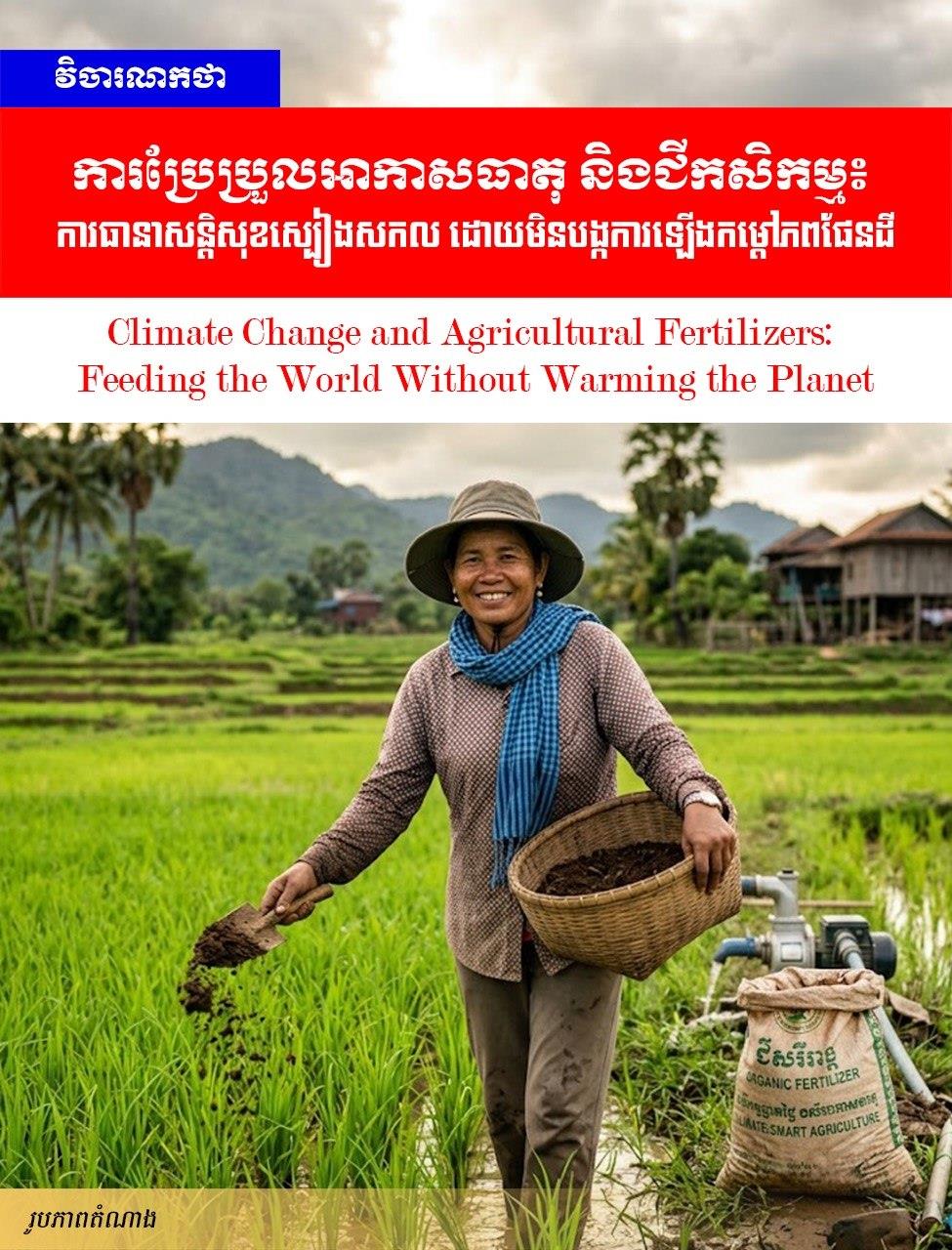

(Phnom Penh): Agriculture is one of humanity’s greatest achievements. It feeds billions of people, supports livelihoods, and forms the backbone of many national economies. Fertilizers, in particular, have helped farmers increase crop yields and improve food security for generations.
Without fertilizers, it would be difficult to produce enough food to meet the needs of a growing global population.
Yet, like many powerful tools, fertilizers come with responsibilities. When used improperly or excessively, agricultural fertilizers can contribute to climate change, pollute water sources, and degrade ecosystems.
Understanding this connection is essential if we are to build a future that is both food-secure and environmentally sustainable.
Most chemical fertilizers contain nitrogen, phosphorus, and potassium, the nutrients plants need to grow. Nitrogen fertilizers are especially important because they help crops develop quickly and produce higher yields.
However, not all of the nitrogen applied to fields is absorbed by plants.
A significant portion escapes into the environment. Some is washed into rivers, lakes, and groundwater. Some evaporates into the atmosphere.
More importantly for climate change, part of the nitrogen in soil is converted into nitrous oxide, a greenhouse gas nearly 300 times more powerful than carbon dioxide at trapping heat over the long term.
Globally, agriculture is one of the largest sources of nitrous oxide emissions. As the world increases food production, fertilizer use has also increased, leading to higher greenhouse gas emissions from agricultural lands.
Climate change and fertilizers are therefore linked in two ways.
First, excessive fertilizer use contributes to climate change through greenhouse gas emissions.
Second, climate change makes fertilizer management more difficult. Higher temperatures, more intense rainfall, floods, and droughts can increase nutrient losses from soils. During heavy rains, fertilizers can be washed away before crops absorb them. During droughts, crops may not utilize nutrients efficiently.
As a result, farmers may be tempted to apply more fertilizer, creating a cycle of rising costs and rising emissions.
The challenge is not to stop using fertilizers. The challenge is to use them wisely.
Across the world, scientists and farmers are promoting what is often called “smart fertilizer management.” This includes applying the right type of fertilizer, at the right rate, at the right time, and in the right place.
Precision agriculture, soil testing, improved irrigation, and modern farming techniques can help farmers maximize yields while minimizing waste.
Organic fertilizers, compost, animal manure, crop residues, and biofertilizers can also play important roles in improving soil health and reducing dependence on synthetic inputs.
Healthy soils rich in organic matter not only support crop growth but also store carbon, helping to mitigate climate change.
In addition, protecting forests and natural ecosystems remains essential. Forests act as natural carbon sinks, absorbing greenhouse gases from the atmosphere.
When agricultural expansion leads to deforestation, the climate benefits of food production can be undermined by increased emissions from land-use change.
For countries such as Cambodia, where agriculture remains a vital sector of the economy, balancing food production and environmental protection is increasingly important. Farmers are already experiencing the effects of climate change through changing rainfall patterns, prolonged droughts, floods, and rising temperatures.
Sustainable fertilizer management can help improve agricultural productivity while strengthening resilience to these challenges.
Governments, agricultural institutions, researchers, and farmers must work together to promote climate-smart agriculture. Training, access to technology, soil testing services, and public awareness are all critical components of this effort.
The future of agriculture should not be a choice between feeding people and protecting the planet. We must achieve both.
Fertilizers have helped humanity overcome hunger and improve living standards. Used responsibly, they will continue to play an important role in food production.
But as the world confronts the realities of climate change, we must recognize that every input to agriculture carries environmental consequences.
The goal is not simply to grow more food. The goal is to grow food more efficiently, more sustainably, and with greater respect for the natural systems upon which all life depends.
By using fertilizers wisely, protecting our soils, conserving our forests, and embracing climate-smart farming practices, we can nourish both people and the planet for generations to come.
=FRESH NEWS