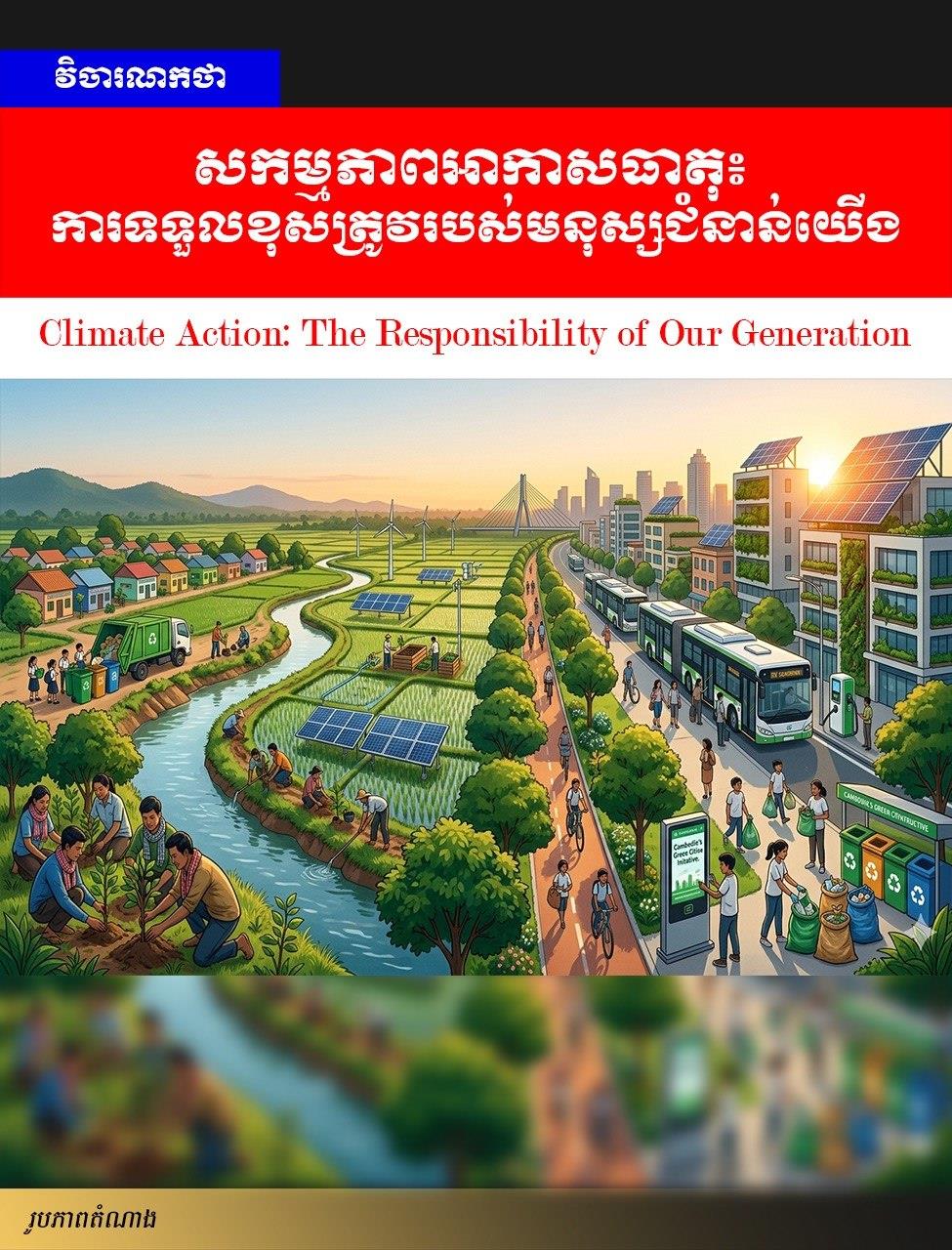

(Phnom Penh): Climate change is no longer a prediction for the future. It is a reality of the present.
Around the world, communities are experiencing stronger storms, prolonged droughts, devastating floods, rising temperatures, melting glaciers, sea-level rise, and increasing threats to food and water security.
Scientists have made it clear that these changes are largely driven by human activities that release greenhouse gases into the atmosphere.
The challenge before us is immense, but so is our capacity to act.
Climate action is simply the collective effort to reduce greenhouse gas emissions and adapt to the impacts of a changing climate. It is not the responsibility of governments alone. It requires the participation of businesses, communities, schools, families, and individuals. Every sector of society has a role to play.
The causes of climate change are found across six major sectors: energy, industry, agriculture, forestry and land use, solvents and chemical products, and waste. Addressing climate change, therefore, requires action in all of these areas.
In the energy sector, climate action means increasing the use of renewable energy sources such as solar, wind, and hydropower while improving energy efficiency.
Every household that conserves electricity and every business that invests in clean energy contributes to reducing emissions.
In the transportation sector, climate action includes promoting public transportation, electric vehicles, walking, cycling, and cleaner fuels. Cleaner transportation not only reduces greenhouse gas emissions but also improves air quality and public health.
In agriculture, climate action means adopting sustainable farming practices, improving fertilizer and pesticide management, conserving water, and protecting soil health.
Farmers are among the first to feel the impacts of climate change, making climate-smart agriculture essential for food security.
In forestry, climate action means protecting existing forests and expanding forest cover through reforestation and afforestation. Forests are among the most effective natural solutions to climate change because they absorb carbon dioxide from the atmosphere and store it for decades.
In waste management, climate action means reducing waste generation, recycling materials, composting organic waste, and preventing open burning.
Plastic pollution, unmanaged waste, and landfill emissions not only harm the environment but also contribute to climate change.
The good news is that climate action is already happening across the world.
Countries are investing in renewable energy. Cities are expanding green transportation systems. Communities are planting trees and restoring ecosystems.
Businesses are embracing cleaner technologies. Young people are raising awareness and inspiring change.
Cambodia is also contributing to global climate action through its commitment to sustainable development.
Efforts to reduce plastic waste, promote cleanliness, protect forests, expand tree planting, conserve biodiversity, and support green communities demonstrate that environmental protection and economic development can go hand in hand.
Campaigns that encourage people to reduce plastic use, keep public spaces clean, and plant trees are more than environmental activities.
They are examples of climate action at the community level. Every tree planted absorbs carbon. Every plastic bag avoided reduces pollution. Every clean river, forest, and community strengthens resilience against climate change.
Yet climate action is not only about policies and programs. It is also about choices.
The choice to switch off unnecessary lights.
The choice to reduce waste.
The choice to plant a tree.
The choice to use resources wisely.
The choice to protect nature rather than destroy it.
When multiplied by millions of people, these simple actions become a powerful force for change.
Climate change is often described as a global problem, and it is.
But the solutions begin locally, in our homes, schools, workplaces, farms, businesses, and communities. The future of our planet will be determined not only by international agreements but also by the daily decisions made by ordinary citizens.
History will judge our generation not by how much we knew about climate change, but by what we did about it.
Climate action is not merely an environmental obligation. It is an investment in public health, economic prosperity, food security, and the well-being of future generations.
The challenge is urgent, but the opportunity is equally great. By acting today, we can build a cleaner environment, a stronger economy, and a more sustainable future for all.
The climate is changing. The question is whether we are willing to change with it. The answer must be yes.
=FRESH NEWS