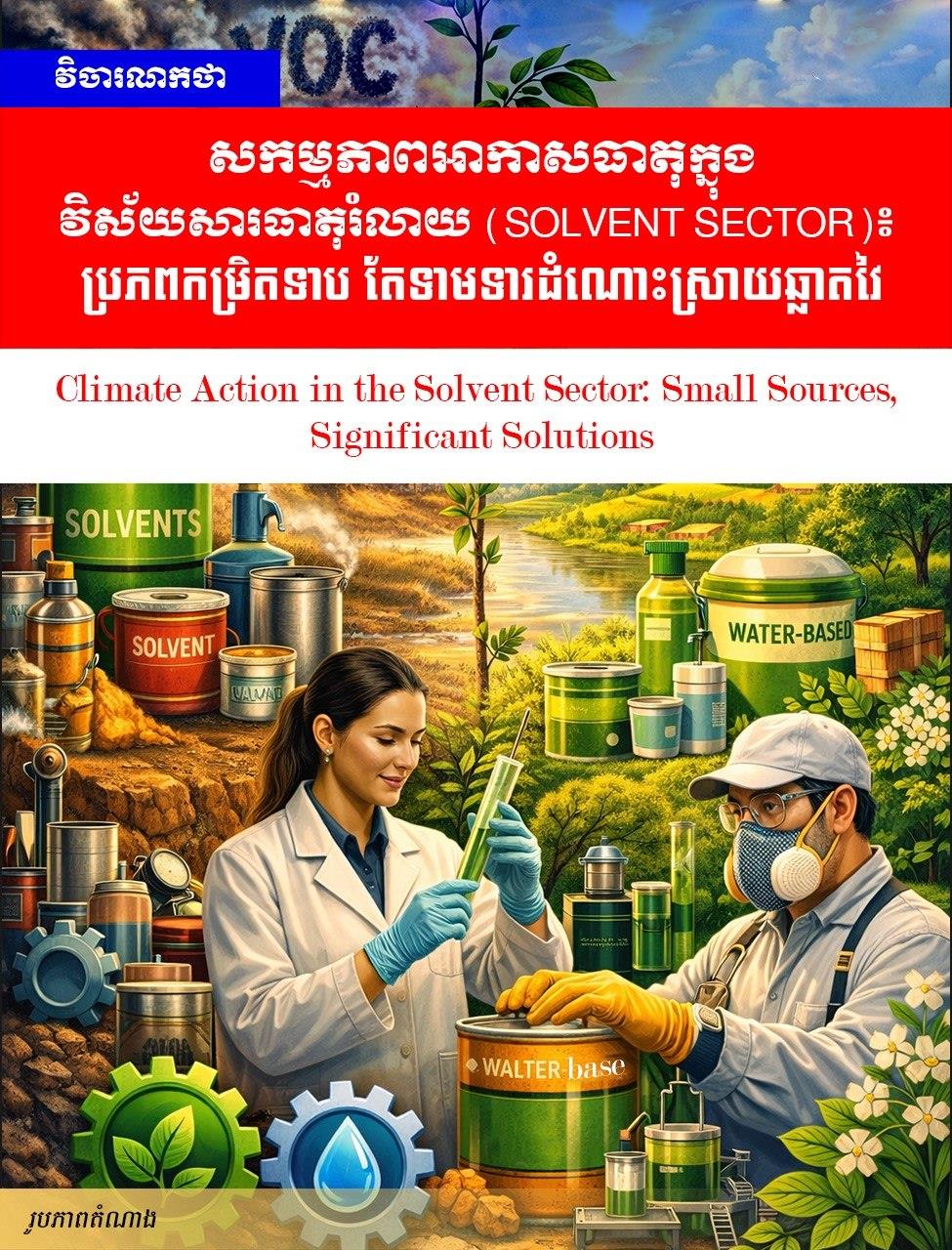

(Phnom Penh): When discussing climate change, public attention often focuses on power plants, factories, vehicles, and deforestation. These are indeed major contributors to greenhouse gas emissions. However, climate action requires attention to all sources of emissions, including those that are less visible but still important.
One such source is the solvent sector.
Solvents are substances used to dissolve, dilute, or clean other materials. They are found in a wide range of products and industries, including paints, coatings, printing inks, adhesives, cleaning agents, cosmetics, pharmaceuticals, electronics manufacturing, and chemical production.
Most people use products containing solvents in their daily lives, often without realizing it.
Although the solvent sector contributes a smaller share of greenhouse gas emissions compared to energy or industry, it remains an important part of climate action because it releases volatile organic compounds (VOCs) and other air pollutants that affect both the environment and human health.
Many solvents evaporate into the atmosphere during manufacturing, storage, transportation, and use. These emissions contribute to the formation of ground-level ozone and smog, which can damage crops, forests, ecosystems, and human respiratory health. Some solvent-related chemicals also have direct or indirect climate impacts.
As countries work toward reducing greenhouse gas emissions and improving environmental quality, the solvent sector presents an opportunity for practical and cost-effective climate action.
The first and most effective action is reducing the use of high-emission solvents whenever suitable alternatives are available.
Advances in technology have made it possible to replace many traditional solvent-based products with water-based, low-VOC, or solvent-free alternatives. Water-based paints, coatings, and cleaning products often provide similar performance while significantly reducing emissions.
Innovation plays a crucial role.
Researchers and manufacturers around the world are developing greener chemicals and environmentally friendly production methods. These innovations allow industries to maintain productivity while reducing environmental impacts.
Businesses that invest in cleaner technologies not only help protect the environment but often benefit from improved efficiency and market competitiveness.
Another important climate action is improving industrial practices.
Many emissions occur because solvents are not properly stored, handled, or recovered. Modern equipment can capture and recycle solvent vapors before they are released into the atmosphere.
Better maintenance, leak prevention, closed production systems, and efficient storage facilities can substantially reduce emissions.
Good regulation and environmental standards are equally important.
Governments can encourage industries to adopt cleaner technologies through regulations, incentives, technical assistance, and public awareness programs.
Environmental standards help ensure that businesses operate responsibly while protecting public health and the environment.
Climate action in the solvent sector also contributes to cleaner air.
Poor air quality affects millions of people worldwide and can lead to respiratory diseases, cardiovascular problems, and reduced quality of life.
By reducing solvent emissions, countries can simultaneously address climate change, improve public health, and enhance environmental quality.
For developing countries, climate action in the solvent sector presents an opportunity to embrace modern industrial practices from the beginning.
As industries expand and economies grow, cleaner technologies can be integrated into production systems before pollution becomes a larger challenge.
Consumers also have a role to play.
Choosing environmentally friendly products, supporting companies that prioritize sustainability, and following product usage instructions can help reduce emissions.: Small choices made by millions of consumers collectively create significant environmental benefits.
One of the important lessons of climate action is that every sector matters.
Large emissions reductions from energy, transportation, forestry, and industry are essential. Yet achieving long-term climate goals also requires attention to smaller sources that are often overlooked.
The solvent sector demonstrates how incremental improvements across many activities can contribute to substantial environmental gains.
Climate action is not always about dramatic changes. Sometimes it is about improving processes, adopting better technologies, and making smarter choices.
These actions may appear modest individually, but together they help build a cleaner and more sustainable future.
The transition to a low-carbon economy will require innovation, responsibility, and cooperation across all sectors of society. The solvent sector is no exception.
By promoting cleaner products, reducing emissions, embracing green technologies, and strengthening environmental stewardship, we can ensure that even the smallest sources of pollution become part of the solution to climate change.
In the fight against climate change, every sector counts, every improvement matters, and every action brings us one step closer to a healthier planet for future generations.
=FRESH NEWS