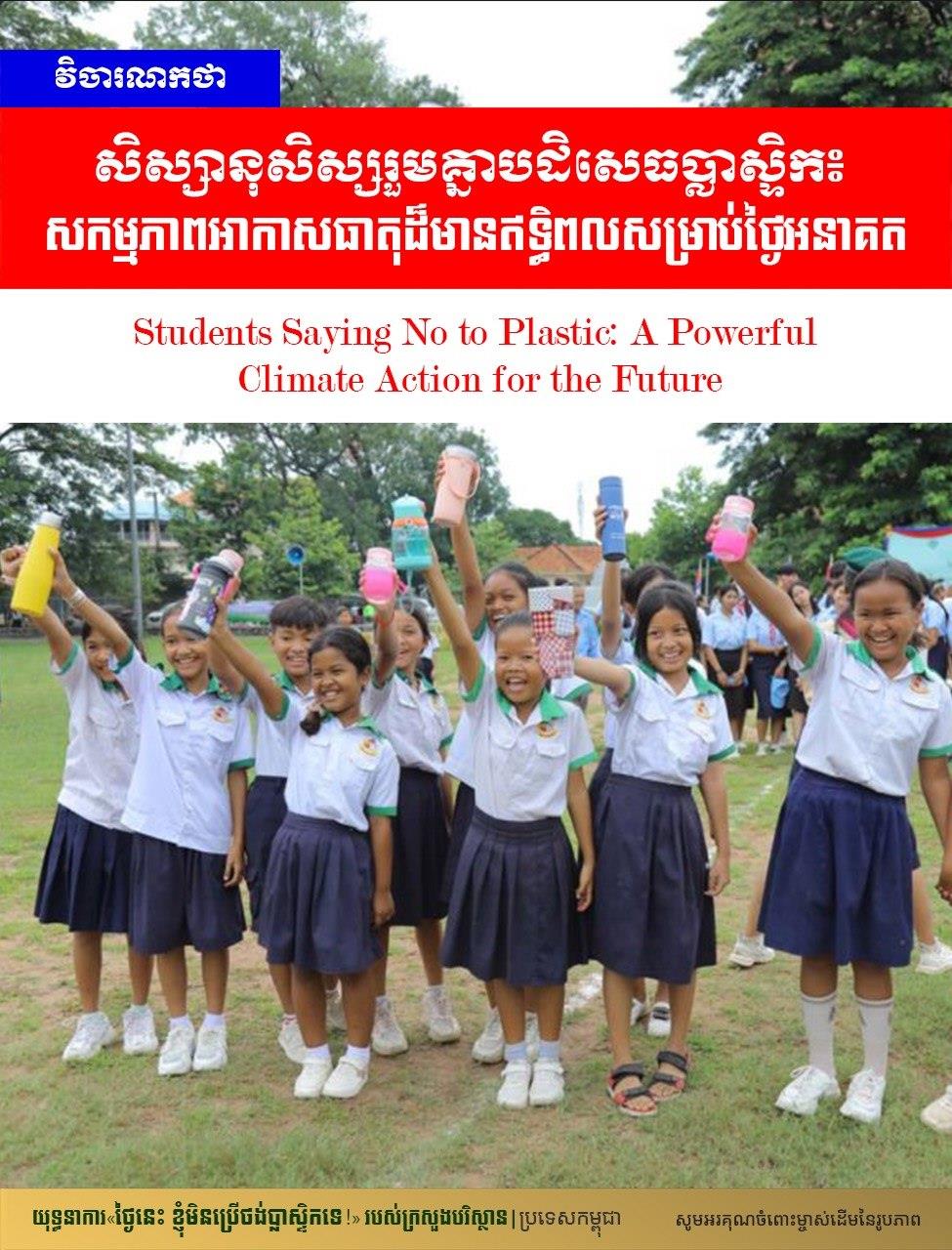

(Phnom Penh): Climate change is often discussed in terms of large-scale solutions: renewable energy, electric vehicles, green industries, and international agreements.
While these efforts are essential, one of the most powerful climate actions may begin with something much simpler, a student’s decision to say “No” to a plastic bag.
At first glance, refusing a plastic bag may seem insignificant compared to the global challenge of climate change.
Yet history shows that lasting change often begins with small actions adopted by many people.
When millions of individuals change their behavior, societies change. When societies change, nations change. And when nations change, the world changes.
Plastic is closely linked to climate change throughout its entire lifecycle.
Most plastics are made from fossil fuels. Extracting oil and gas, manufacturing plastic products, transporting them, and disposing of them all generate greenhouse gas emissions.
Every plastic bag produced carries a carbon footprint. Every piece of plastic waste burned releases carbon dioxide and other pollutants into the atmosphere.
Globally, billions of plastic bags are used each year, many for only a few minutes before being discarded.
Unfortunately, plastic waste often ends up in rivers, lakes, forests, oceans, and landfills, where it can persist for decades or even centuries.
Reducing plastic consumption is therefore not only a waste management issue, it is also a climate action.
Students are uniquely positioned to lead this transformation.
Schools are places where values are formed, habits are developed, and future leaders are shaped.
A student who learns environmental responsibility today becomes an environmentally conscious citizen tomorrow.
More importantly, students influence the people around them. They bring lessons home, encourage their families to adopt better habits, and inspire their communities through their actions.
This is why campaigns encouraging students to say no to plastic are so important.
The objective is not simply to reduce the number of plastic bags used. The deeper goal is to cultivate a culture of environmental responsibility.
When students choose reusable bags, refillable water bottles, and environmentally friendly alternatives, they are learning that their daily choices have consequences for the environment and the climate.
Perhaps the greatest strength of student-led climate action is its multiplier effect.
One student can influence a family.
One classroom can influence a school.
One school can influence a community.
And millions of students can influence an entire nation.
This is precisely why educational campaigns have become a powerful tool in environmental protection. They do more than raise awareness; they change behavior.
Cambodia offers an inspiring example of this approach. Through the campaign “Today, I Do Not Use Plastic Bag,”millions of students across the country have been encouraged to reduce plastic consumption and adopt environmentally responsible habits.
What began as an environmental campaign has evolved into a broader social movement that promotes cleaner schools, cleaner communities, and greater public awareness about environmental protection.
The success of such campaigns demonstrates an important lesson: climate action does not always require complex technology or large investments.
Sometimes it begins with a simple decision made by a young person.
A decision not to accept a plastic bag.
A decision to keep a school clean.
A decision to pick up litter instead of ignoring it.
A decision to care about the environment.
These actions may appear small individually, but collectively they can have a profound impact.
The fight against climate change is ultimately a fight for the future. It is about protecting the air we breathe, the water we drink, the forests we cherish, and the opportunities available to future generations.
Students have the most at stake because they will inherit the world that today’s decisions create.
That is why empowering young people to take environmental action is one of the smartest investments any society can make.
The climate challenge can sometimes seem overwhelming.
Yet campaigns encouraging students to say no to plastic remind us that meaningful change begins with individual responsibility. Every plastic bag avoided reduces waste.
Every environmentally conscious student becomes an ambassador for change. Every positive habit adopted today helps build a more sustainable tomorrow.
Climate action is not only about reducing emissions. It is about shaping a culture that respects nature, values responsibility, and understands that even the smallest actions can contribute to a healthier planet.
When a student says “No” to a plastic bag, they are saying “Yes” to a cleaner environment, “Yes” to a more sustainable future, and “Yes” to climate action.
And when millions of students say it together, their voices become a force capable of changing the world.
=FRESH NEWS