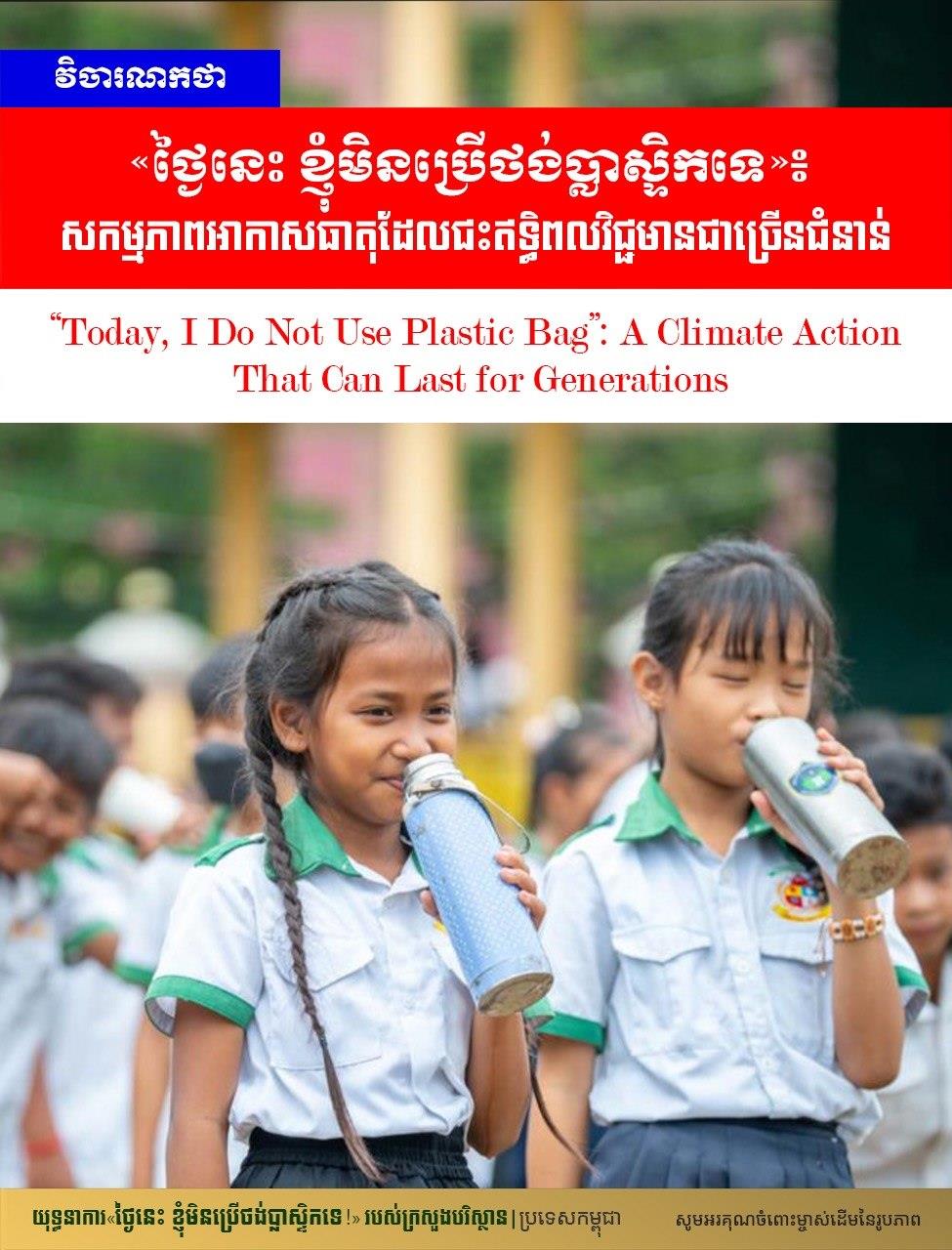

(Phnom Penh): Climate change is often discussed through large numbers and ambitious targets millions of tons of emissions reduced, billions of dollars invested in clean energy, and international agreements negotiated among nations. While these efforts are essential, the most enduring climate actions often begin with something far simpler: changing human behavior.
This is the true significance of the campaign "Today, I Do Not Use Plastic Bag."
At first glance, refusing a plastic bag may seem like a small act. Yet history teaches us that lasting social change rarely begins with grand gestures. It begins with daily habits that gradually become cultural norms. When a habit is adopted by millions of people, it becomes a movement. When a movement is embraced by a generation, it becomes part of a nation's identity.
That is why the decision to focus this campaign on students is so important.
Students are not only the citizens of tomorrow; they are also the parents, grandparents, teachers, business leaders, and policymakers of the future. The habits they develop today will shape the choices they make for the rest of their lives.
When a student learns to refuse unnecessary plastic bags, they are learning more than an environmental lesson. They are learning responsibility, discipline, and respect for the natural world. These values do not disappear when they graduate. They accompany them into adulthood.
One day, these students will have families of their own.
When they go shopping, they will carry reusable bags because that habit was formed in their youth.
When their children ask for plastic bags, they will explain why alternatives are better.
When their grandchildren grow up, they will see sustainable practices as normal rather than exceptional.
What begins as a campaign in a classroom today can become a family tradition tomorrow.
This is how real societal transformation occurs not through temporary enforcement, but through generational change.
Plastic pollution is also closely linked to climate change. Plastics are produced primarily from
fossil fuels. Their extraction, manufacturing, transportation, and disposal generate greenhouse gas emissions. When plastic waste is burned, it releases carbon dioxide and harmful pollutants into the atmosphere. Reducing plastic consumption therefore contributes not only to cleaner communities but also to climate mitigation.
Yet the greatest achievement of the campaign may not be the number of plastic bags avoided.
Its greatest achievement may be the creation of a generation that thinks differently.
A generation that understands that individual actions matter.
A generation that values sustainability.
A generation that recognizes that environmental protection is not the responsibility of government alone but a shared duty of all citizens.
In Cambodia, the campaign has already demonstrated the power of collective action. Millions of students have embraced the simple commitment of refusing plastic bags. More importantly, they have brought this message home to their families and communities. Parents often learn from their children, just as children learn from their parents.
This creates a powerful ripple effect.
One student influences a household.
One household influences a neighborhood.
One neighborhood influences a community.
One generation influences the next.
The environmental benefits therefore multiply over time.
Many climate policies seek immediate results, and rightly so. However, some of the most important climate actions are those whose full impact may only become visible decades later. Educating children and shaping habits belong to this category.
A tree planted today may provide shade for future generations.
Likewise, an environmental value taught today may guide decisions for decades to come.
The students participating in the "Today, I Do Not Use Plastic Bag" campaign are not merely reducing plastic waste in the present.
They are helping to establish a culture that future generations will inherit.
Their children are likely to say no to plastic because they learned it from their parents.
Their grandchildren are likely to say no to plastic because they learned it from their families.
In this way, a simple campaign becomes something much larger than itself. It becomes a legacy.
Climate change is often described as a challenge for future generations. Yet the solution also lies with future generations. By educating students today, we are not only reducing emissions and plastic pollution in the present; we are cultivating lifelong habits that can endure for decades.
The true success of the campaign will not be measured solely by how many plastic bags are avoided this year.
Its true success will be measured by whether a child who learns to refuse a plastic bag today teaches the same lesson to their child tomorrow.
If that happens, then the campaign will have achieved something extraordinary: it will have transformed a simple daily choice into a lasting culture of environmental responsibility.
And that may prove to be one of the most powerful climate actions of all.
=FRESH NEWS