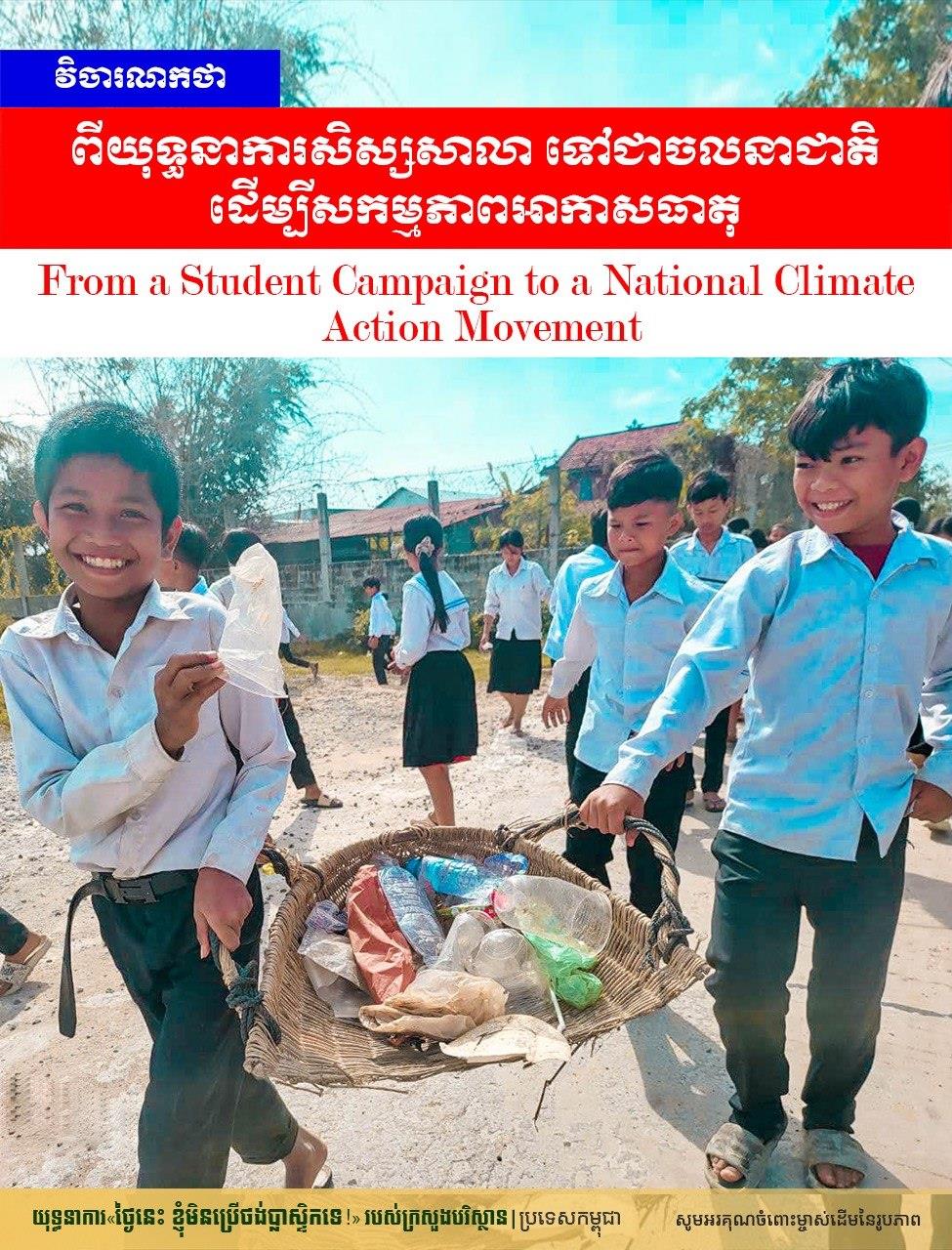

(Phnom Penh): When people think about climate action, they often imagine international agreements, advanced technologies, or large-scale investments. Yet some of the most powerful environmental transformations begin with a simple change in human behavior. Cambodia’s “Today I Do Not Use Plastic Bag” campaign is a remarkable example of how a small commitment can grow into a national movement.
Launched through the leadership and participation of students, the campaign began with a simple pledge: to refuse the use of unnecessary plastic bags. What seemed like a small action quickly demonstrated the extraordinary power of collective responsibility. Students became ambassadors of change, bringing environmental awareness from their classrooms into their homes, communities, and workplaces.
The results have been extraordinary. More than 14 million people have joined the campaign, representing more than half of Cambodia’s population of 17 million people. Few environmental campaigns anywhere in the world have achieved such broad public participation in such a short period of time.
Even more remarkably, the campaign has delivered measurable environmental outcomes. Within just one year, plastic bag imports and domestic production in Cambodia decreased by 84 percent. This achievement demonstrates that when millions of people change their daily behavior, significant environmental and economic impacts can follow. It also proves that public participation can be one of the most effective tools for addressing environmental challenges.
The campaign’s success lies in its ability to transform awareness into action. Students learned that protecting the environment is not merely about understanding environmental problems; it is about changing daily behavior. They encouraged their parents, relatives, neighbors, and friends to adopt the same commitment. As a result, refusing plastic bags became more than an environmental message—it became a social norm.
The campaign also demonstrated that climate action can begin with simple choices. Plastic pollution is closely linked to climate change because plastic products are primarily derived from fossil fuels. Their production, transportation, and disposal generate greenhouse gas emissions. By reducing plastic consumption, citizens contribute not only to cleaner communities but also to the global effort to combat climate change.
Perhaps most importantly, the campaign evolved beyond a commitment into action. Inspired by the same spirit of environmental responsibility, the movement gave rise to the nationwide initiative “Clean Cambodia, Khmer Can Do.” More than seven million people participated in cleaning public areas across the country, demonstrating that environmental stewardship is not the responsibility of government alone but of every citizen.
This progression—from commitment to action—is what makes the campaign truly significant. A pledge not to use plastic bags encouraged people to rethink their relationship with the environment. The clean-up movement transformed that awareness into visible action. Together, they have created a powerful foundation for lasting environmental change.
Today, the movement continues to evolve. What began as a campaign has become a national movement. What is now a movement is steadily becoming a habit. This transformation—from awareness to action, from action to movement, and from movement to habit—is the ultimate goal of the Ministry of Environment.
When environmental responsibility becomes a habit, positive change no longer depends on campaigns or special events. Citizens naturally choose cleaner, greener, and more sustainable behaviors. Students who learn these values today will carry them into adulthood and pass them on to future generations. In this way, climate action becomes part of the national culture.
The story of “Today I Do Not Use Plastic Bag” offers an important lesson. Real change does not always begin with grand gestures. Sometimes it begins with a simple decision made by a student.
When millions make the same decision, that small action becomes a movement. When that movement becomes a habit, it transforms a nation.
Cambodia’s experience demonstrates that climate action is not only about reducing emissions or managing waste. It is about inspiring people to take responsibility for their environment and empowering them to become part of the solution. Through the dedication of students and the participation of millions of citizens, a simple pledge has become one of the country’s most successful public environmental movements.
The journey continues, but its direction is clear: from commitment, to action, to movement, to habit—and ultimately, to a cleaner, greener, and more sustainable Cambodia. In an era when the world is searching for effective climate solutions, Cambodia’s experience shows that empowering young people and changing daily habits can achieve results that once seemed impossible. A campaign started by students has become a movement embraced by a nation.
=FRESH NEWS