
(Phnom Penh): When people talk about climate change, they often look toward the black smoke billowing from industrial factories or vehicle exhaust pipes.
Yet, there is another massive source of environmental destruction happening quietly every single day, right in front of our eyes: on our dinner plates.
Food waste is not merely a moral or economic issue; it is a severe environmental crisis that we can solve through simple behavioral changes.
Globally, as well as in Cambodia, thousands of tons of food are thrown away every day.
When this food rots in landfills, it generates methane gas, a greenhouse gas that is over 20 times more potent than carbon dioxide (CO2) in warming the planet.
Throwing away a scoop of rice or a leftover bowl of soup is not just a waste of food, it is a waste of the water, land, labor, and energy used to produce that food in the first place.
"Protecting the planet does not require us to do extraordinary things beyond our capabilities; it simply requires us to take responsibility for everything we consume and eat."
However, the solution to this massive crisis can begin with a small step: shifting our mindset to "order mindfully, buy purposely, and eat completely."
If every citizen, student, and family commits to leaving no leftovers, this small action will create a massive ripple effect. When millions of people reduce food waste, it will immediately alleviate pressure on landfills and reduce the emission of toxic gases into the atmosphere.
Transforming this awareness into a "habit" is the key to success. In the context of Cambodian families, teaching the value of food and the avoidance of waste is a beautiful culture passed down by our ancestors. Reviving these values in the modern era, fueled by an understanding of climate impacts, will turn zero-food-waste into a "new social norm" that everyone takes pride in practicing.
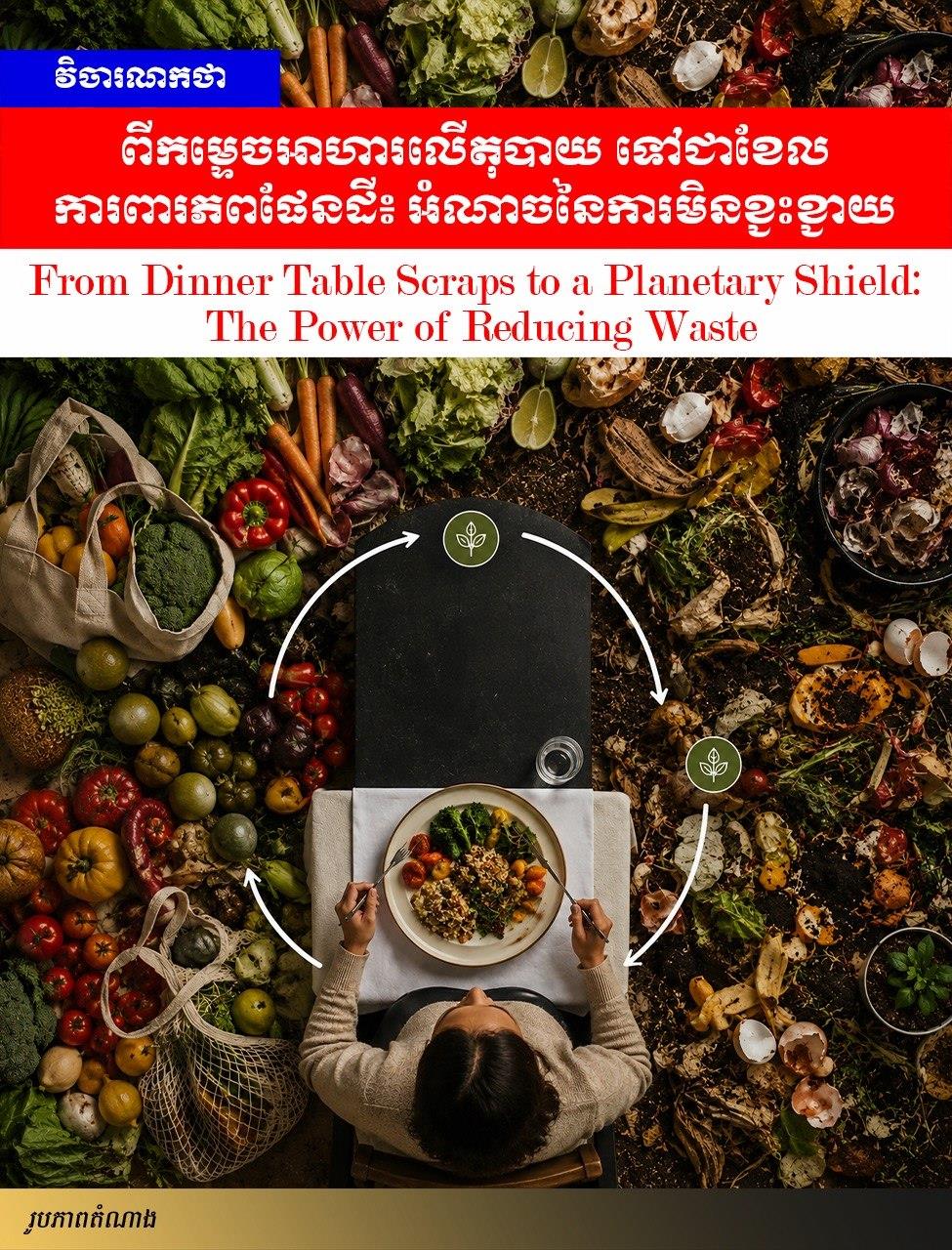
Furthermore, this movement can evolve into larger actions, such as converting organic waste into compost for green agriculture.
What was once pollution-causing trash can be transformed back into nutrients that enrich the soil. This is a sustainable life cycle that proves humanity has the power to restore nature, provided we have the willingness to change.
The story of fighting climate change is not just a matter for scientists or politicians. It is in the hands of each and every one of us.
Every time we decide not to waste food, we are doing our part to cool down the earth.
The journey toward a clean, green, and sustainable Cambodia is not measured solely by the number of trees planted or the technologies purchased; it is measured by our daily living habits.
Let us start today, from our respective dinner tables, to create a national movement that ensures no food is wasted and no future is destroyed.
=FRESH NEWS