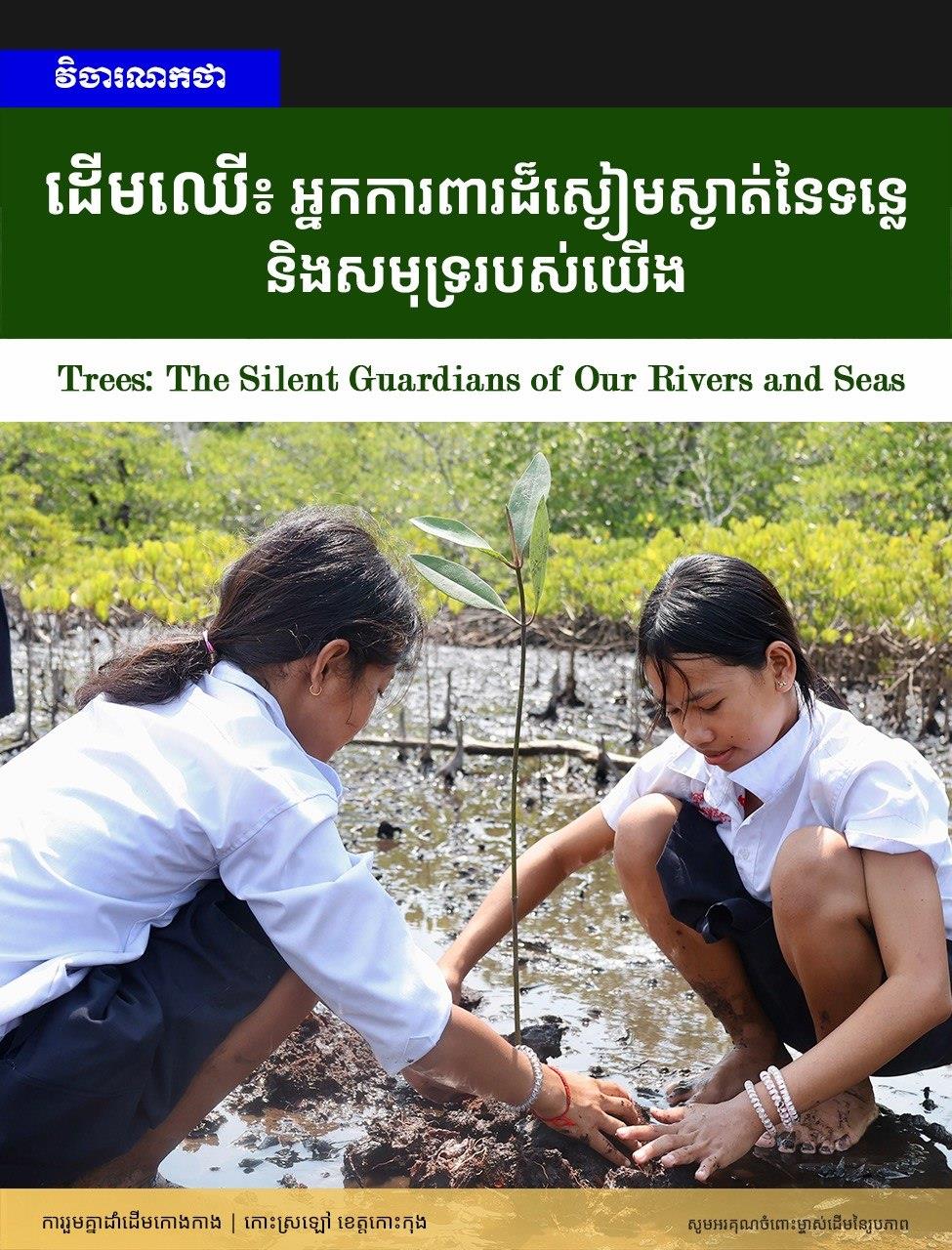

(Phnom Penh): When people think about protecting rivers, lakes, or the sea, they often think about reducing pollution or cleaning up plastic waste. These actions are important, but there is another guardian of water that often goes unnoticed.
That guardian is the tree.
Although trees grow on land, their influence reaches every stream, every river, every lake, and eventually every ocean. The journey of clean water begins not at the riverbank or the coastline, but in healthy forests.
Trees are nature’s water engineers.
When rain falls onto a healthy forest, tree canopies soften its impact. Their leaves slow the falling rain, while their roots allow water to seep gently into the soil instead of rushing across the surface.
This natural process replenishes underground aquifers, feeds springs, and keeps rivers flowing long after the rainy season has ended.
In contrast, where forests have been cleared, rainwater flows rapidly over bare land. Valuable topsoil is washed away into streams and rivers, carrying sediment that clouds the water and reduces its quality.
Rivers become shallower, reservoirs fill with mud, and communities become more vulnerable to floods during the rainy season and water shortages during the dry season.
Healthy forests therefore help provide healthy freshwater.
Trees also serve as natural filters. Their roots trap sediments, absorb excess nutrients, and reduce pollutants before they reach rivers and lakes.
Cleaner rivers mean safer drinking water, healthier fisheries, and lower water treatment costs for communities.
But the benefits do not end when rivers reach the sea.
Every river eventually carries its water into the ocean. When rivers are polluted with soil, chemicals, and waste from degraded landscapes, coastal ecosystems suffer. Coral reefs become smothered by sediment.
Seagrass beds receive less sunlight. Mangrove forests become stressed. Fish, crabs, shrimp, and countless marine species lose the healthy habitats they depend upon.
By protecting trees upstream, we also protect life downstream.
This connection is especially important for Cambodia. Our forests feed our rivers, our rivers nourish our wetlands, and our rivers ultimately flow into the Gulf of Thailand.
Along our coastline, mangrove forests act as a remarkable bridge between land and sea. They stabilize coastlines, reduce erosion, filter pollutants, provide nurseries for fish and crustaceans, store vast amounts of carbon, and protect coastal communities from storms and rising seas.
Mangroves are trees, but they are also guardians of the ocean.
As climate change and El Niño bring longer dry seasons and more extreme weather, healthy forests become even more valuable. They help maintain stream flows during droughts, protect watersheds that supply farms and cities, and strengthen the resilience of both freshwater and marine ecosystems.
Every tree planted in a watershed contributes to cleaner water. Every tree protected along a riverbank helps reduce erosion. Every mangrove restored strengthens the health of our coasts and fisheries.
This is why planting trees is not simply a forestry activity.
It is a water conservation strategy.
It is a fisheries conservation strategy.
It is a climate adaptation strategy.
It is an investment in public health and national prosperity.
Every citizen has a role to play. Plant trees around homes, schools, farms, and communities. Protect forests in upper watersheds. Restore riverbank vegetation.
Safeguard mangrove forests. Prevent forest fires and illegal logging. Avoid polluting rivers and streams. Every action strengthens the natural systems that sustain us.
Water connects every living thing on Earth.
And trees are among water’s greatest protectors.
If we want cleaner rivers, healthier lakes, abundant fisheries, thriving coral reefs, and resilient coastlines, we must first protect the forests that nourish them.
When we plant a tree, we are not only growing a forest.
We are protecting a spring.
We are safeguarding a river.
We are preserving the sea.
And in doing so, we are securing clean water, healthy ecosystems, and a better future for generations to come.
For when the trees flourish, the waters flourish. And when the waters flourish, all life flourishes with them.
=FRESH NEWS