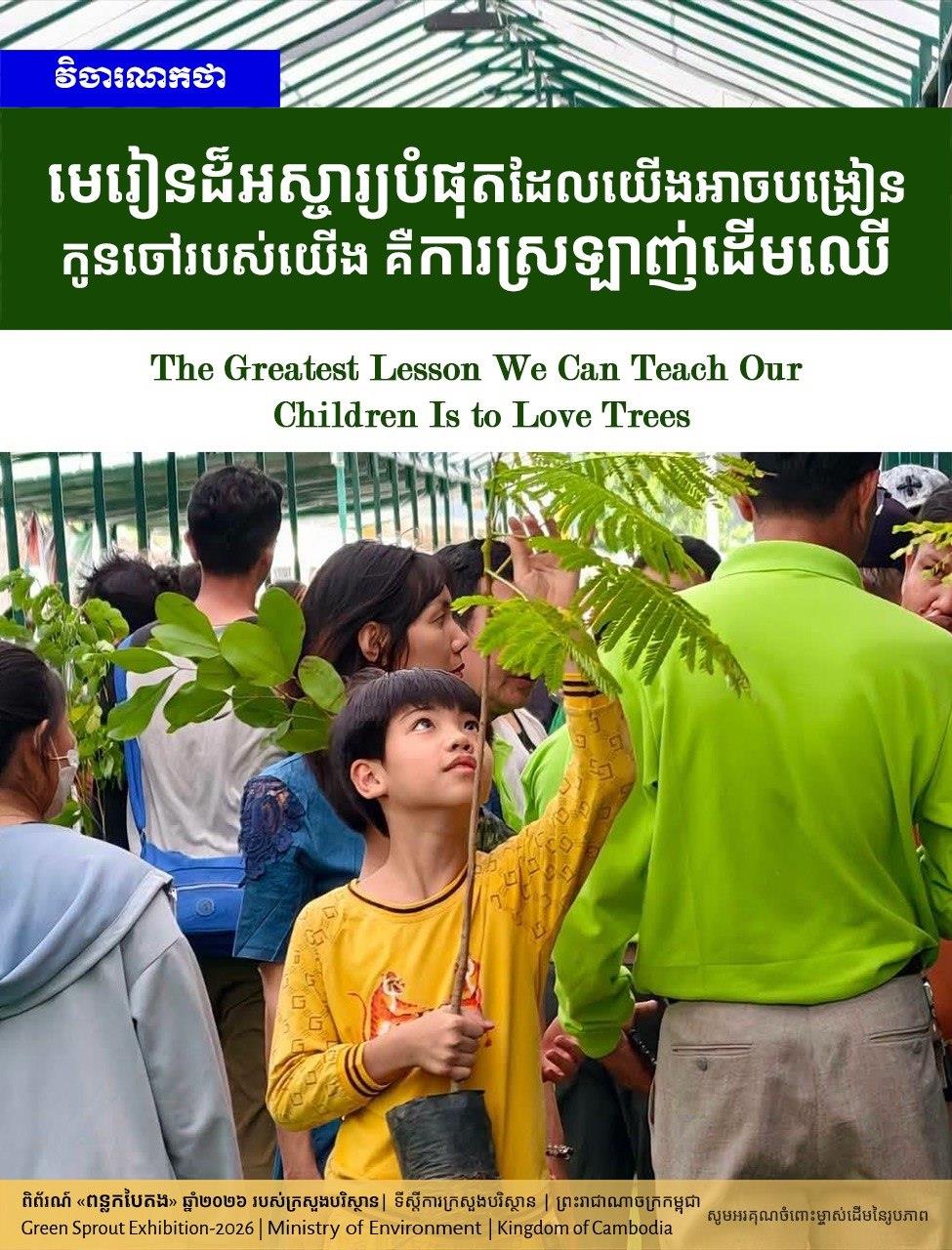

(Phnom Penh): There are many things we teach our children. We teach them to read and to write. We teach them mathematics, science, history, and technology. These lessons prepare them to make a living.
But there is another lesson, perhaps the most important of all, that prepares them to live.
It is the lesson of loving trees.
A tree is much more than wood, leaves, and branches. It is life itself. It breathes so that we may breathe. It stands silently through storms so that generations after us may find shelter beneath its shade. It asks for nothing, yet gives everything.
The greatest environmental policy does not begin with laws. It begins with love.
When a child loves a tree, that child will never cut down a forest without reason. When a child admires the beauty of nature, that child will never willingly destroy it.
Love is the strongest form of protection. It needs no enforcement, because it comes from within.
That is why environmental education must begin with the heart before it reaches the mind.
Imagine a young student gently placing a small sapling into the earth. To an adult, it may seem like an ordinary activity.
But to that child, something extraordinary has happened. For the first time, the child realizes that life can be created, nurtured, and protected by his or her own hands.
Every drop of water poured onto that young tree becomes a lesson in responsibility.
Every new leaf becomes a lesson in hope.
Every growing branch becomes a lesson in patience.
And every year the tree survives becomes a reminder that great things are built not in a single day, but through continuous care.
In teaching children to love trees, we are not simply growing forests. We are growing character.
Trees teach humility. The tallest tree begins as the smallest seed.
Trees teach generosity. They offer shade even to those who never planted them.
Trees teach resilience. They bend before the wind, yet continue to grow toward the light.
Trees teach unity. Beneath every forest lies a network of roots, each supporting the others, reminding us that strength comes through connection rather than isolation.
These are lessons no textbook can fully explain.
Today’s children will become tomorrow’s leaders, scientists, teachers, farmers, entrepreneurs, engineers, and policymakers.
One day they will make decisions that shape our nation’s future. If they grow up loving trees, those decisions will naturally protect forests, rivers, wildlife, clean air, and the climate.
The future of our environment depends not only on the trees we plant today, but on the values we plant in our children.
This responsibility belongs to all of us.
Parents can introduce children to the beauty of nature by planting trees together at home and spending time outdoors.
Teachers can transform school grounds into living classrooms where every tree tells a story of life, resilience, and hope.
Communities can celebrate tree planting not as a ceremony, but as a shared promise to future generations.
Governments can create opportunities for every child to plant and care for a tree, allowing environmental stewardship to become part of everyday life.
When these efforts come together, tree planting becomes more than an environmental activity, it becomes a national culture.
Our generation may plant millions of trees.
But if we can inspire millions of children to love trees, those children will protect billions of trees throughout their lives.
That is the true secret of lasting conservation.
The world today faces rising temperatures, changing climates, disappearing forests, and declining biodiversity.
These challenges cannot be solved by technology alone. They require a generation that sees nature not as a resource to be consumed, but as a family to be protected.
The strongest roots of a forest are not found beneath the soil.
They are found within the hearts of the children who will one day inherit it.
So let every school become a garden of learning.
Let every classroom have a window that opens to nature.
Let every student plant at least one tree.
And let every tree remind every child that they are not separate from nature, they are part of it.
One day, long after we are gone, those children will walk beneath the shade of the trees they planted in their youth. They will tell their own children, “I planted this tree when I was a student.”
That tree will stand as a living memory of hope, responsibility, and love.
Because in the end, the greatest gift we can leave the next generation is not wealth or monuments.
It is a greener Earth, a cleaner environment, and a heart that has learned to love every tree.
For when we teach a child to love a tree, we are not merely planting a seed in the ground.
We are planting hope in humanity.
=FRESH NEWS