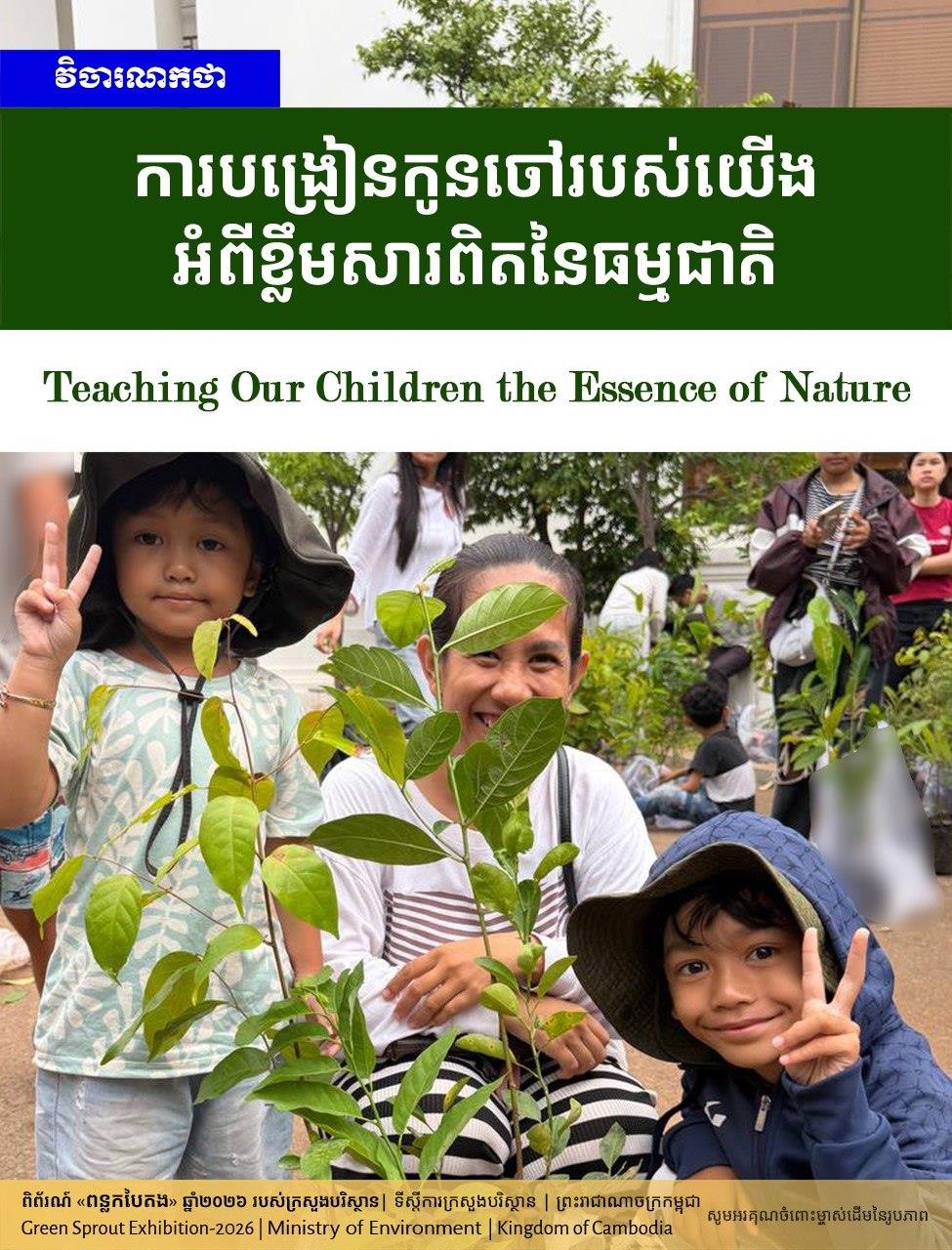

(Phnom Penh): There is an old saying that if we wish to shape the future, we must first shape the hearts of our children. Among all the lessons we can teach them, perhaps none is more enduring than helping them understand the essence of nature.
Nature is not merely the forests we visit, the rivers we cross, or the mountains we admire from afar. Nature is the very foundation of life. It is the air that fills our lungs, the water that sustains every living being, the soil that nourishes our food, and the sunlight that gives energy to the world. Before there were cities, roads, or technology, there was nature. And despite all our progress, our future still depends on it.
Yet many children today are growing up disconnected from this simple truth. They recognize the names of digital applications more easily than the names of native trees. They spend more time looking at screens than watching the clouds drift across the sky or listening to birds welcome the morning. As society advances, our connection with nature must not be left behind.
Teaching children the essence of nature is not simply teaching them about plants, animals, or ecosystems. It is helping them understand the relationship between humanity and the natural world. It is teaching them that every breath they take comes from a forest, every meal begins with healthy soil, and every drop of clean water depends on a protected watershed.
Nature also teaches values that no textbook alone can impart.
A seed teaches faith. Hidden beneath the soil, it grows without applause, trusting that light will eventually find it.
A tree teaches generosity. It offers fruit to the hungry, shade to the weary, and shelter to countless forms of life, never asking who deserves its gifts.
A river teaches perseverance. Though rocks stand in its path, it never abandons its journey to the sea.
A forest teaches community. Thousands of different species live together in balance, proving that diversity is not a weakness but a source of strength.
The changing seasons teach hope. After every drought comes rain. After every fallen leaf comes new life. Nature reminds us that renewal is always possible.
When children understand these lessons, they begin to see themselves differently. They no longer view nature as something outside themselves. They realize they are part of it. The health of the Earth and the health of humanity are inseparable.
This understanding changes behavior more effectively than rules alone. A child who truly understands the value of clean water will not waste it. A child who appreciates the role of forests will not destroy them. A child who learns to respect every living creature will grow into an adult who protects life in all its forms.
This is why families, schools, and communities all have a shared responsibility.
Parents can introduce children to nature through simple experiences: planting a tree, growing vegetables, watching butterflies, walking through a forest, or enjoying the quiet beauty of sunrise and sunset. These moments often become life’s most meaningful lessons.
Schools can transform environmental education from theory into experience. Every school garden, every tree-planting activity, every visit to a protected area, and every lesson held beneath the shade of a tree allows children to experience the living classroom that nature provides.
Communities can create parks, green spaces, and conservation activities where children learn not only to enjoy nature but also to care for it. When an entire community values nature, children naturally adopt the same values.
The challenges facing our world today—climate change, pollution, biodiversity loss, and water scarcity—cannot be solved by science and technology alone. They also require wisdom, compassion, and responsibility. These qualities are cultivated not only in classrooms but through a lifelong relationship with nature.
The greatest environmental legacy we can leave is not simply millions of trees planted or thousands of hectares of forest protected.
It is a generation of young people who instinctively understand that protecting nature means protecting themselves, their families, their nation, and future generations.
The essence of nature is ultimately the essence of life itself.
It teaches us that everything is connected. The river depends on the forest. The forest depends on healthy soil. Wildlife depends on clean habitats. Humanity depends on all of them.
When one part suffers, the whole system is weakened.
When one part flourishes, all life benefits.
Let us therefore teach our children not only to admire nature, but to understand it; not only to use its gifts, but to protect them; not only to live on the Earth, but to live in harmony with it.
For the future of our nation will not be determined solely by the knowledge our children possess.
It will be determined by the wisdom they carry in their hearts.
And perhaps the greatest wisdom of all is to recognize that nature is not something we inherited from the past.
It is something we are entrusted to preserve for the future.
When we teach our children the essence of nature, we do more than educate a generation.
We nurture a civilization that understands the profound truth that to care for nature is to care for life itself.
=FRESH NEWS