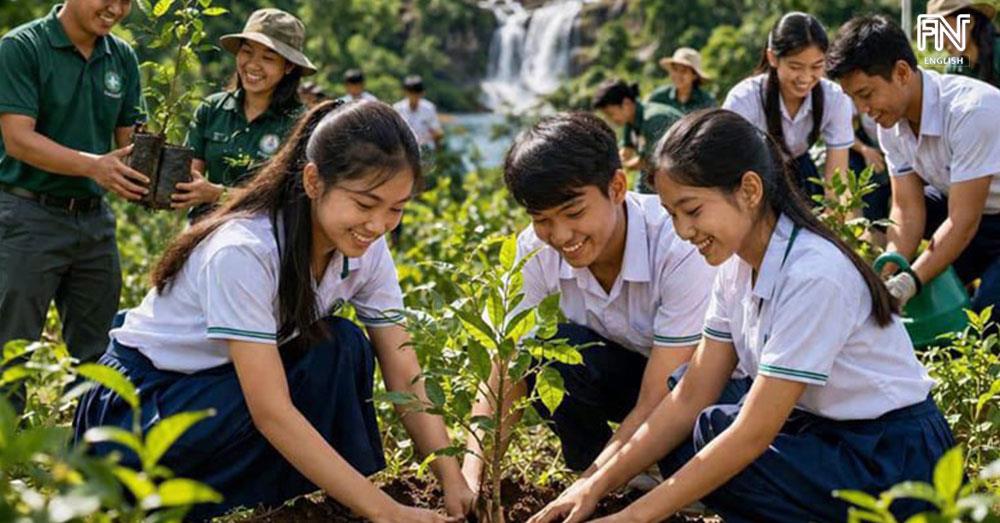

(Phnom Penh): Protecting the environment is one of the greatest responsibilities of our generation. Clean air, safe water, healthy forests, rich biodiversity, and a stable climate are not luxuries, they are the foundation of human health, economic prosperity, and national security.
Safeguarding them requires more than government action alone. It requires the participation of every sector of society, especially civil society.
Civil society is the bridge between government and the people.
It includes community organizations, non-governmental organizations, professional associations, youth groups, women’s organizations, religious institutions, volunteer networks, academic institutions, foundations, and countless citizens who dedicate their time, knowledge, and energy to improving society.
Their strength lies not in authority, but in trust, commitment, and their close connection to local communities.
When civil society participates in environmental protection, remarkable things happen.
Communities become more informed about environmental challenges. Citizens gain a better understanding of waste management, forest conservation, biodiversity protection, climate change, clean water, and pollution prevention.
Awareness leads to understanding, understanding inspires action, and action creates lasting change.
Civil society has the unique ability to reach people where government programs may not always reach.
Volunteers organize community clean-up campaigns, educate families about reducing plastic waste, encourage tree planting, promote recycling, restore wetlands, protect wildlife, and inspire people to adopt environmentally responsible lifestyles. These efforts create a culture in which protecting nature becomes a shared social value.
Education is one of civil society’s greatest contributions.
When environmental knowledge is shared through schools, community meetings, religious gatherings, youth activities, and public campaigns, people begin to understand that environmental protection is not someone else’s responsibility, it belongs to everyone.
A community that understands the value of nature is far more likely to protect it.
Civil society also strengthens accountability. Community members often become the first to notice illegal dumping, forest destruction, wildlife trafficking, pollution, or activities that threaten natural resources.
By reporting concerns through appropriate channels and working constructively with authorities, they become valuable partners in safeguarding the environment. Their participation helps ensure that environmental laws are respected and that natural resources are managed responsibly.
Equally important, civil society brings innovation. Many organizations develop practical solutions to local environmental challenges, from community recycling systems and mangrove restoration projects to clean energy initiatives, sustainable farming, environmental education, and ecotourism.
These locally driven solutions often inspire broader national efforts because they are built upon community knowledge and experience.
Environmental protection is strongest when it is based on cooperation rather than confrontation.
Governments establish policies and enforce laws. Businesses develop cleaner technologies and invest in sustainable practices. Academic institutions contribute scientific research and innovation.
Civil society mobilizes communities, builds public trust, and transforms environmental responsibility into everyday action. Each partner has a unique role, and together they create lasting progress.
The greatest environmental achievements are rarely accomplished by one institution alone. They are the result of countless individuals choosing to work together toward a common purpose.
Every volunteer who plants a tree, every organization that educates a village, every youth group that cleans a river, every religious leader who encourages respect for nature, and every community that protects its local forest contributes to a healthier nation.
Participation also builds social unity. Environmental activities bring together people of different backgrounds, professions, ages, and beliefs. When communities work side by side to improve their surroundings, they strengthen trust, cooperation, and a shared sense of responsibility. The environment becomes a common cause that unites rather than divides.
The challenges we face today, plastic pollution, climate change, biodiversity loss, water pollution, and land degradation, are too large for any single institution to solve alone. But they are not too large for a united society.
Every citizen has something to contribute. Some contribute scientific knowledge. Others contribute financial resources. Many contribute time, effort, compassion, and dedication. No contribution is too small when it helps protect the environment.
A cleaner environment is not created by government alone. It is created when citizens become partners, when communities become stewards, and when civil society transforms awareness into action.
The future of our nation depends not only on the policies we adopt but also on the values we practice. When civil society participates actively in environmental protection, it strengthens democracy, builds resilient communities, protects public health, and preserves nature for future generations.
The message is simple: Government can lead, but lasting environmental protection is achieved when civil society walks alongside it. Together, with shared purpose and shared responsibility, we can build a nation that is cleaner, greener, more sustainable, and healthier for all.
=FRESH NEWS