
(Phnom Penh): The world has no shortage of wars demanding our attention. Iran, Ukraine and Gaza dominate the headlines. Yet other conflicts, less visible but still dangerous, risk being treated as local problems of no concern to the rest of the world. The Cambodia-Thailand border crisis deserves more attention.
One year after fighting escalated along our border, the crisis is far from over. The guns and rockets are silent, yet Thai forces remain on Cambodian sovereign territory. Tens of thousands of Cambodian families still cannot return home. Schools, farms, health services and businesses in affected border areas cannot operate normally.
The ceasefire is important, but it must lead to permanent peace. That requires the safe return of Cambodian families, respect for sovereignty, and full implementation of the commitments both sides have already made.
Recent events show why dialogue must continue. After the ceasefire reached on Dec. 27, Thai armed forces together with Thai local authorities carried out many illegal activities such as demolishing the homes of Cambodian citizens and administrative buildings of Cambodia, prohibiting Cambodian citizens from returning to their homes, conducting land surveying activities to allocate plots to Thai citizens, laying barbed wire, placing shipping containers, conducting excavation and land filling operations, removing ponds, digging canals, clearing land and constructing roads. Such unilateral actions during a ceasefire reduce trust and risk undermining the path to permanent peace.
For Cambodian families, the yearlong crisis has had severe consequences. Last year's fighting, including renewed clashes in December, displaced over 649,000 civilians. As of late June, more than 21,400 people remain displaced, uncertain when they can safely return home. Cambodia's cultural heritage also suffered, with significant damage to the Temple of Preah Vihear, a UNESCO World Heritage Site.
The ceasefire is not the end of the story. This dispute must be resolved through law and evidence, not unilateral action. The international boundary between the two countries was delimited and demarcated by the Franco-Siamese Convention of 1904 and the Treaty of 1907, as well as the maps at scale 1:200,000, which are the result of the demarcation work carried out by the Commissions of Delimitation of the Boundary between Indo-China and Siam. Siam, Thailand's predecessor state, was a party to those agreements and participated in the subsequent boundary process.
The maps prepared by the commissions remain central to Cambodia's legal position. In 1962, the International Court of Justice found that Thailand had accepted the key map placing the Temple of Preah Vihear in Cambodia, and confirmed Cambodian sovereignty over the temple. In 2013, the court clarified that its 1962 judgment covered the whole promontory of Preah Vihear. French archives contain records and maps that can help both countries verify the border using historical evidence. The recent statement by the Thai prime minister rejecting the recognition of these mapsindicates a disregard for binding international jurisprudence and established principles of international law.
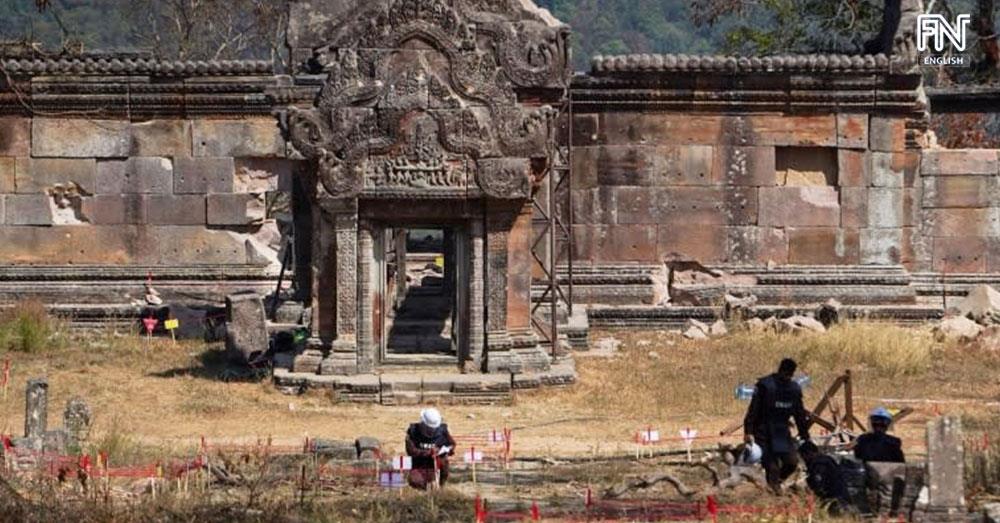
Members of the Cambodian Mine Action Centre work at Preah Vihear temple, a UNESCO World Heritage site on the border between Thailand and Cambodia, where cluster munitions and unexploded artillery shells were marked around the temple grounds following clashes between the two countries, in Preah Vihear province, Cambodia, on Feb. 12.
If Thailand now disputes parts of the border, there is already an agreed way to address that: the Joint Boundary Commission (JBC). Cambodia welcomes the continued engagement of the JBC and urges both sides to fully implement the joint statement of Dec. 27, 2025, especially its call for the prompt resumption of survey and demarcation work under existing agreements. No soldier or official can decide the border by pointing to a spot on the ground. The boundary must be settled through the peaceful mechanism that both countries accepted.
The same principle applies to the sea. Cambodia and Thailand have an unresolved maritime boundary in the Gulf of Thailand, an area with significant oil and gas potential. In 2001, both countries agreed to a process for addressing this issue, but Thailand has since withdrawn from it. Cambodia responded by pursuing a peaceful legal process under the United Nations Convention on the Law of the Sea (UNCLOS). That process does not impose a settlement. It gives both sides a structured way to receive recommendations and return to negotiations.
Turning to the law is not escalation. It is a peaceful way to prevent further conflict.
There are also economic costs to the ongoing dispute. Cambodia and Thailand are key links in regional supply chains used by global companies. Border closures have resulted in lost income for workers and uncertainty for businesses. Investors can manage ordinary risk, but repeated border disruptions make planning harder and harm trade on both sides.
ASEAN has an important role to play. Cambodia welcomes ASEAN observers who help reduce tension and support the peaceful settlement of disputes. That role is most effective when it remains impartial and respects the legal positions of both countries. No observer visit should be presented as acceptance of occupation or as evidence that the border has changed.
Peace is not secured solely by the absence of gunfire. It is achieved when families can return safely, and both sides rely on law, not force, to manage the border. Cambodia does not seek confrontation with Thailand. Our people are connected by history, geography and daily life. The border should be a place where people can live, go to school, farm their land and trade safely, not a line of permanent fear.
One year after the fighting began, the ceasefire must lead to a just and lasting peace based on sovereignty and the safe return of Cambodian families.
Prak Sokhonn is deputy prime minister and minister of foreign affairs and international cooperation for the Royal Government of Cambodia.
This article was originally published on Nikkei Asia.
=FRESH NEWS