
(Phnom Penh): One year after war erupted along the Cambodia–Thailand border, one of the messages that captured international attention did not come from a politician or a military commander. Instead, it came from Hollywood actress and humanitarian Angelina Jolie, who has maintained a deep and enduring connection with Cambodia for more than two decades.
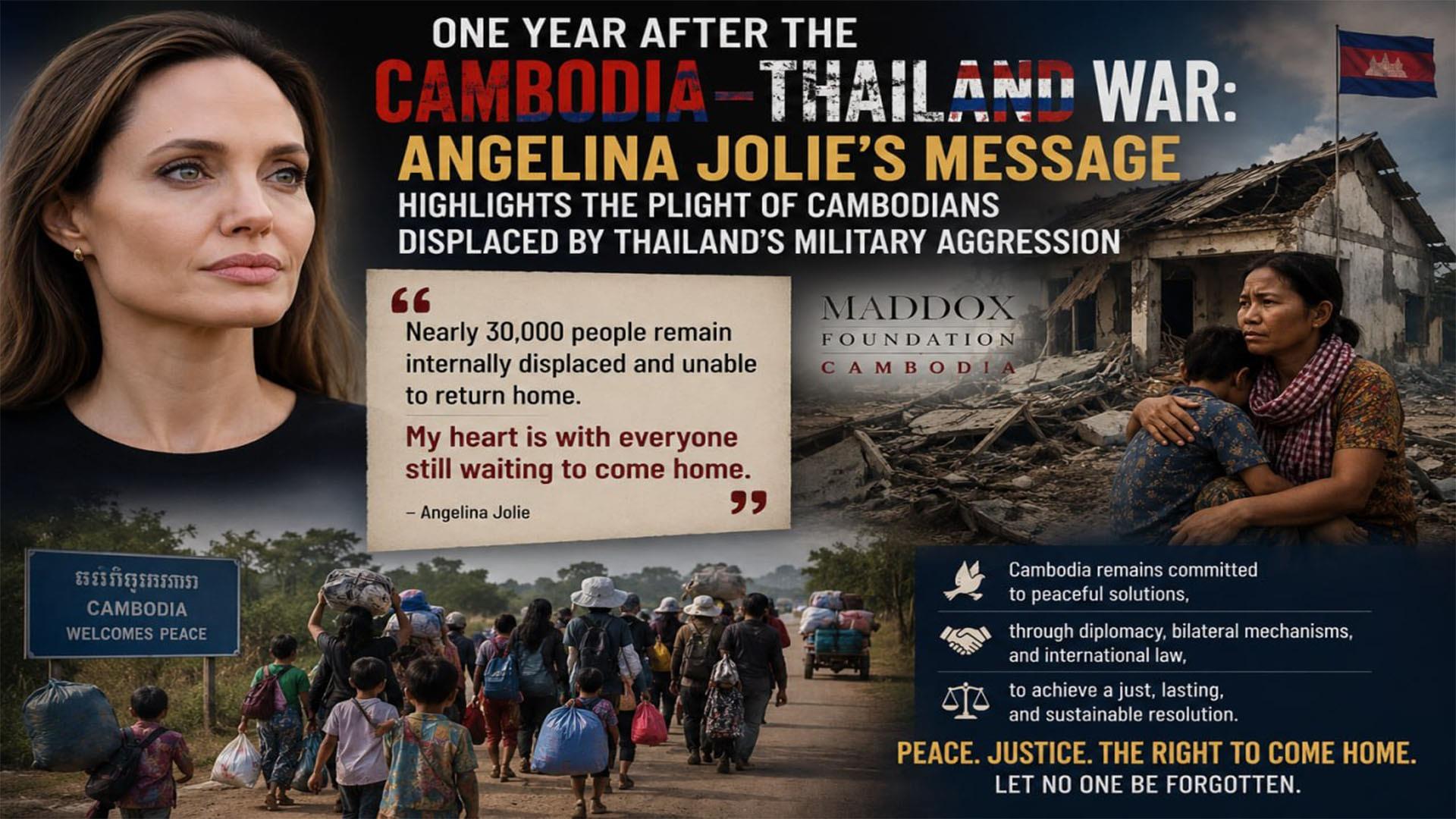
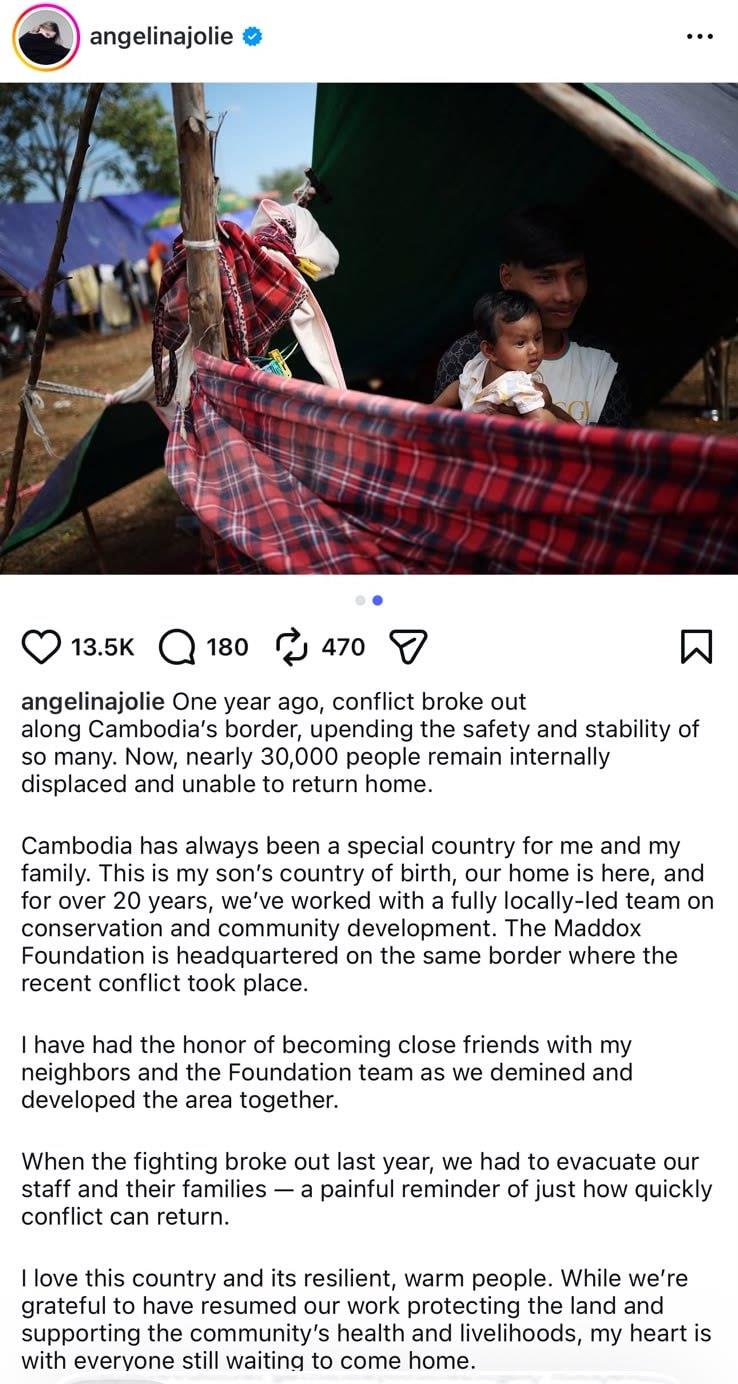
Rather than speaking about military victories or defeats, Jolie focused on the human cost of the conflict. She wrote that "nearly 30,000 people remain internally displaced and unable to return home," adding, "My heart is with everyone still waiting to come home."
These simple yet deeply moving words reflected not only her compassion for Cambodian civilians forced from their homes by the war resulting from Thailand's military aggression, but also the profound bond she has developed with Cambodia and its people through decades of living, working, and engaging with local communities. Her message was more than an expression of sympathy from afar; it was the heartfelt voice of someone who regards Cambodia as part of her own life and family.
Jolie's statement did not dwell on military strategy or political confrontation. Instead, it drew attention to the humanitarian consequences of the conflict. At the same time, it provides an opportunity to reflect on Cambodia's approach to resolving the border dispute over the past year. Although the conflict has not yet been fully resolved, Cambodia has consistently maintained that diplomacy, mutually agreed bilateral mechanisms, and international law should remain the primary means of resolving disputes, rather than allowing the use of force to become the final answer.
Jolie's message serves as a reminder that the greatest victims of war are not governments or armies, but ordinary people whose lives have been uprooted by violence. It also highlights a broader question: how should a border dispute be resolved so that those displaced by conflict can safely return home?
Over the past year, Cambodia has consistently argued that lasting peace cannot be achieved through military means alone. Instead, it has sought to defend its sovereignty while simultaneously pursuing diplomatic engagement, peaceful dispute-settlement mechanisms, and international law. From Cambodia's perspective, these approaches are not signs of weakness, but essential foundations for a durable and just peace.
The Humanitarian Message: A Reminder of the Value of Peace
Angelina Jolie is not an outside observer who has only recently become familiar with Cambodia. For more than two decades, she has worked in the country on nature conservation, community development, and humanitarian demining initiatives. She also noted that the Maddox Foundation is headquartered in the very border region where the recent conflict took place.
Reflecting on the outbreak of the fighting, Jolie wrote:
“When the fighting broke out last year, we had to evacuate our staff and their families — a painful reminder of just how quickly conflict can return.”
Her remarks not only reflect the Foundation's own experience, but also illustrate how the conflict disrupted the lives of Cambodian civilians and interrupted years of community development and conservation efforts in the affected border areas.
Rather than discussing military operations or political calculations, Jolie's message focused on those who continue to bear the heaviest burden of war—the civilians who lost their homes, livelihoods, and sense of security. In doing so, she reminded the international community that behind every border conflict are human lives waiting for peace to return.
One Year On: Cambodia's Choice of Non-Violence and International Law
One year after the outbreak of the border conflict, Cambodia has continued to uphold a policy of defending its sovereignty and territorial integrity while consistently emphasizing peaceful means of dispute settlement.
Throughout the past year, senior Cambodian leaders have repeatedly reaffirmed that Cambodia will not abandon what it considers its legitimate claims concerning sovereignty and territorial integrity. At the same time, they have maintained that these claims should be pursued through peaceful means, in accordance with the Charter of the United Nations and the principles of international law.
This position reflects the view that, although military force may alter the situation on the battlefield temporarily, it cannot resolve the underlying causes of a territorial dispute. A durable settlement requires dialogue, confidence-building between the parties, and respect for legal principles that both sides have accepted.
A clear example emerged during the past year in the debate surrounding Cambodia's initiation of compulsory conciliation proceedings under the United Nations Convention on the Law of the Sea (UNCLOS). Cambodia has maintained that these proceedings concern only the maritime dispute and do not preclude continued negotiations over the land boundary. The reason is straightforward: land and maritime boundary issues are governed by different bodies of international law and are subject to separate dispute-settlement mechanisms.
Regarding the land boundary, both countries continue to have the Joint Boundary Commission (JBC), established under the 2000 Memorandum of Understanding, which was reaffirmed in the ceasefire agreement of 27 December 2025.
Through this approach, Cambodia has argued that diplomacy and international legal mechanisms are not mutually exclusive. Rather, bilateral negotiations and international legal processes can operate in parallel, complementing one another in managing disputes peacefully while reducing the risk of renewed confrontation.
Angelina Jolie's Message and the Lessons for the Future
When Angelina Jolie wrote, “I love this country and its resilient, warm people,” and added, “My heart is with everyone still waiting to come home,” she was expressing more than her personal affection for Cambodia. Her words underscored a universal humanitarian truth: the people who lose their homes because of war should never be forgotten, and lasting peace should ultimately be measured by whether they are able to return home safely and with dignity.
In this context, Cambodia's position over the past year has centered on seeking a peaceful resolution to the dispute. Although the conflict has not yet been fully resolved, Cambodia has continued to pursue dialogue, existing bilateral mechanisms, and international legal processes in parallel, with the aim of safeguarding its sovereignty and territorial integrity while promoting a durable and peaceful settlement.
One year after the outbreak of the conflict, Jolie's message serves as a reminder that war inevitably drives people from their homes. Yet helping them return requires more than the cessation of hostilities. It requires dialogue, diplomacy, mutual trust, and respect for international law as the foundation for a lasting peace.
Conclusion
One year after the war, the words that carry the greatest meaning are perhaps not “victory” or “defeat,” but rather “coming home”—the hope that Angelina Jolie so poignantly expressed.
For civilians forced to flee their homes, returning home requires more than simply ending the fighting. It demands a peaceful resolution of the dispute, confidence-building between the parties, and solutions grounded in diplomacy and international law.
Over the past year, Cambodia has consistently expressed its belief that those displaced by the conflict and now living in temporary relocation communities will one day be able to return to their homes and communities through a peaceful settlement based on diplomacy and international law. This hope resonates with Jolie's message: “My heart is with everyone still waiting to come home.”
Her words also serve as a reminder to the international community that people affected by war should not be forgotten. Supporting efforts to achieve a peaceful, lawful, and lasting resolution is essential—not only to uphold justice and stability, but also to ensure that displaced families can return home safely, rebuild their lives with dignity, and look toward the future with hope.