
(Phnom Penh): One year ago, the Cambodia–Thailand border became a place where the sound of gunfire replaced the rhythms of everyday life. The war claimed lives, destroyed homes and forced tens of thousands of people to flee their communities.
One year later, messages from the international community are no longer focused on battlefields or military victory. Instead, they are centered on a more meaningful question: When will the displaced be able to return home?
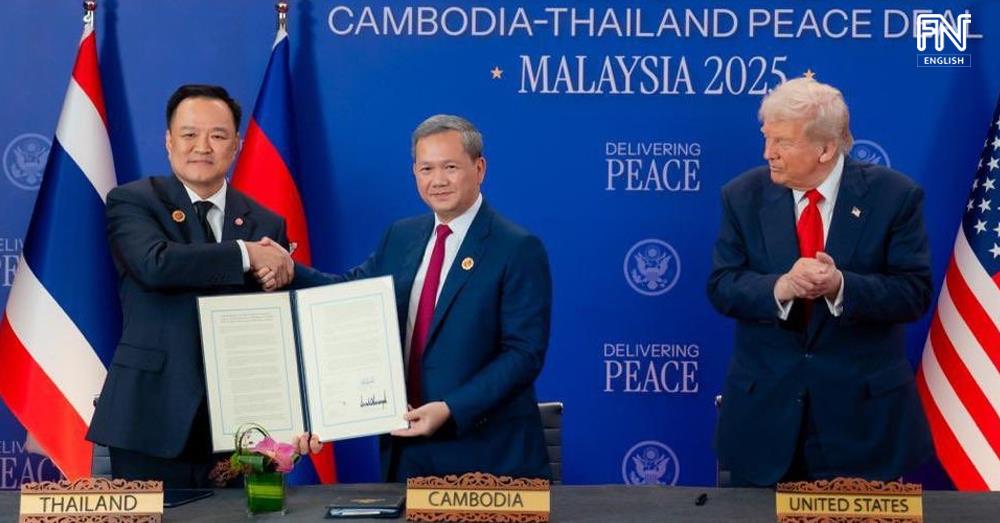
On the first anniversary of the conflict, the United States Embassy in Cambodia reaffirmed that Washington remains committed to “strengthening lasting peace” between Cambodia and Thailand through continued support for diplomatic efforts and the implementation of the Kuala Lumpur Peace Accords.
Several days before the US Embassy issued its message, Hollywood actress Angelina Jolie, who has maintained close ties with Cambodia for more than two decades, also drew attention to the fact that nearly 30,000 Cambodians remain unable to return to their homes.
She wrote: “My heart is with everyone still waiting to come home.”
The two messages are not unrelated. Together, they indicate that one year after the war, international attention is shifting away from discussions of military confrontation and towards the construction of peace and the creation of conditions that would allow affected civilians to return home safely.
Peace Neither Begins Nor Ends With a Ceasefire
One year ago, a ceasefire agreement was reached through the mediation of US President Donald Trump, with Malaysian Prime Minister Anwar Ibrahim acting in his capacity as the rotating chair of ASEAN, and with China participating as a witness.
The agreement halted direct fighting between Cambodia and Thailand and opened the way for both sides to return to diplomatic mechanisms to address the dispute.
However, the cessation of hostilities was only the first step. The experience of conflicts around the world shows that a war may be halted by an agreement, but genuine peace does not emerge automatically.
It requires the good-faith implementation of agreements, the rebuilding of trust between the parties and the continued resolution of outstanding issues through peaceful means.
This may help explain why, in its message marking the first anniversary of the Cambodia–Thailand border conflict, the US Embassy did not speak of “victory” or “defeat.” Instead, it emphasised a commitment to “strengthening lasting peace.”
The message suggests that the objective is not merely to prevent renewed fighting, but to ensure that the conflict does not return and that those affected by the war are able to live in safety and return to their communities with hope.
Angelina Jolie’s Message Is a Reminder That the War Is Not Yet Over for the Displaced
While the United States Embassy reaffirmed its commitment to “strengthening lasting peace” between Cambodia and Thailand, Angelina Jolie’s message added a humanitarian perspective, reminding the public that peace cannot be considered complete while displaced families remain unable to return home safely.
Her message did not focus on military strategy or political negotiations. Instead, it focused on people—the real victims of war.
Jolie recalled that when the fighting broke out, staff members of the Maddox Foundation and their families had to be evacuated from the border region. For her, it was “a painful reminder of just how quickly conflict can return” if peace is not continuously protected and strengthened.
Even more significant was her observation that “nearly 30,000 people remain internally displaced and unable to return home.”
That single sentence illustrates that, for displaced families, the war is not yet over. As long as they remain unable to return to their homes in safety and dignity, peace cannot be considered complete.
If the United States’ message expressed a commitment to building “lasting peace,” Jolie’s message served as a reminder that such peace must ultimately be measured by its impact on human lives.
In the end, genuine peace should not be measured merely by the length of time during which the guns remain silent. It should be measured by the day displaced families can return home safely and with renewed hope.
Cambodia Continues to Choose Diplomacy and International Law
Over the past year, Cambodia has repeatedly stated that the defence of its sovereignty and territorial integrity must proceed alongside the peaceful settlement of disputes.
This position is based on the continued use of existing bilateral mechanisms, negotiations and international legal processes, with the aim of reducing the risk of renewed military confrontation and achieving a durable, long-term settlement.
This approach is also consistent with the fundamental principles of the United Nations Charter, which call on states to settle international disputes through peaceful means.
In the context of the Cambodia–Thailand border dispute, this means that lasting peace cannot depend solely on a ceasefire or a balance of military power. It must also rest on respect for international law, the good-faith implementation of agreements and sustained dialogue between the two sides.
Cambodia’s position also corresponds with the message of the US Embassy, which called for the strengthening of “lasting peace,” and with Jolie’s reminder that peace cannot be considered complete while tens of thousands of displaced people remain unable to return home.
On the first anniversary of the ceasefire, Cambodian Prime Minister Hun Manet offered another interpretation of the conflict’s domestic impact. He said that, contrary to the expectations of some, the border war had neither weakened nor divided Cambodia, but had instead made the country stronger.
He said: “Some people believed that this border conflict would bring down the Cambodian People’s Party. In particular, they thought that the Hun family would lose power because of the border issue. They expected us to be defeated. But that has not happened. Neither the Cambodian People’s Party nor Cambodia has been divided. On the contrary, this spirit of nationalism has made Cambodia even stronger under the leadership of the Royal Government led by the Cambodian People’s Party, because it serves the common interest of our nation.”
The remarks reflect the government’s interpretation that the border conflict was not only a security challenge, but also a factor that strengthened national unity and reinforced the government’s determination to pursue reform and development for future generations.
From this perspective, defending sovereignty, strengthening national resilience and pursuing peace are not contradictory objectives. They are parallel processes that must advance together if a sustainable settlement is to be achieved.
Messages From Hollywood, the United States and Cambodia Converge on a Common Principle
A closer examination shows that, one year after the war, three important messages from different sources have converged around a shared principle concerning the future of peace along the Cambodia–Thailand border.
The United States reaffirmed its commitment to “strengthening lasting peace.” Angelina Jolie reminded the world that tens of thousands of displaced people remain unable to return home.
Cambodia, meanwhile, has continued to insist that the defence of sovereignty and territorial integrity must proceed in parallel with diplomatic and legal efforts to resolve the dispute. Prime Minister Hun Manet has also argued that the conflict did not weaken the country, but instead reinforced its determination to strengthen national resilience.
When these messages are considered together, it becomes clear that they differ in emphasis, but not necessarily in their broader objective.
The United States is focused on maintaining peace. Angelina Jolie is focused on alleviating the suffering of war victims. Cambodia is focused on defending sovereignty, pursuing a settlement through international law and strengthening national resilience in response to the challenge.
The three messages converge on one central principle: lasting peace cannot be created through force. It must be built through respect for international law, sustained dialogue, the preservation of national stability and the creation of conditions that allow those affected by war to return home in safety and dignity.
This may be the most important message one year after the war. Ending the fighting marks the beginning of a peace process, but genuine peace will be measured by the day the border becomes stable, international law is respected and displaced civilians can return to their land without fear.
Conclusion
One year after the war, the words that carry the greatest meaning may no longer be “victory” or “defeat,” but rather the pursuit of a peace that can enable displaced Cambodians to return home.
The United States’ commitment to “strengthening lasting peace,” Angelina Jolie’s reminder of the tens of thousands of displaced people, and the Cambodian government’s commitment to resolving the dispute through diplomacy and international law all convey the same fundamental message, despite coming from different sources.
Genuine peace is not defined only by silence on the battlefield. It is defined by security, dignity and the ability of civilians to return to their homes.
For that day to come, a ceasefire alone will not be enough. The parties concerned must continue to respect international law, implement their agreements in good faith and maintain peaceful dialogue.
Only then can peace become more than a phrase contained in diplomatic statements or written agreements. It must become a lived reality for those whose lives were disrupted by the war.
Ultimately, if the day comes when all displaced families can return home safely and the Cambodia–Thailand border can sustain a durable peace, only then can it truly be said that the war has ended under the conditions of genuine peace.