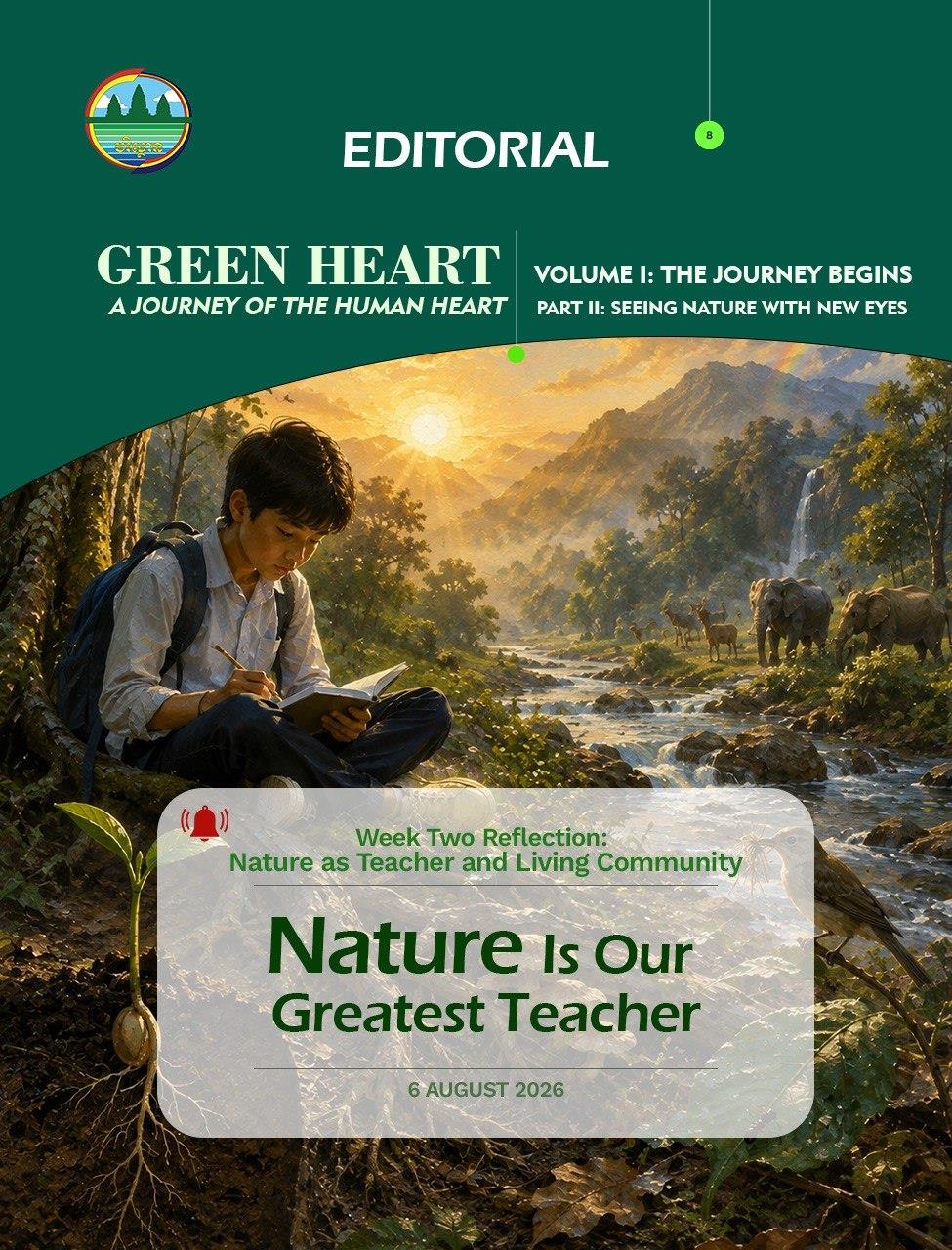

(Phnom Penh): Some classrooms have walls, desks, and a board. Nature’s classroom has clouds, roots, wings, sunlight, and rain. Its lessons are always present, yet we often hurry past without noticing them.
“Nature teaches quietly, but its lessons can guide an entire life.”
A seed teaches patience. It does not become a tree in one day. Hidden beneath the soil, it begins with changes too small for us to see. Growth takes time, nourishment, and the right conditions.
When our own progress feels slow, the seed reminds us that unseen effort can still be real.
A river teaches movement. It meets stones and bends around them. It may slow in one place and quicken in another, but it continues its journey. This does not mean we should simply accept every obstacle. It shows that strength can include flexibility.
A forest teaches community. Tall trees, young plants, fungi, insects, birds, and countless small organisms share one place. They do not all perform the same role. Their differences help the whole system live.
Human communities also become stronger when people contribute different abilities with mutual respect.
Nature is not a perfect moral guide. A storm can destroy. An animal may hunt another animal. We should not copy everything that occurs in the wild. Instead, we observe carefully and reflect wisely. Nature offers patterns, not commands.
To learn from nature, we must slow down. A student who sits quietly under a tree may notice shade moving across the ground, insects visiting flowers, or dry leaves becoming part of the soil. These observations awaken questions. Questions lead to knowledge, and knowledge deepens respect.
Technology and books can help us understand what we see, but direct experience gives that knowledge a heart. “A tree provides habitat” becomes more meaningful after watching a bird carry grass into its branches. “Soil holds life” becomes unforgettable after seeing a seedling rise from it.
The greatest teacher does not ask for payment. Nature asks only for attention and respect. Its lessons can make us patient, observant, humble, and grateful. When we approach the living world as students rather than owners, every garden, pond, field, and roadside tree can become a place of learning.
Today, let us enter that classroom. The lesson may be small. Perhaps a leaf will teach us how to receive light, or a cloud will remind us that all things change. If the heart is attentive, nature is always ready to teach.
Buddhist Reflection
Mindful observation is a path to insight. Buddhism encourages us to see change, dependence, and cause and effect in direct experience. Nature makes these truths visible: flowers open and fade, seasons pass, and life arises through conditions. Careful seeing can deepen both wisdom and humility.
Today’s Reflection
What lesson have I learned from observing a plant, animal, season, or landscape?
Today’s Action
Spend ten quiet minutes outdoors in a safe place. Write down three things you notice and one lesson they suggest.
Today’s Pledge
Today I will approach nature with the attention, respect, and humility of a student.
When we protect nature, we protect all beings, including ourselves.
=FRESH NEWS