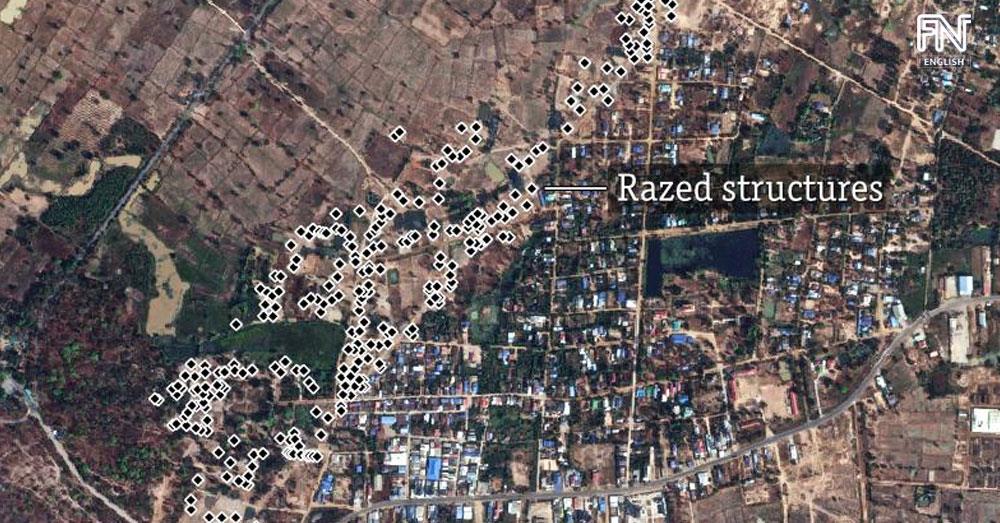

(Phnom Penh): LICADHO, a Cambodian rights group that documents abuses and publishes case records, said on Tuesday (Aug. 5) that satellite imagery it dates to around March 2026 shows Thai forces razed and cleared at least 627 homes and other structures in at least three villages along the border.
The group put the counts at 270 structures in Chok Chey, 299 in Boeung Trarkuon and 58 in Prey Chan, all in Banteay Meanchey, a Cambodian province bordering Thailand. It rested its legal case on Article 53 of the Fourth Geneva Convention, the 1949 treaty on protecting civilians in wartime, which bars an occupying power, meaning a state holding territory of another, from destroying property except where destruction is rendered absolutely necessary by military operations.
The comparison LICADHO published sets one frame captioned April 2025 against another captioned March 2026, a span that also holds the fighting both governments’ United Nations filings date to 7 to 27 December 2025.
The same Convention carries a procedure for establishing an alleged violation, and its wording splits the question in two. Article 149 says that at the request of a party to the conflict an enquiry shall be instituted, “in a manner to be decided between the interested Parties”.
The International Committee of the Red Cross, the neutral body that guards and interprets the Geneva Conventions, reads the first half as binding. In its 2020 commentary on that article, which is common to all four Conventions and numbered 149 in the Fourth, it records that the holding of the enquiry is compulsory once one belligerent has asked for it, and that the mechanism may be activated unilaterally and imposed on the adverse party.
The second half sets a condition. The commentary calls the requirement that the interested parties decide the manner “a major obstacle to its effective implementation”, and reads those parties as including the state whose conduct is to be investigated.
That condition is the reason the ICRC gives for what has happened since. The commentary records that the mechanism has “so far never been used”, proposed on only four occasions since 1929, and that the parties never actually set up an enquiry for lack of consent. It also records that Article 149 is not the Convention’s only route to a finding.
A state must redress a violation by its own forces whether or not the other side asks for an enquiry, and the formal procedure becomes necessary, on the ICRC’s reading, only where the existence of the violation is contested.
Article 146 requires every party to provide penal sanctions for grave breaches, the violations the Convention treats as most serious, and Article 147 counts extensive destruction of property not justified by military necessity among them.
Where fact-finding into such allegations has actually happened in recent decades, the commentary records, it has run through bodies set up by the United Nations or by regional organisations, which do not need the parties’ consent.
What the August count rests on differs from what the January one did. LICADHO’s January 2026 article used three-frame sets from the European Space Agency’s Sentinel-2 satellites. For Chok Chey the frames were dated 3 December 2025, 28 December 2025 and 12 January 2026, and for Boeung Trarkuon 3 December, 28 December and 17 January.
The August article rests instead on higher-resolution images LICADHO says became available after an update to Apple Maps and appear to have been taken around March 2026. Neither article sets out a counting method, on the versions read on 6 August 2026.
The August one says the images are shared without indicating the border claims of either Cambodia or Thailand, where the January one had placed the destruction in contested areas, on land both sides recognise as Thailand and on land both sides recognise as Cambodia.
Article 53 sits in the Convention’s section on occupied territories, and it attaches its prohibition to a status rather than to a state by name. Whether Thailand holds that status where the structures stood is the question the article turns on. Cambodia asserts it. Thailand rejects the accusations as groundless and places its measures inside Thai territory. Neither government’s filing points to a determination by a court, an arbitral body or a boundary mechanism.
The article also excepts destruction rendered absolutely necessary by military operations, and it names nobody to decide whether the exception applies.
Cambodia’s letter of 3 January 2026, circulated to the United Nations as A/80/587-S/2026/7, alleged that Thai armed forces were intensifying demolition of civilian and cultural structures at Prey Chan, Chouk Chey and Boeung Trakoun, the spellings the letter uses. It invoked Article 53 alongside Article 52 of Additional Protocol I, the 1977 treaty adding rules on how wars are fought, which the letter describes as prohibiting attacks on civilian objects.
The ICRC’s list of states parties to that Protocol, read on 6 August 2026, records Cambodia as a party from 14 January 1998 and does not list Thailand at any status. Whether the provision binds Thailand as customary law, meaning rules that bind states through general practice rather than a signed treaty, is a question these documents do not answer.
Thailand’s Permanent Representative replied in a letter dated 19 January 2026, circulated as A/80/593-S/2026/37, that all measures undertaken by Thai authorities were conducted within Thai territory at the time of the ceasefire, which that letter dates to the Joint Statement signed on 27 December 2025.
A second route runs through the same condition as the first. The International Humanitarian Fact-Finding Commission, a standing body created to investigate alleged war-law breaches, has automatic competence only between states that have made the declaration Article 90 of Additional Protocol I provides for, and the ICRC list records no such declaration by Cambodia and does not list Thailand as a party.
Article 90 then provides that in other situations the Commission shall institute an enquiry at the request of a party to the conflict only with the consent of the other party or parties concerned. So the door that non-participation shuts is the automatic one, and the door consent opens stays available to both.
The ICRC’s commentary records that the Commission has never been called upon to act by states, noting one enquiry it completed at the request of the Organization for Security and Co-operation in Europe into a 2017 incident in Ukraine.
Neither government’s filing mentions a request for an enquiry under Article 149. The commentary records that such a request may be communicated directly, or through a Protecting Power, a neutral state, the ICRC or any other impartial organisation, none of which publishes as a matter of course, so whether one has been made is not something the published record would necessarily show.
What the article does settle is who may make it. The request belongs to a party to the conflict, other states parties are not allowed to launch the procedure formally, and Article 149 names no route for an affected resident.
The first rung the record does not reach is the forum, because the article names none and leaves the manner to the parties. Burden, cost and access it does not address at all. The duty it does create, to put an end to a violation and repress it, is conditioned on the violation having been established.
The residents of Chok Chey, Boeung Trarkuon and Prey Chan carry this, and LICADHO, citing Cambodian government data from 2019, puts Chok Chey alone at 631 families and 2,586 residents, with the village’s primary school and Boeung Trarkuon’s health centre behind the emplacements Thai forces placed after the ceasefire. The other right they are told they hold is the right to return.
Tom Andrews, the independent expert appointed by the United Nations to report on human rights in Cambodia, said in his end-of-mission statement of 31 July 2026 that it is a matter of international law that those displaced by armed conflict have the right to return to their homes, and that residents told him they could not, because their villages and towns are occupied by Thai soldiers.
He named the instrument as well as the principle. The Joint Statement annexed to Thailand’s own United Nations letter commits both sides, at Point 4, to allow civilians in the affected border areas to return at the earliest, without obstruction and in safety and dignity, to their homes and normal livelihoods “in areas within their own side”.
Point 3 of the same document refers the survey and demarcation of the boundary to the Joint Boundary Commission, the body that surveys and marks the two countries’ land boundary, and gives first priority to the affected border areas where civilians resided. Thailand’s letter says it has strictly complied with the Joint Statement’s terms, and that its current troop positions are compliance with Point 2.
The record that would change this is a request for an enquiry under Article 149 and an agreement between the two governments on how it would run, or a demarcation under Point 3 that places the three villages on a side.
An enquiry under Article 149 would answer whether the Convention was broken. The line that Point 4 scopes the return commitment to is assigned in the same document to the Joint Boundary Commission, whose survey of these border segments the two governments agreed to treat as their first priority.
This article was first published on Midnight The Quiet Catalyst.
=FRESH NEWS