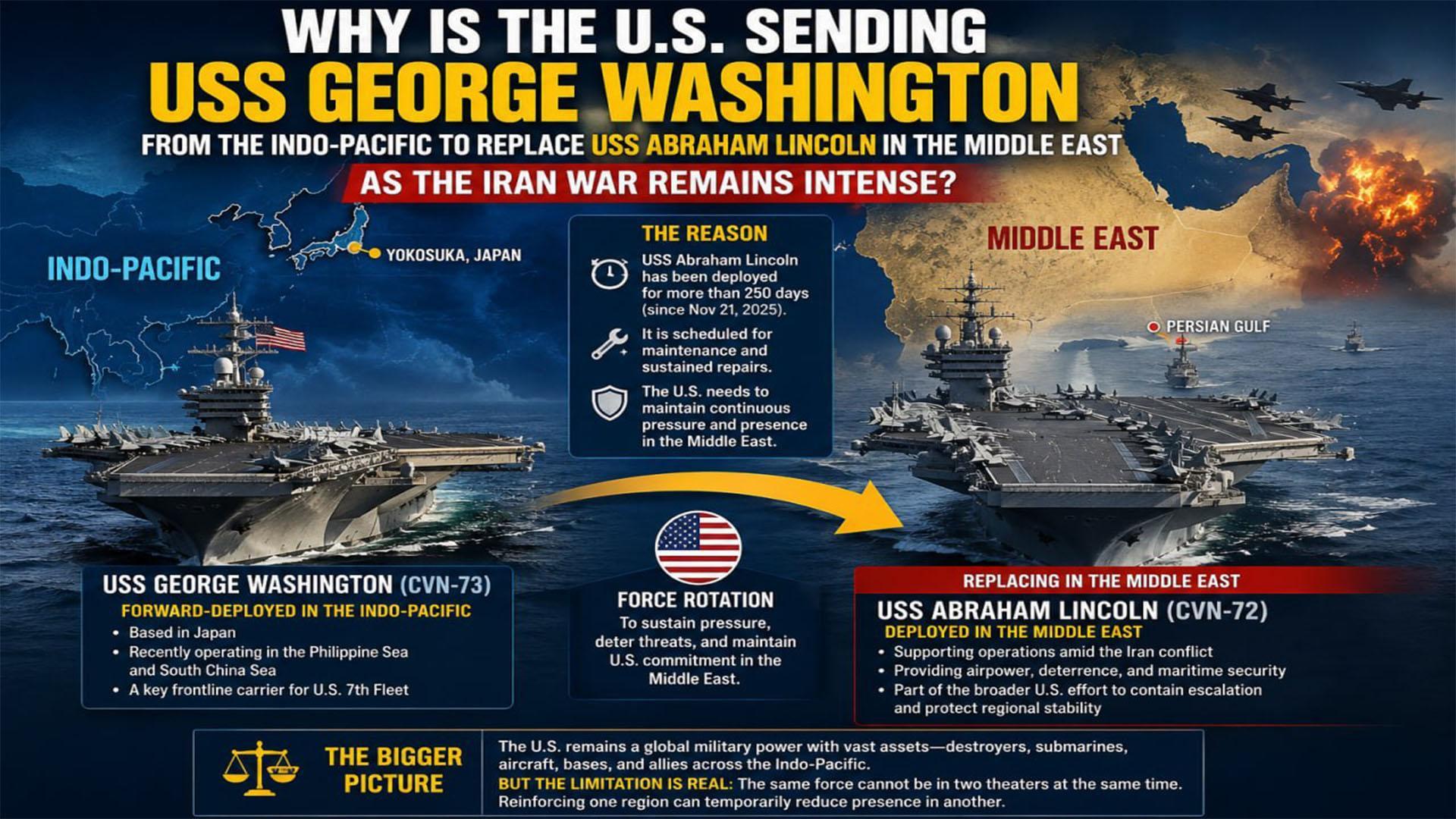

(Phnom Penh): In the middle of an intense war, militaries generally seek to avoid disrupting a core force already engaged in combat. Yet the United States is doing something that, at first glance, appears to run counter to that logic.
As the war with Iran continues and the U.S. Navy maintains military pressure in the Middle East, the aircraft carrier USS Abraham Lincoln, which has become a key component of U.S. operations in the region, is preparing to leave the theater.
At the same time, USS George Washington, a forward-deployed aircraft carrier based in the Indo-Pacific, is heading toward the Middle East to take its place.
The rotation comes amid reports of difficult living conditions, supply problems and mounting mental-health concerns among sailors aboard Abraham Lincoln following an unusually long deployment.
But does Lincoln's departure mean the carrier is no longer combat-capable? Or does it suggest that the United States is beginning to scale back military operations against Iran?
The answer, at least based on the evidence currently available, is no.
The deployment of USS George Washington to replace USS Abraham Lincoln should primarily be understood as a force rotation, rather than a military withdrawal. U.S. officials have said the replacement was planned in advance and was not an emergency decision prompted by recent reports of problems aboard Lincoln.
But the rotation raises a strategic question that extends far beyond the two carriers: Could George Washington's departure from the Indo-Pacific create a temporary gap in America's deterrence posture in Asia?
USS Abraham Lincoln Has Been at Sea for an Unusually Long Time
USS Abraham Lincoln departed San Diego on November 21, 2025. By mid-August 2026, its deployment had extended beyond 250 days, including roughly 200 days without a port call.
That matters because an aircraft carrier is not simply a massive steel warship whose engines can run indefinitely.
It is effectively a floating city, with thousands of sailors living and working around the clock. It carries aircraft, radar and weapons systems, maintenance facilities, kitchens, medical facilities, water-production systems and an enormous network of machinery and technology—all of which require continuous maintenance and logistical support.
Moreover, official U.S. Navy budget documents for fiscal year 2026 listed USS Abraham Lincoln for a Planned Incremental Availability (PIA), a scheduled period of maintenance and repair intended to preserve the ship's long-term operational readiness.
This illustrates an important distinction: the ability to fight and the ability to sustain operations indefinitely are not the same thing.
A carrier may still possess combat aircraft, weapons and strike capability. But as a deployment stretches over many months, pressure inevitably accumulates on the crew, machinery and supply system. Eventually, keeping a carrier at sea for too long can itself begin to erode operational readiness.
Lincoln's replacement by George Washington therefore does not necessarily indicate that Lincoln has lost its ability to fight or that Washington is reducing its military presence. Rather, rotating the carrier out can help prevent an extended deployment from degrading its future readiness.
U.S. Lawmakers Demand Answers About Conditions Aboard Lincoln
Concerns that initially emerged among sailors and their families have now reached the U.S. Congress.
Reports have cited shortages of basic supplies, problems involving water and plumbing, sanitation concerns, mail disruptions and growing worries over sailors' mental health.
U.S. lawmakers, including Representative Mike Levin, have demanded answers from Defense Secretary Pete Hegseth and Navy leadership over why sanitation problems were not addressed sooner, why sailors allegedly did not receive adequate mental-health support, and why concerns were not communicated earlier to families and appropriate government officials.
The issue carries additional weight because Lincoln carries nearly 5,000 personnel and has been deployed since November 2025. Extended deployments can place considerable strain on sailors, particularly when crews must remain at a heightened state of readiness amid threats from Iranian drones and missiles.
Hegseth, however, has rejected portrayals suggesting that conditions aboard Lincoln are collapsing, saying reports of deteriorating conditions have been “completely misrepresented.” He has maintained that the Navy is working to provide the ship and its crew with the resources they need.
There is therefore not enough evidence to conclude that living conditions or mental-health concerns aboard Lincoln caused the Pentagon to withdraw the carrier from the operational theater.
On the contrary, a U.S. official has said the deployment of USS George Washington to replace Lincoln was pre-planned.
That distinction is important. The reported problems aboard Lincoln may demonstrate the strain associated with a prolonged wartime deployment, but they should not automatically be treated as the cause of the carrier rotation.
George Washington Is Being Pulled From the Indo-Pacific to the Middle East
USS George Washington is not an idle aircraft carrier waiting in port for its next assignment.
It is a major forward-deployed component of U.S. naval power in the Indo-Pacific and is homeported at Yokosuka, Japan.
In June 2026, the carrier participated in Valiant Shield, a major exercise in the Philippine Sea aimed at strengthening joint operational capabilities among U.S. forces and partners in the western Pacific.
By late July, George Washington was still operating in the South China Sea before making a port visit to Da Nang, Vietnam.
Sending George Washington from the Indo-Pacific toward the Middle East therefore represents more than simply replacing one carrier with another.
It illustrates a fundamental strategic constraint that even the world's most powerful military must confront: The United States may possess enormous military power, but it cannot deploy all of that power everywhere at the same time.
An aircraft carrier cannot operate in two theaters simultaneously.
When George Washington is pulled from the Indo-Pacific to maintain U.S. carrier presence in the Middle East, a force previously assigned to operations in Asia is being redirected to meet an urgent requirement in another theater.
The war with Iran therefore imposes costs that extend beyond the Middle East. It requires Washington to decide which theater needs military assets most urgently—and where it can temporarily accept a reduced presence.
Does George Washington's Move Create a Strategic Gap in the Indo-Pacific?
The deployment of USS George Washington to replace USS Abraham Lincoln raises another important question: By removing a major aircraft carrier from the Indo-Pacific, is Washington creating a gap in its deterrence strategy in Asia?
The question matters because George Washington is not simply another carrier arriving from the continental United States. It is one of America's most important forward-deployed naval assets in Asia and is homeported at Yokosuka.
The issue becomes even more significant because the Indo-Pacific remains central to Washington's strategy of deterring China and reassuring U.S. allies.
In late May 2026, as George Washington began its summer operations, China's aircraft carrier Liaoning was also operating in the Philippine Sea east of Luzon.
The U.S. Navy regards USS George Washington as its forward-deployed aircraft carrier based in Japan. The carrier serves as the centerpiece of Carrier Strike Group 5 (CSG-5), a major forward-deployed combat formation within the U.S. Seventh Fleet.
That role was demonstrated on June 21, 2026, when the George Washington Carrier Strike Group participated in Valiant Shield 2026 with Japanese forces in the Philippine Sea. The U.S. Navy described the exercise as part of efforts to strengthen combined operational capabilities and demonstrate America's commitment to a free and open Indo-Pacific.
George Washington's diversion from Asia to the Middle East therefore means Washington is doing more than swapping one carrier for another. It is redirecting a strategically important military asset from one priority theater to meet an urgent requirement in another.
But George Washington's departure does not mean that the Indo-Pacific has been left undefended.
The United States continues to maintain destroyers, submarines, combat aircraft, military bases and substantial allied and partner forces throughout the region.
It is therefore more accurate to describe George Washington's departure as a temporary reduction in U.S. aircraft-carrier presence in the Indo-Pacific, rather than a complete defensive vacuum.
Nevertheless, that temporary reduction has strategic significance. An aircraft carrier provides mobile airpower and sea-based power projection that other individual naval platforms cannot fully replicate.
George Washington may therefore fill the space left by Lincoln in the Middle East, but doing so temporarily reduces America's carrier presence in the Indo-Pacific.
Conclusion
So why is the United States sending USS George Washington to replace USS Abraham Lincoln while the war with Iran remains intense?
The available evidence does not suggest that Washington is seeking to scale back or end its military operations in the Middle East. Nor is there sufficient evidence to conclude that Lincoln is being withdrawn because of reported internal problems aboard the carrier. The central reason is that Lincoln has been deployed for an unusually long period, and maintaining sustained U.S. military presence and pressure in the Middle East requires rotating a heavily used force out and bringing a fresh one in.
But the rotation raises a broader strategic question: Does sending George Washington to the Middle East weaken America's deterrence posture in the Indo-Pacific?
The answer is that it does not create a complete defensive gap.
The United States still maintains destroyers, submarines, combat aircraft, military bases and extensive allied and partner capabilities throughout the Indo-Pacific.
But George Washington's departure does mean a temporary reduction in U.S. aircraft-carrier presence in the region. That is a strategic cost Washington is accepting in order to sustain military pressure in the Middle East.
Even so, the temporary absence of one aircraft carrier does not mean that U.S. deterrent power in the Indo-Pacific has disappeared. Any state seeking to exploit the shift in U.S. force posture would still have to consider the substantial American military capabilities that remain in the region, as well as the potential costs of challenging U.S. and allied interests.
George Washington's absence from the Indo-Pacific, therefore, does not amount to a complete strategic vacuum. Instead, it illustrates one of the hardest choices confronting a global military power: when crises intensify in multiple theaters at the same time, reinforcing one region can temporarily reduce military presence in another—and that trade-off cannot be entirely avoided.