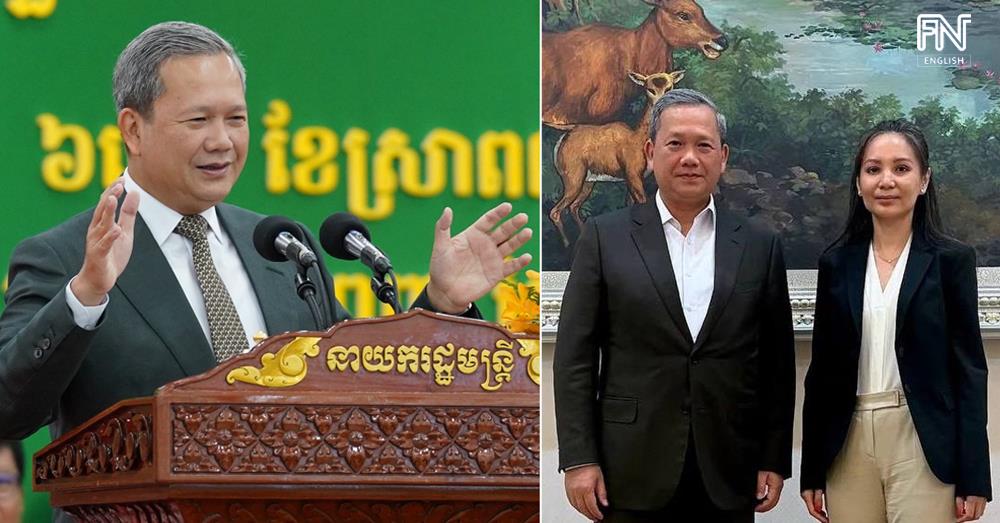

(Phnom Penh): In politics, a country does not need everyone to think alike. What it needs are people with differing views who are still capable of sitting down together, engaging in reasoned discussion, listening to one another and finding common ground in the national interest.
Remarks by Cambodian Prime Minister Hun Manet on August 19, 2026, made that message particularly clear:
“The Royal Government and the Cambodian People’s Party have not closed the door to those who genuinely intend and are willing to work with the Royal Government and the Cambodian People’s Party as fellow Cambodian partners in service of the national cause. We welcome them!”
This statement reflects a principle that the Royal Government says it has consistently upheld: keeping the door open to dialogue and to those willing to contribute constructively to the country.
A Culture of Dialogue Is Not a Culture of Agreement
One misconception needs to be dispelled: dialogue does not mean that all sides must agree. If everyone thought alike, there would be little need for dialogue in the first place.
The true value of dialogue lies precisely in the ability of people who hold different views to talk to one another without turning political differences into hostility.
Prime Minister Hun Manet made clear that analysts, intellectuals and politicians do not need to agree with the Royal Government when offering their views. On the contrary, he said he wants to hear about shortcomings, because there is little value in simply repeating what the government already knows.
His analogy of a “mirror” carries particular significance. The Prime Minister said:
“We cannot see everything from every angle. We can look into a mirror, but we need someone else to help us see what is behind us.”
The message is straightforward. A person can look into a mirror and see what is in front, but cannot easily see what is behind. Governments face a similar limitation. No government can reasonably claim to see every problem from every angle.
In this sense, voices from outside the government — including critical ones — can help leaders see what they might otherwise overlook.
The Case of Kem Monovithya: Putting Dialogue Into Practice
Declaring that the “door is open” is one thing. Giving someone with a different political background and orientation an opportunity to contribute to national affairs is another. The case of Kem Monovithya provides a notable example.
She is the daughter of Kem Sokha, the former leader of Cambodia’s opposition, and has herself had a political background distinct from that of the ruling party. Yet Prime Minister Hun Manet has acknowledged her capabilities and her extensive international network, which could be put to use for Cambodia’s benefit.
She has been appointed as a special envoy to assist with matters related to investment and border issues. The appointment carries significance beyond simply giving one individual a position. It suggests that political differences need not become barriers to working together when the national interest is at stake.
This raises an important question: When the national interest comes first, should the question merely be, “Which side were you on?” Or should it instead be, “What capabilities can you bring today to help your country?”
That is the spirit a culture of dialogue should embody: not eliminating differences, but turning those differences into a source of collective strength for the nation.
Criticism Is Welcome — But Arguments Should Be Met With Arguments
Openness to differing views does not mean that everything said carries equal merit. In a genuine culture of dialogue, evidence-based criticism of public policy and personal insults or attacks are two fundamentally different things.
If someone argues that a policy is flawed, that person should be prepared to explain: What exactly is wrong with it? What evidence supports that conclusion? What are its consequences? And, where possible, what better alternative is available?
When criticism can answer those questions, it becomes more than simply an opposing voice. It can become valuable input for improving public policy and governance.
By contrast, when political debate is replaced by insults, labeling, ridicule or personal attacks, what is lost first is not necessarily a victory or defeat for either side. What suffers is the quality of public discourse and the opportunity to find common solutions.
A culture of dialogue therefore requires responsibility from all sides.
The Royal Government should remain open-minded and tolerant of reasoned criticism. At the same time, critics should exercise discipline by relying on evidence, arguments and proposed solutions rather than emotion, insults or personal attacks.
A genuine culture of dialogue is neither about silencing critics nor about treating personal abuse as legitimate political expression. It is a space where reason is answered with reason and arguments are met with arguments.
Political Parties Should Not Exist to Tear One Another Apart
Another notable point in Prime Minister Hun Manet’s remarks was his assertion that political parties are not created to tear one another apart, but to represent citizens with different views.
That idea touches on a fundamental principle of democracy.
Political parties can compete. They can criticize one another. They can advocate different policies. But political competition should not reach the point where the ability to defeat a rival becomes more important than the ability to cooperate when the national interest demands it.
This is particularly important on matters involving borders, diplomacy, the economy and investment. The national interest is not the exclusive property of any single political party.
A government may hold the mandate and responsibility to govern, but the country belongs to its people as a whole.
Conclusion: Turning Political Differences Into National Strength
The central message from the Prime Minister’s August 19 remarks is not that the Royal Government expects everyone to agree with it.
The more meaningful message is this: People do not have to agree in order to sit down and talk. They do not have to share the same political orientation in order to work together. And criticism does not have to turn into hostility when arguments are answered with arguments.
The case of Kem Monovithya provides a practical example of that principle. People with different political backgrounds and orientations can still find common ground and put their capabilities to work in the national interest.
Cambodia does not lack people with differing opinions. The important question is not how to make everyone think alike, but how to turn those differences into collective strength for nation-building.
A culture of dialogue, therefore, should not be measured by whether the government defeats the opposition or the opposition defeats the government. Its true victory comes when Cambodians who think differently can still talk to one another, listen to one another and work together when the national interest demands it.
Ultimately, Cambodia does not need every Cambodian to think alike. It needs Cambodians who think differently to remain capable of working together to do what is right for their country.