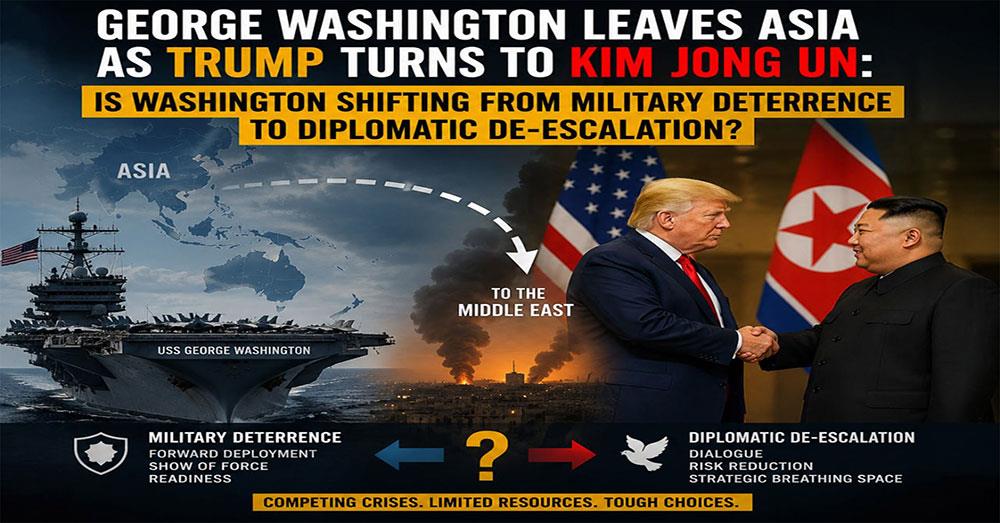

(PHNOM PENH): As the United States remains deeply engaged in the war with Iran, two developments in Asia are drawing attention: the aircraft carrier USS George Washington is leaving the Indo-Pacific for the Middle East, while President Donald Trump is scaling back military exercises with South Korea and reopening the door to a meeting with North Korean leader Kim Jong Un.
Are these simply two developments unfolding at the same time, or do they point to a broader adjustment in Washington’s strategy?
As the United States faces growing constraints on its ability to maintain maximum military strength across multiple theaters at once, is Washington increasingly using diplomacy to reduce risks in one region while concentrating military resources in another?
The evidence is not yet sufficient to reach a definitive conclusion. But the developments now unfolding make the question increasingly relevant.
*George Washington Is Leaving the Pacific — But Not Because Asia Has Become Less Important
The USS George Washington is not being moved out of the Pacific because Washington has concluded that Asia is no longer strategically important. The more immediate reason is the demand for military resources in the Middle East.
The George Washington, forward-deployed in Yokosuka, Japan, is being sent to the Middle East to replace the USS Abraham Lincoln, following the Lincoln’s prolonged deployment and reports of mounting pressure involving crew fatigue, logistics and sailors’ welfare.
But the movement of the George Washington carries strategic consequences.
Its departure will temporarily leave the United States without a forward-deployed aircraft carrier in the Pacific, even as the region remains one of Washington’s most important strategic theaters.
That does not mean the United States is abandoning the Pacific. Washington retains an extensive network of military bases, air power, submarines, surface warships and allied forces across the region.
Aircraft carriers, however, play a distinctive role. They are not merely combat platforms; they are also highly visible instruments of military presence, deterrence and rapid crisis response.
The important question, therefore, is not whether “America is leaving the Pacific.” It is this:
As the Middle East draws military resources away from Asia, what will Washington use to compensate for the temporary reduction in carrier-based deterrence?
*Trump Opens the Diplomatic Door as the U.S. Military Posture in the Pacific Is Adjusted
At the same time that some U.S. military resources are being redirected toward the Middle East, President Trump has signaled a different approach on the Korean Peninsula: reducing some military activity while reopening the diplomatic door to North Korea.
On August 16, Trump ordered the Pentagon to scale back U.S. participation in joint military exercises with South Korea. The United States and South Korea subsequently shortened the annual Ulchi Freedom Shield exercises from 11 days to five and reduced some field-training activities.
Trump has criticized the exercises as costly and provocative to North Korea, while again emphasizing his personal relationship with North Korean leader Kim Jong Un.
More significantly, on August 19, Trump said he expected to meet Kim sometime in 2026, although no specific date has been announced.
That raises a strategic question:
Could reopening diplomacy with Pyongyang help Washington reduce the risk of another military crisis on the Korean Peninsula at a time when U.S. military resources are already under pressure from the Middle East?
*The Iran War May Be the Link Between the Two Developments
The war with Iran is demanding an increasing share of U.S. military resources.
The George Washington is being pulled from the Pacific to help maintain U.S. carrier strength in the Middle East as the Abraham Lincoln prepares to leave after its extended deployment.
On the Korean Peninsula, meanwhile, Trump has linked his decision to scale back military exercises to his frustration with South Korea over Seoul’s unwillingness to assist Washington in the Iran war.
South Korean Foreign Minister Cho Hyun has also suggested that Trump’s decision appeared intended, at least in part, to pressure Seoul over both Iran and South Korean investment in the United States.
This raises the possibility of a broader strategic calculation:
If Washington must concentrate more military power in the Middle East, it has an even stronger incentive to prevent another major military crisis from erupting in the Indo-Pacific at the same time.
Trump’s renewed outreach to Kim can therefore be interpreted as an attempt to create a temporary “strategic breathing space” in Asia while the United States concentrates more resources on the Middle East.
That interpretation, however, should remain a hypothesis rather than a confirmed policy. There is not yet sufficient evidence to show that the carrier redeployment and Trump’s North Korea diplomacy are components of a single formally coordinated strategy.
*Diplomacy With Kim Could Reduce One Risk — But It Cannot Fill the Entire Strategic Gap
If Trump succeeds in reducing tensions with North Korea, Washington could lower the risk of another military crisis erupting on the Korean Peninsula. That would become especially valuable when American military resources are being stretched by commitments elsewhere. But the Indo-Pacific is not only about North Korea.
The United States continues to face major strategic challenges involving China, Taiwan, the East China Sea and the South China Sea. Most importantly, military competition with China remains a central concern as Beijing continues to expand its naval capabilities, including its aircraft-carrier fleet.
Therefore, even if diplomatic engagement with Kim Jong Un reduces one source of risk on the Korean Peninsula, it cannot replace the role of the USS George Washington in demonstrating U.S. military presence, deterrence and rapid-response capability across the broader Indo-Pacific.
This illustrates an important distinction between managing one potential crisis and maintaining the strategic balance across an entire region.
Diplomacy with Pyongyang may help lower the North Korean risk, but it cannot address challenges involving China, Taiwan or maritime disputes elsewhere in the Indo-Pacific.
In that sense, diplomacy may help Washington buy time and create a “strategic breathing space” on the Korean Peninsula. But it cannot fully compensate for the temporary reduction in military deterrence created by shifting major assets out of the Pacific.
Conclusion
So, does the departure of the USS George Washington from the Indo-Pacific, combined with Trump’s renewed outreach to Kim Jong Un, mean that Washington is shifting from military deterrence to diplomatic de-escalation?
The answer is: there is not yet enough evidence to conclude that the United States is making such a fundamental strategic shift. But the two developments highlight a genuine strategic pressure: Washington is being forced to distribute finite military resources across several critical theaters at the same time.
Sending the George Washington to the Middle East may create a temporary gap in carrier presence in the Pacific. Successful diplomacy with Kim could reduce one potential source of instability on the Korean Peninsula. But diplomacy cannot substitute for the broader U.S. military posture required to respond to other strategic challenges across the Indo-Pacific.
In this context, a larger principle emerges:
When the United States cannot maintain maximum military power everywhere at once, diplomacy can become a tool for reducing risk in one theater while military resources are concentrated in another.
That does not necessarily mean Washington is replacing deterrence with diplomacy. Rather, it may indicate an effort to use deterrence and diplomacy together, adjusting the balance between them according to where U.S. military resources are most urgently needed.
The next question, therefore, is critical: Will Kim Jong Un accept the diplomatic hand Trump is extending — and if he does not, will Washington have sufficient military and diplomatic capacity to manage two major crises at the same time?