
(Phnom Penh): A war cannot always be decided by military power alone. Armed forces may defend positions on the ground, but determining where one country’s territory ends and another’s begins ultimately depends on treaties, maps, historical records, evidence and international law. Likewise, building international understanding and recognition of a country’s position requires diplomacy and the effective use of international mechanisms.
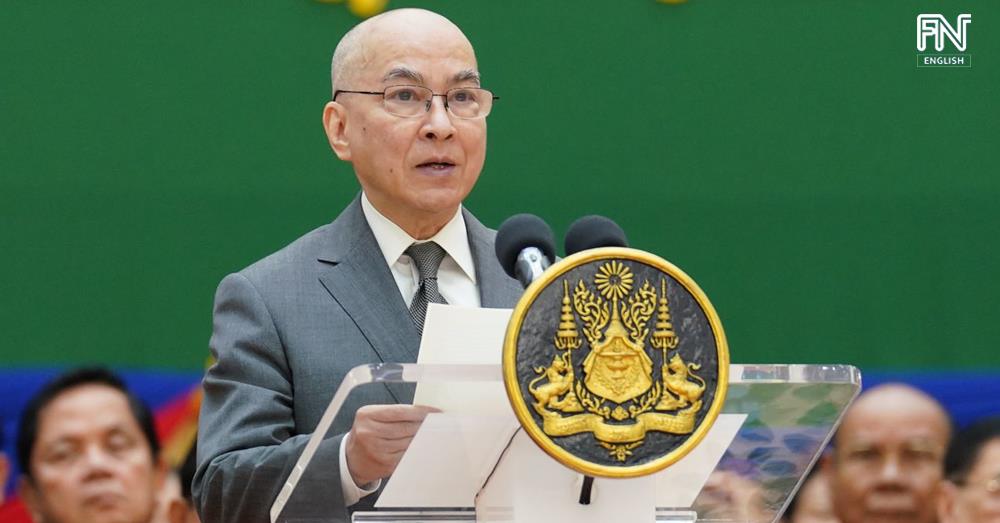
This is what makes the remarks by His Majesty King Norodom Sihamoni, King of Cambodia, particularly significant when viewed in the context of the Cambodia-Thailand border dispute. The remarks were delivered on August 21 during the inauguration of the “Solidarity Palace,” the Senate’s new building.
His Majesty said:
“I wish to express my profound gratitude to Samdech Akka Moha Sena Padei Techo, President of the Senate and President of the Supreme Privy Council to His Majesty the King. Whenever our nation has faced serious violations and threats from foreign countries in the past, Samdech has provided leadership and stood together with the Cambodian people through both hardship and prosperity. He has also contributed alongside the Royal Government of Cambodia by providing strategic advice, encouragement and support in every form and in every aspect, working tirelessly day and night for one single cause: safeguarding the territorial integrity and national sovereignty of our country.”
His Majesty further stated:
“I also wish to express my profound admiration and highest praise for the heroism of all Cambodian soldiers who have fought courageously and resolutely on every front for the cause of defending the nation, the territory and the people, as well as for the Cambodian people throughout the country, who have united in strong national solidarity and demonstrated a high degree of national unity under the wise and highly capable leadership of the Royal Government of the Kingdom of Cambodia, headed by Samdech Moha Borvor Thipadei Hun Manet, in fighting on every front — the political, diplomatic, military and legal fronts — to defend our nation, national sovereignty, territorial integrity and the Cambodian people.”
The King’s remarks highlight two important points. First is the role of Senate President Samdech Techo Hun Sen in providing strategic advice, encouragement and support to the Royal Government in the cause of defending Cambodia’s territorial integrity and sovereignty. Second is His Majesty’s praise for the Royal Government, led by Prime Minister Hun Manet, for pursuing the national interest across what the King described as “every front” — political, diplomatic, military and legal.
In the context of the Cambodia-Thailand dispute, these “four fronts” provide a useful framework for understanding how the conflict has evolved — from armed clashes along the border to diplomacy and international engagement, and increasingly to international legal mechanisms.
The fronts may change, but the central objective highlighted in the King’s remarks remains the same: defending Cambodia’s national sovereignty, territorial integrity and its people.
The Military Front: Defending Territory During Armed Conflict
Thailand’s reliance on its 1:50,000-scale maps in asserting territorial claims became one of the central points of contention in the dispute that escalated into armed conflict in 2025.
The fighting caused damage to ancient Cambodian temples of national and international heritage significance, as well as infrastructure in Cambodian border areas, including bridges, schools, pagodas, homes and villages. Cambodian authorities have accused Thai forces of bombing and shelling heritage sites, destroying and clearing civilian property, and occupying areas claimed by Cambodia.
The conflict also displaced hundreds of thousands of people. More than 20,000 Cambodian displaced persons remain unable to return to their homes, with Cambodian authorities citing barriers, including shipping containers and barbed wire installed by Thai forces in disputed areas.
International attention from figures and institutions including Hollywood actress Angelina Jolie, United Nations officials, UNESCO and the United States Embassy has helped broaden the issue beyond the military confrontation itself, bringing humanitarian concerns, international law and the search for lasting peace into sharper focus.
His Majesty paid particular tribute to those who fought on the battlefield:
“I wish to express my profound admiration and highest praise for the heroism of all Cambodian soldiers who have fought courageously and resolutely on every front for the cause of defending the nation, the territory and the people.”
The Diplomatic Front: Silencing the Guns and Making Cambodia’s Voice Heard
Following the armed clashes, diplomacy assumed an increasingly important role in preventing the conflict from escalating further and in bringing the parties back toward peaceful means of dispute settlement.
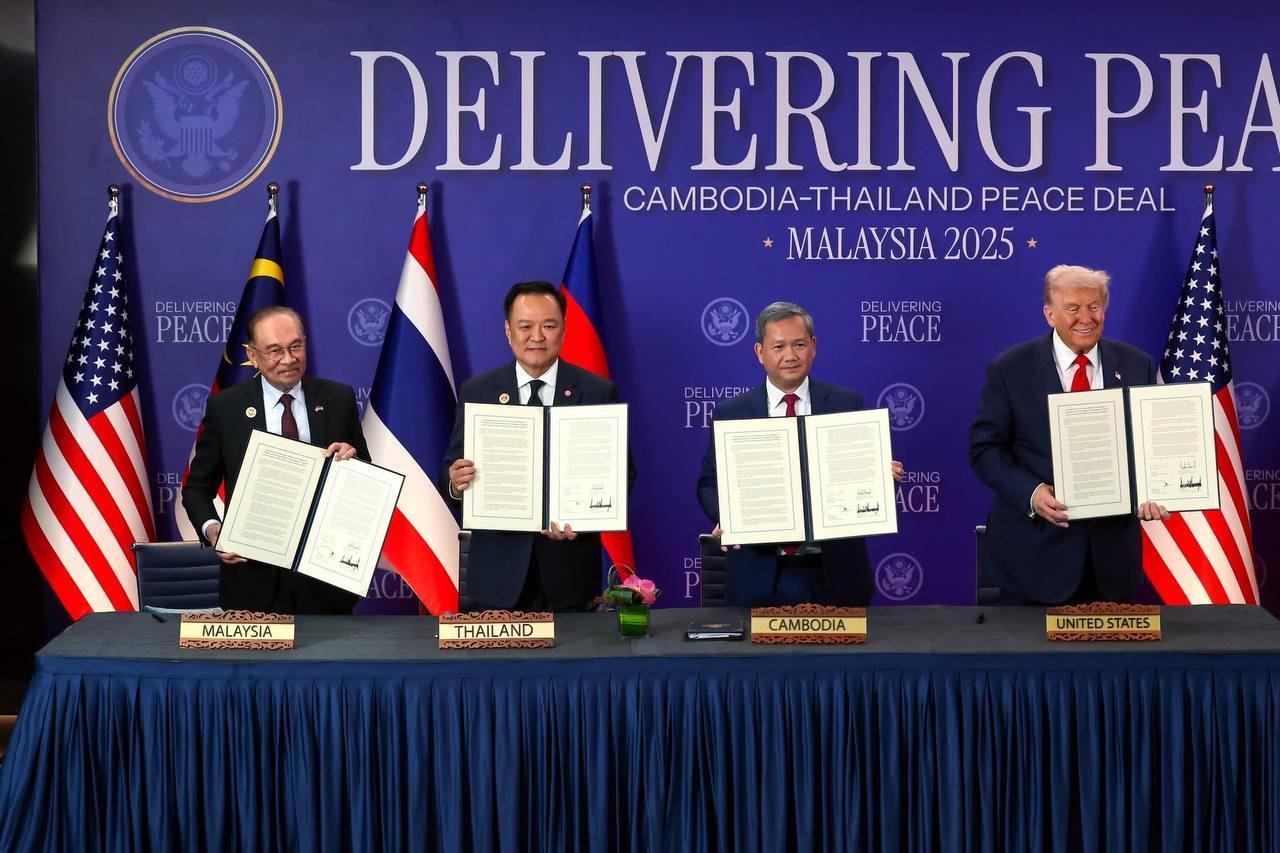
The intervention of U.S. President Donald Trump and Malaysian Prime Minister Anwar Ibrahim, then serving as ASEAN Chair, contributed to the ceasefire reached on July 28, 2025.
But silencing the guns was only one step. Addressing the underlying causes of the border dispute continued to require sustained diplomacy and engagement through international mechanisms.
Cambodia subsequently continued to raise issues concerning its borders, sovereignty and territorial integrity on international platforms. In remarks before the United Nations Security Council, Cambodian Foreign Minister Prak Sokhonn stressed that territorial integrity, the peaceful settlement of disputes and refraining from the threat or use of force remain indispensable to international peace, security, stability and justice.
Cambodia’s “diplomatic front,” therefore, has not been limited to helping silence the guns. It has also been about presenting Cambodia’s position internationally and shifting the confrontation away from armed force toward peaceful and legal means of dispute settlement.
The Legal Front: When the Question Shifts From “Who Is Stronger?” to “Who Has the Stronger Evidence?”
On the military front, the question is often: Who has greater military power?
On the legal front, however, the questions are fundamentally different: Which party has the stronger treaty basis? Which maps carry legal weight? And which evidence can withstand scrutiny under international law?
Thai security scholar Surachart Bamrungsuk has recently drawn attention to the distinction between the 1:50,000-scale maps used by Thailand and the 1:200,000-scale maps associated with the historical treaties and boundary arrangements between Cambodia and Thailand.
A central point in his analysis is that, once a dispute enters the legal arena, the decisive issue is not necessarily which map is more detailed or technologically sophisticated. Rather, the critical questions concern treaty foundations, state acceptance and legal validity.
The legal front has also opened another avenue concerning the maritime dispute.
The Cambodia-Thailand maritime dispute has entered a Compulsory Conciliation process under the 1982 United Nations Convention on the Law of the Sea, or UNCLOS. The procedure is provided for under Annex V of the Convention. Under the applicable compulsory conciliation provisions, a party’s failure to respond or participate does not, by itself, prevent the proceedings from continuing.
This illustrates the fundamental distinction between the military and legal fronts: military power may shape conditions on the ground for a period of time, but on the legal front, treaties, maps, historical evidence, state conduct and international law carry the weight.
The Political Front: National Solidarity as a Source of Strength
His Majesty also praised the Cambodian people for having “united in strong national solidarity and demonstrated a high degree of national unity.”
Viewed in the context of the Cambodia-Thailand dispute, this underscores a broader reality: national defense is not solely the responsibility of the armed forces or the government. During a prolonged crisis, a country also depends on domestic stability, social cohesion and the ability to maintain a consistent national objective over time.
Thai security scholar Surachart Bamrungsuk has offered an assessment that points to a similar political effect. According to his analysis, the conflict did not weaken Cambodia in the way some advocates of a military solution in Thailand may have expected. Instead, he argued, it strengthened Cambodia’s domestic cohesion as well as its political and diplomatic position internationally.
It is in this context that the King’s emphasis on national solidarity takes on particular significance:
“...strong national solidarity and a high degree of national unity under the wise and highly capable leadership of the Royal Government of the Kingdom of Cambodia, headed by Samdech Moha Borvor Thipadei Hun Manet, in fighting on every front — the political, diplomatic, military and legal fronts — to defend our nation, national sovereignty, territorial integrity and the Cambodian people.”
Conclusion: The Fronts May Change, but the Objective Does Not
Defending sovereignty is not confined to the military battlefield.
When a country comes under armed attack, soldiers defend the territory. When the objective is to stop the fighting, diplomacy must take the lead. When competing territorial or maritime claims need to be tested, treaties, maps, historical evidence and international law become critical. And behind all these efforts lies the political front, where national cohesion can help sustain a country through a prolonged dispute.
This is the broader significance of His Majesty King Norodom Sihamoni’s reference to Cambodia’s “four fronts.”
The battlefield may shift from the border to the negotiating table, from the negotiating table to international forums, and from diplomacy to international legal mechanisms. But the central objective remains unchanged: the defense of Cambodia’s territorial integrity, national sovereignty and its people.