
(Phnom Penh): Every night, we can look up and see the Moon in the sky. Sometimes it appears as a thin crescent, sometimes half illuminated, and sometimes as a bright full circle. To many people, the Moon may seem simply like an object that lights up the night sky.
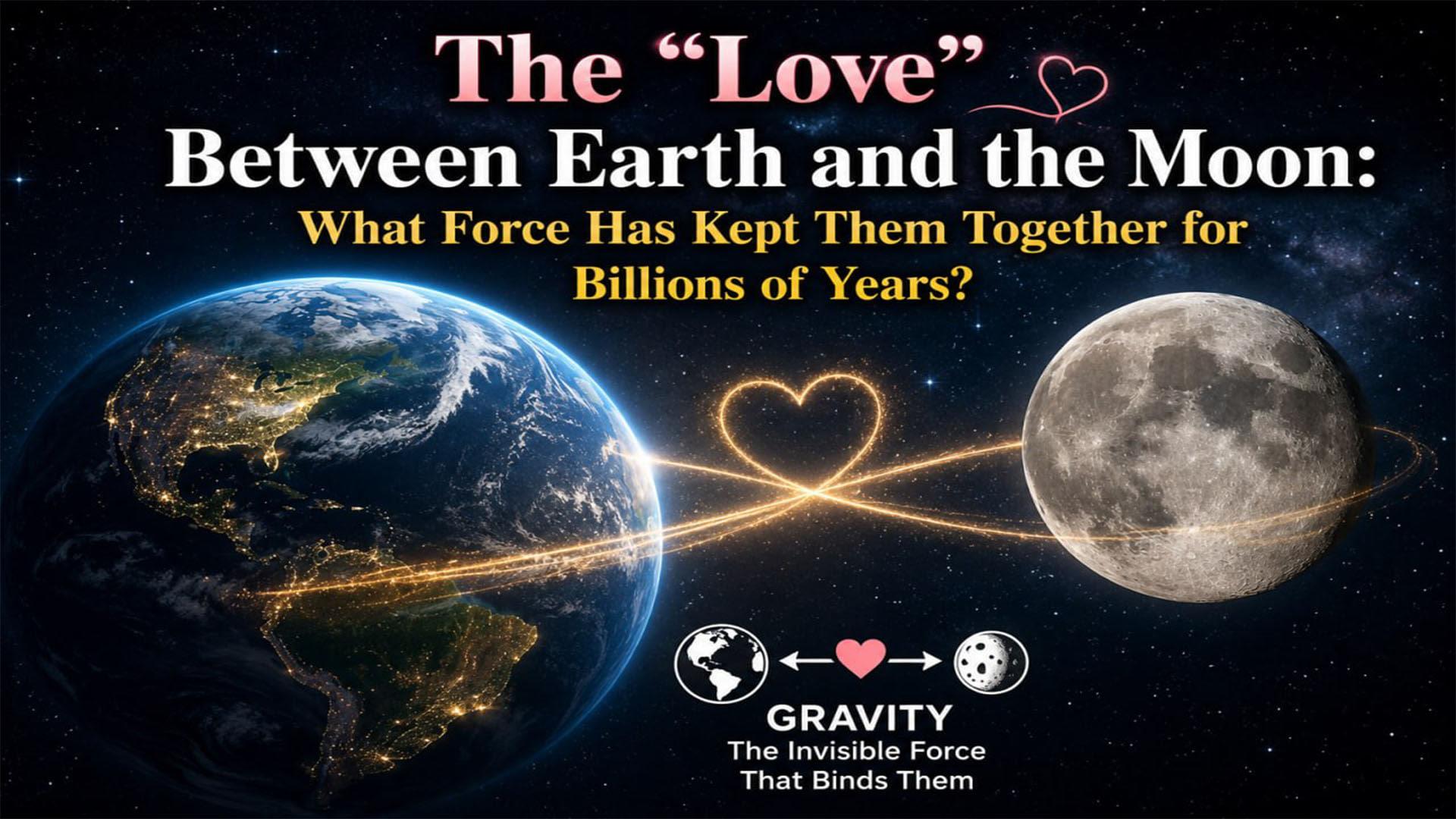
But scientifically, Earth and the Moon are deeply connected by gravity. Earth pulls on the Moon, while the Moon also pulls on Earth. Their interaction not only governs the Moon’s motion but also produces effects that we can observe here on Earth, including the regular rise and fall of ocean levels.
What makes this relationship particularly fascinating is the distance between them. The Moon is, on average, about 384,400 kilometers (238,855 miles) from Earth. Yet even across this vast distance, the Moon’s gravity continues to exert a measurable influence on our planet.
So how exactly are Earth and the Moon connected? And how can the Moon, nearly 400,000 kilometers away, exert enough influence to contribute to the daily rise and fall of Earth’s oceans?
The Moon Is Not Motionless in the Sky
What we see in the night sky is part of a much larger system of motion. According to NASA, the Moon orbits Earth at an average distance of about 384,400 kilometers and takes approximately 27.3 days to complete one orbit.
But the Moon does not simply travel around Earth. It also rotates on its own axis.
Remarkably, the Moon takes approximately 27.3 days to complete one rotation—almost exactly the same amount of time it takes to orbit Earth once.
This is why people on Earth see nearly the same side of the Moon all the time.
Why Do the Moon’s Rotation and Orbit Both Take About 27.3 Days?
The fact that the Moon takes approximately 27.3 days both to rotate once on its axis and to orbit Earth once is not a coincidence.
The phenomenon is known as tidal locking, while the resulting one-to-one relationship between the Moon’s rotation and orbital period is known as synchronous rotation.
NASA explains that the Moon once rotated faster than it does today. But Earth’s gravity does not pull equally on every part of the Moon. The side closer to Earth experiences a slightly stronger gravitational pull than the side farther away, producing a small deformation.
As the Moon rotated, this deformation and internal friction dissipated rotational energy as heat, gradually slowing the Moon’s spin.
Over a very long period, the Moon’s rotation slowed until the time required for one rotation became equal to the time required for one orbit around Earth—about 27.3 days. As a result, nearly the same lunar hemisphere continuously faces Earth.
A simple analogy can make this easier to understand. Imagine walking around a chair while keeping your face pointed toward the chair at all times. By the time you complete one trip around the chair, you will also have rotated your body once.
The Moon behaves in a similar way.
Therefore, we see nearly the same side of the Moon not because the Moon does not rotate, but because its rotation is synchronized with its orbit around Earth.
If the Moon did not rotate on its axis at all while orbiting Earth, we would gradually see different parts of its surface.
What Causes the Waxing and Waning of the Moon?
When we see the Moon as a thin crescent, a half Moon, or a Full Moon, the Moon itself is not growing larger or shrinking. It remains a spherical body, and it does not produce its own visible light.
The moonlight we see is sunlight reflected from the Moon’s surface.
At any given time, the Sun illuminates approximately half of the Moon’s total surface. One hemisphere is illuminated while the other is in darkness.
As the Moon travels around Earth, however, the relative positions of the Sun, Earth and Moon continually change. What changes, therefore, is not how much of the Moon is illuminated by the Sun, but how much of that illuminated half we can see from Earth.
This produces the Moon’s familiar phases.
At New Moon, the Moon is positioned roughly between the Sun and Earth. The illuminated hemisphere faces mostly away from Earth, while the side facing us is largely dark. As a result, the Moon is generally invisible to the naked eye during this phase.
After New Moon, a thin illuminated crescent becomes visible and grows from day to day. This is the waxing phase. The Moon progresses from Waxing Crescent to First Quarter, then continues to brighten until it reaches Full Moon.
At Full Moon, the Sun still illuminates only about half of the Moon’s total surface. The difference is that the illuminated hemisphere is now facing almost entirely toward Earth, making the Moon appear as a fully illuminated disk.
After Full Moon, the illuminated portion visible from Earth gradually decreases. This is the waning phase, which continues until the cycle returns to New Moon.
Why Is the Lunar Phase Cycle 29.5 Days if the Moon Orbits Earth in 27.3 Days?
This raises another fascinating question.
If the Moon completes one orbit around Earth in approximately 27.3 days, why does it take about 29.5 days to go from one New Moon to the next?
The reason is simple: Earth does not remain stationary while waiting for the Moon to complete its orbit.
While the Moon is orbiting Earth, Earth itself is moving around the Sun.
During the 27.3 days it takes the Moon to complete one 360-degree orbit relative to the distant stars, Earth has already moved forward along its own orbit around the Sun.
Consequently, even after the Moon has completed one full orbit around Earth, the relative positions of the Sun, Earth and Moon have not yet returned to the same alignment as at the previous New Moon.
The Moon must continue moving along its orbit for roughly another 2.2 days to catch up with Earth’s new position and restore approximately the same Sun–Earth–Moon geometry.
That is why the cycle from one New Moon to the next takes about 29.5 days.
Put simply, 27.3 days is the time the Moon takes to orbit Earth once relative to the distant stars, while 29.5 days is the time required for the Sun, Earth and Moon to return to approximately the same relative configuration.
Earth Pulls the Moon—and the Moon Pulls Earth
This is one of the most important points in understanding the Earth–Moon relationship.
Because Earth is much larger than the Moon, it is easy to imagine that only Earth pulls on the Moon. In reality, both bodies gravitationally attract each other.
Earth’s gravity continuously bends the Moon’s path, keeping it in orbit. At the same time, the Moon’s gravity pulls on Earth.
One of the most visible consequences of this interaction is the regular rise and fall of ocean levels—high and low tides.
The U.S. National Oceanic and Atmospheric Administration (NOAA) explains that the Moon pulls on the entire Earth, not just its oceans. Because Earth has a large diameter, however, the side closer to the Moon experiences a stronger gravitational pull than the side farther away.
This difference in gravitational attraction across Earth is known as the tidal force.
Ocean water can move and redistribute itself much more readily than solid rock. As a result, the effects of this differential gravitational pull are particularly visible in the oceans through the regular rise and fall of sea levels.
But the Moon is not the only celestial body influencing Earth’s tides.
The Sun also exerts a tide-generating gravitational influence on Earth. Although the Sun is vastly more massive than the Moon, the Moon has a stronger tide-generating effect because it is far closer to Earth.
Put simply, Earth’s gravity shapes the Moon’s orbital motion, while the Moon pulls back on Earth—and ocean tides provide one of the most visible manifestations of this gravitational interaction.
Are Lunar Phases Connected to Ocean Tides?
Yes—but it is important to understand exactly how.
The connection arises because the positions of the Sun, Earth and Moon change throughout the lunar cycle.
During New Moon, the Moon lies roughly between the Sun and Earth. During Full Moon, Earth lies roughly between the Sun and Moon. In both configurations, the three bodies are approximately aligned.
At these times, the tide-generating effects of the Sun and Moon reinforce each other, producing higher high tides and lower low tides than usual. In other words, the difference between high and low tide—the tidal range—becomes greater.
This is known as a spring tide.
Despite its name, a spring tide has nothing to do with the spring season. Spring tides occur roughly twice during each lunar cycle, around New Moon and Full Moon.
By contrast, during the First Quarter and Last Quarter phases, the directions of the Sun and Moon, as viewed from Earth, form an angle of roughly 90 degrees.
Their tide-generating effects then partially counteract one another. High tides are generally not as high and low tides not as low as during spring tides, producing a smaller tidal range.
This is known as a neap tide.
Lunar phases and ocean tides, therefore, are not entirely separate phenomena. Both are connected to the changing geometry of the Sun–Earth–Moon system.
What we observe as the changing appearance of the Moon in the sky and what we experience as the rhythmic rise and fall of the oceans on Earth are both expressions of the same celestial system—governed by light, motion and gravity.
Conclusion
The relationship between Earth and the Moon is not simply the story of two objects separated by nearly 400,000 kilometers. They form a gravitationally interacting system in which each body exerts an influence on the other.
Earth’s gravity continually bends the Moon’s motion into orbit. Over immense spans of time, gravitational tidal interactions also slowed the Moon’s rotation until it became synchronized with its orbital period—a condition known as tidal locking. This is why we see nearly the same face of the Moon whenever we look up at it.
But the influence does not flow in only one direction. The Moon also pulls on Earth. One of the clearest manifestations of this interaction can be seen in the regular rise and fall of the oceans.
So when we look up at the Moon, we are not simply looking at a distant object disconnected from our planet. We are looking at Earth’s gravitational partner—a world that has been interacting with our planet for billions of years.
But this relationship leads to another intriguing question:
If the Moon is nearly 400,000 kilometers away, how can its gravity influence the enormous mass of Earth’s oceans, causing sea levels to rise and fall every day?
The answer lies not simply in the idea that “the Moon pulls the water,” but in something more subtle: the Moon’s gravitational pull is not equally strong across the entire Earth.
That difference is known as the tidal force.
How does tidal force work? And if the Moon is on one side of Earth, why can the ocean also bulge on the opposite side?
That will be the subject of the next Fresh Exclusive / Cosmo.