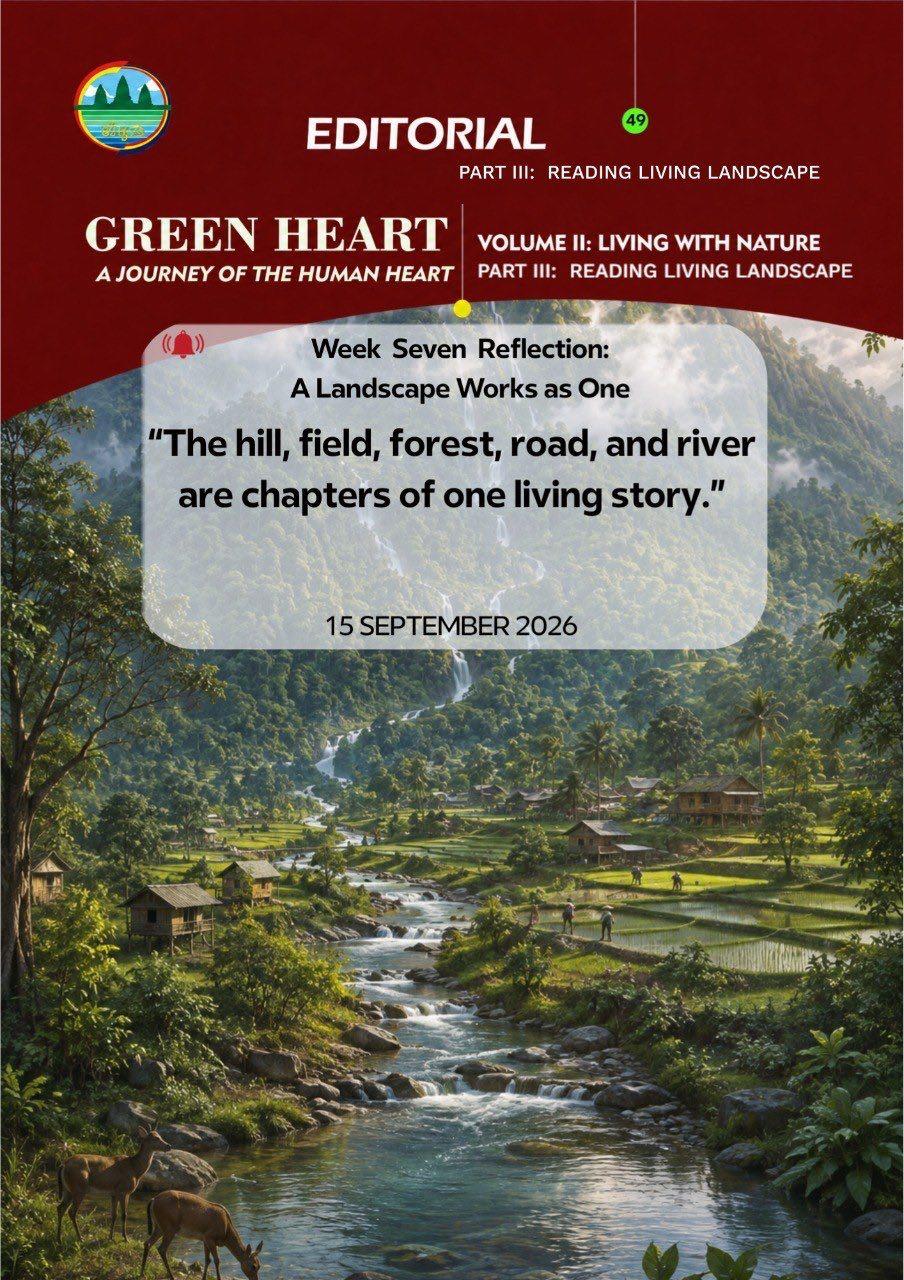

(Phnom Penh): People divide land into names and boundaries: forest, farm, village, road, wetland, mountain, park. These categories help us plan and communicate. Water, wind, wildlife, fire, seeds, and soil do not always follow them.
“The hill, field, forest, road, and river are chapters of one living story.”
A forest on a hill may influence water reaching farms below. A road may interrupt wildlife movement or direct runoff toward a stream. A wetland may reduce flood peaks for a town. A farm may provide habitat as well as food when managed thoughtfully.
Landscape thinking asks how places work together. Protecting one isolated patch may not be enough if animals cannot move, water is polluted upstream, or surrounding pressures become too great. Connections and transitions matter.
Human needs also form part of the landscape. People need homes, food, schools, transport, energy, and livelihoods. Wise planning seeks patterns that meet these needs while maintaining ecological functions and reducing risk.
Trade-offs are real. A decision may bring benefits to one group and costs to another. Good planning uses evidence, listens to affected people, compares alternatives, and looks beyond immediate profit or convenience.
Restoration can reconnect a landscape through riverbank vegetation, wildlife corridors, safer crossings, reforestation, soil protection, or wetland recovery. The right approach depends on local species, land uses, rights, and conditions.
This week, air, wind, clouds, seasons, mountains, and soil revealed connections across space and time. None works alone. The atmosphere meets the mountain; rain meets soil; soil supports plants; plants influence water and air; people participate in every layer.
Students can practice landscape thinking with a hand-drawn map. Include homes, roads, water, vegetation, farms, and open spaces. Add arrows for water, wind, animals, and people. Suddenly, separate places become a system.
A green heart learns to zoom in and out. It cares for one leaf, then asks about the whole forest. It protects one pond, then follows the watershed. It respects one home, then considers the landscape shared by all.
When we plan as if the pieces are separate, surprises become more likely. When we see the story as one, wisdom has a better map.
No map is ever complete. Landscapes change, knowledge improves, and people experience the same place differently. Good planning returns to the map, checks it against reality, and corrects it with humility.
A wise map remains open to another observation and another voice.
Buddhist Reflection
Right view includes relationships, causes, and wider consequences. It does not erase differences; it understands how differences participate in a whole. This broader vision helps compassion become practical.
Today’s Reflection
Which two places near me appear separate but are connected by water, wind, wildlife, or people?
Today’s Action
Draw a simple landscape map and add at least five arrows showing movement or connection.
Today’s Pledge
Today I will look beyond boundaries and care for the relationships that make a landscape whole.
When we protect nature, we protect all beings, including ourselves.
=FRESH NEWS