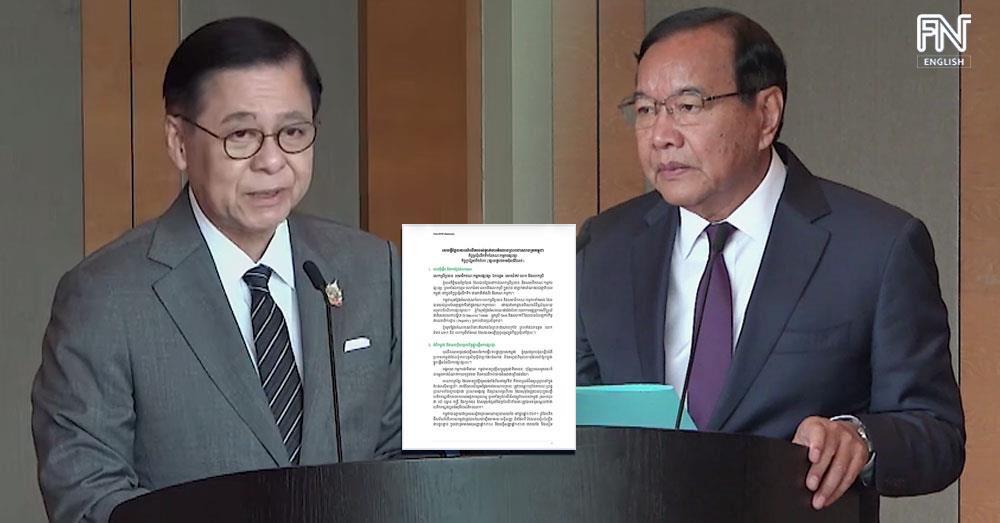

(Phnom Penh): Cambodia and Thailand struck markedly different tones on September 15, 2026, as they delivered their opening statements at the first meeting of the Compulsory Conciliation Commission under the United Nations Convention on the Law of the Sea (UNCLOS) in Singapore.
Cambodia adopted a measured tone, focusing on international law, the circumstances that led it to invoke the UNCLOS mechanism, and possible pathways toward resolving the maritime dispute.
Thailand, by contrast, used sharper language, raising a series of accusations related to past conflicts as it challenged Cambodia’s account.
The contrast raises an important question: Does Cambodia’s softer approach suggest weakness, while Thailand’s tougher rhetoric gives Bangkok an advantage?
At this stage, the answer is: not necessarily.
The compulsory conciliation process is not a contest over which side speaks more forcefully. It is a peaceful dispute-settlement mechanism in which the weight of each party’s position will ultimately depend on the facts, evidence and legal arguments it can place before the Commission.
Two Opening Statements, Two Different Approaches
In his opening statement, Cambodian Deputy Prime Minister and Foreign Minister Prak Sokhonn did not devote his remarks primarily to attacking or accusing Thailand.
Instead, he reviewed the history of maritime negotiations between the two countries, the end of the 2001 Memorandum of Understanding, and Cambodia’s reasons for turning to compulsory conciliation under UNCLOS.
More importantly, Cambodia did not simply place a problem before the Commission. It also presented several possible pathways out of the deadlock.
Cambodia outlined a three-tier approach.
Its first preference is to conclude a treaty with Thailand establishing a single maritime boundary between the two states.
If that cannot yet be achieved, Cambodia said it is prepared to discuss joint development and the equitable sharing of resources.
And if the parties still cannot reach an agreement, Cambodia wants the Commission’s report and recommendations to serve as a basis for further negotiations.
One phrase from Cambodia’s statement captured its tone particularly clearly: “a means to rebuild trust, not as a form of escalation.”
In other words, Phnom Penh presented the conciliation process as a way to restore trust rather than increase tensions.
Thai Foreign Minister Sihasak Phuangketkeow, however, adopted a more confrontational tone. He accused Cambodia of advancing a self-serving narrative and brought into his opening remarks issues involving land-border clashes, rockets, landmines and other allegations concerning Cambodia’s conduct.
The difference is noteworthy.
Cambodia used much of its opening statement to explain how the dispute might move toward a solution, while Thailand devoted part of its statement to rebutting Cambodia and raising allegations that extended beyond the immediate question of maritime delimitation.
In a conciliation process designed to help two parties seek a peaceful settlement, a position centered on law, negotiation and pathways out of deadlock could strengthen Cambodia’s negotiating credibility — provided that position is supported by persuasive evidence and sound legal arguments.
Therefore, strong rhetoric does not necessarily mean a strong legal position, just as a restrained tone does not necessarily signal weakness.
Before the Commission, the real advantage will depend not on who speaks more forcefully, but on which party can better support its position with facts, evidence and law — and present a workable path out of the dispute.
Why Not Striking Back Could Work to Cambodia’s Advantage
The conciliation is proceeding under Article 298 and Annex V of UNCLOS, with the Permanent Court of Arbitration (PCA) serving as the administrative Registry supporting the Conciliation Commission.
The Commission’s role is not to determine which party uses stronger language or responds more quickly to accusations.
Under Annex V, it can hear the parties, examine their claims and objections and, if no agreement is reached, set out conclusions on relevant questions of fact or law and make recommendations aimed at facilitating an amicable settlement.
Cambodia’s decision not to answer every accusation with a counter-accusation therefore does not mean that it accepts those allegations, nor does restraint automatically weaken its legal rights or position.
What matters is whether Cambodia responds to issues relevant to the case with facts, evidence and legal reasoning rather than rhetorical escalation.
If Cambodia can maintain that measured approach while presenting the Commission with treaties, maps, geographic data, historical records, evidence of state practice and relevant principles of international maritime law, it could reinforce the impression that Phnom Penh has come to the conciliation table to seek a rules-based solution rather than win a war of words.
In this context, not striking back does not mean failing to defend oneself. Cambodia can defend its position more effectively by allowing facts, evidence and law to answer rhetoric.
An Apparent Inconsistency in the Thai Foreign Minister’s Remarks
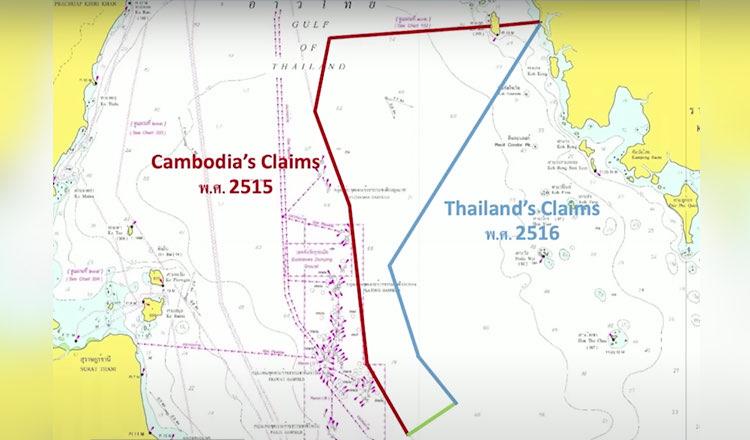
There is another point worth examining. Thailand has insisted that the scope of the compulsory conciliation should be confined to maritime boundary delimitation. The Thai Foreign Ministry has publicly stated that its objective is limited solely to the delimitation of the maritime boundary under UNCLOS.
Yet in his opening statement, Sihasak raised several issues that do not directly determine a maritime boundary, including land-border clashes, rockets, landmines and other allegations concerning Cambodia’s conduct.
This does not in itself mean Thailand has acted unlawfully, nor does it mean the Commission cannot hear such contextual arguments. Each side may present background that it believes is relevant to relations and negotiations between the two states.
But it does raise a question about the consistency of Thailand’s approach:
If Bangkok wants the scope of the conciliation confined to maritime delimitation, why bring land-border disputes and other non-maritime accusations into its opening narrative?
That question becomes even more significant when the issue of Koh Kood, or Ko Kut, is considered.
Koh Kood: If the Scope Is Maritime Delimitation, How Far Can the “Sea” Be Separated From the “Island”?
Another issue complicating the debate over the scope of the conciliation is Koh Kood.
Thailand has maintained that the compulsory conciliation should be confined to maritime delimitation and should not extend to deciding sovereignty over land territory or Koh Kood.
Legally, that distinction matters.
UNCLOS provides a framework governing maritime entitlements and maritime delimitation, but this Conciliation Commission is not a court empowered to decide whether Koh Kood belongs to Cambodia or Thailand.
Article 298 of UNCLOS also places limits on compulsory conciliation where a maritime delimitation dispute necessarily involves the prior resolution of an unsettled dispute concerning sovereignty over continental or insular land territory.
But this leads to a more difficult legal question:
If an island lies within the geography relevant to maritime delimitation, does excluding the question of who owns the island necessarily mean that the island itself must be excluded entirely from consideration of the maritime boundary?
The question matters because, in the law of the sea, maritime entitlements derive from land territory. Coastal geography, the location of islands and relevant baselines can all matter when maritime zones and boundaries are considered.
Thus, sovereignty over an island and the possible geographical effect of an island on maritime delimitation are related questions, but they are not necessarily the same legal question.
The issue for the Commission, therefore, need not be: “Who owns Koh Kood?”
A more nuanced question is: To what extent can the Commission consider maritime delimitation where the geography of Koh Kood may be relevant, without crossing the line into deciding sovereignty over the island itself?
That distinction could become one of the important legal questions surrounding the scope of the conciliation.
Conclusion: Who Had the Advantage on Day One?
At this early stage, there is not enough basis to say that either Cambodia or Thailand “won” the opening day.
The Commission has not yet evaluated or reached conclusions on the parties’ competing facts, evidence or legal arguments.
But measured purely in terms of tone and negotiating posture, Cambodia displayed one potentially important advantage.
Rather than concentrating its opening statement on attacking Thailand, Cambodia placed several possible routes out of the deadlock on the table: a maritime boundary treaty; joint development and equitable resource sharing if immediate delimitation proves impossible; and, failing agreement, the use of the Commission’s report and recommendations as a basis for further negotiations.
That could give Cambodia an early advantage in terms of negotiating posture and credibility. But it should not be confused with a legal advantage over where the maritime boundary should ultimately lie.
The more important question, therefore, is not: “Who spoke more forcefully on the first day?”
It is this: When the Commission begins examining the competing positions, which side can present the more persuasive facts, evidence and legal reasoning — and which side can offer a realistic path out of the deadlock?
Cambodia’s restrained tone on opening day should therefore not automatically be interpreted as weakness. It is an approach well suited to a conciliation process — but its real value will ultimately depend on the quality of the evidence and legal arguments Cambodia presents as the proceedings continue.
Because in a conciliation process under UNCLOS:
“Speaking louder does not necessarily give a party the advantage. The advantage may ultimately belong to the party that can make the facts, evidence and law speak for itself.”