
(Phnom Penh): When a territorial dispute arises, a state has several options: defend positions on the ground, negotiate bilaterally, use diplomacy, or turn to international mechanisms. The key question, however, is not necessarily which single option to choose at the expense of the others.
The more important question is: How can a state use these mechanisms in combination to protect its interests and sovereignty while seeking to prevent a return to armed conflict?
That question has taken on greater significance following the first meeting of the Cambodia–Thailand Conciliation Commission under the United Nations Convention on the Law of the Sea, or UNCLOS, held in Singapore from September 14 to 16, 2026.
The conciliation process was established under Article 298 and Annex V of UNCLOS, with the Permanent Court of Arbitration, or PCA, serving as the Registry, providing administrative support to the Commission.
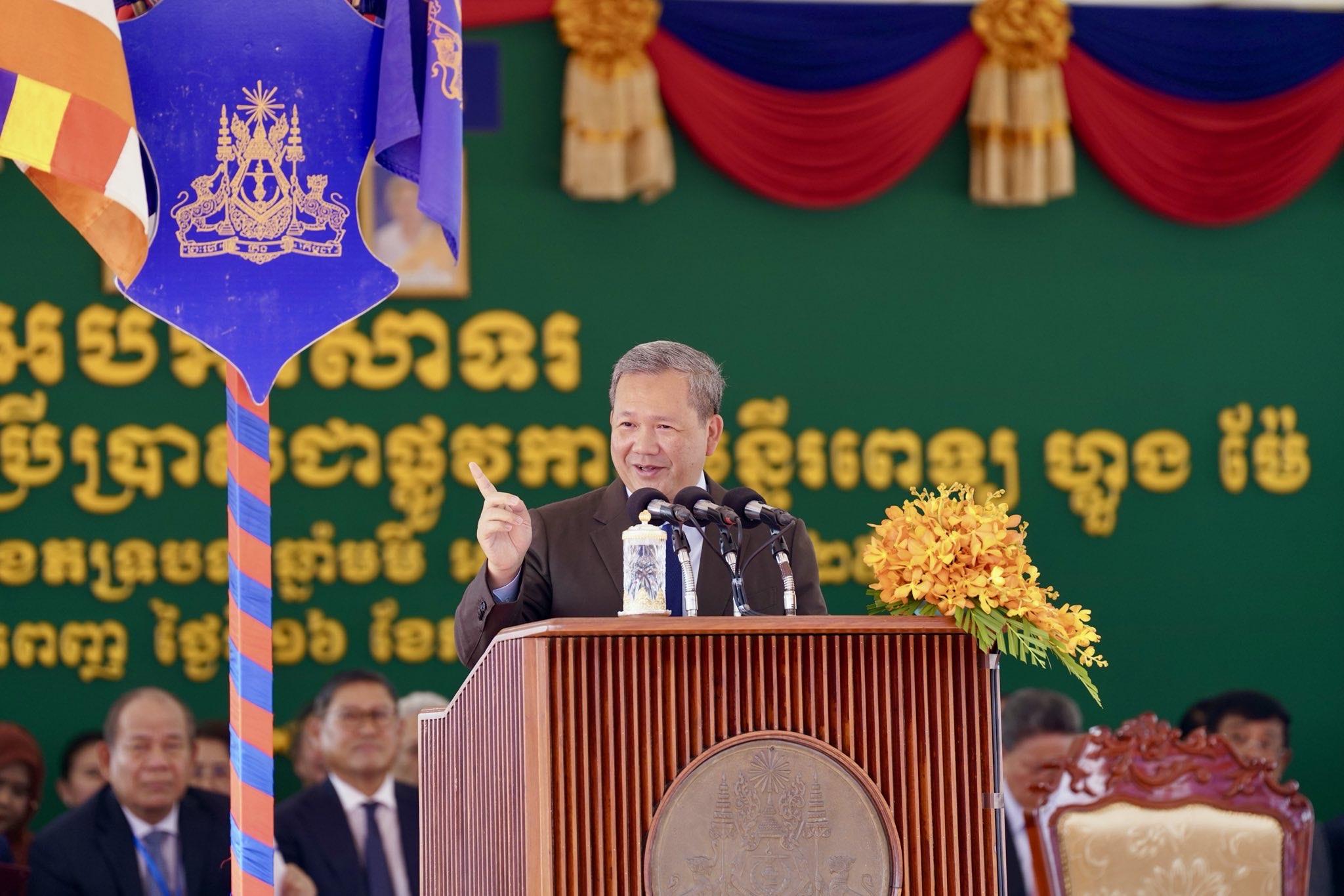
One day after the opening statements in Singapore, Cambodian Prime Minister Hun Manet, speaking in Phnom Penh, emphasized his government's commitment to addressing territorial issues with Thailand through multiple mechanisms.
He stressed: “We have never forgotten our territorial issues,” while outlining the use of law, diplomacy, bilateral channels and international mechanisms in seeking peaceful solutions.
“We have never forgotten our territorial issues. Not for a single second have we forgotten the need to pursue every possible means of resolving them.”
A Ceasefire Does Not Settle Sovereignty
One of the central points in Hun Manet's speech was the distinction between “loss of effective control” and “legal loss of territory.”
That distinction matters because the positions held by troops after fighting have become part of the domestic political debate, with some opposition groups criticizing the government over the loss of control of certain locations.
Hun Manet acknowledged that Cambodia had lost effective control over some positions following the fighting. But he rejected allegations that those losses resulted from the government signing away Cambodian territory to Thailand.
This raises an important legal distinction: effective control over a location is not, by itself, the same as lawful sovereignty over that location.
The fact that one state's forces occupy or control a particular position following hostilities does not automatically mean that the international boundary has changed or that sovereignty over that territory has legally been transferred to the state exercising control.
The questions “Who controls this location?” and “Which state has legal sovereignty over this location?” are therefore not necessarily the same question.
The latter must be examined through the relevant legal framework and evidence, including treaties, agreements, maps, and applicable boundary delimitation and demarcation processes.
This is why Hun Manet placed particular emphasis on the meaning of a ceasefire. In his explanation, requiring troops to stop fighting and remain in their positions when a ceasefire takes effect is intended to stop the bloodshed; it does not in itself constitute recognition that the territory occupied by either side belongs to that side.
In other words, a ceasefire agreement is not a sovereignty settlement. Military positions may indicate who exercises control at a particular moment, but they cannot by themselves replace the legal processes used to determine where a boundary lies or which state holds sovereignty over disputed territory.
“Black Cat or White Cat, as Long as It Catches Mice”: Why Cambodia Is Not Relying on a Single Mechanism
Perhaps one of the most revealing metaphors Hun Manet used to describe his government's approach was:
“A black cat is a cat; a white cat is a cat — as long as it catches mice.”
In this context, the “cat” does not represent one particular mechanism. Rather, the metaphor refers to the different tools that may be employed in pursuit of a solution. Hun Manet cited law, diplomacy, bilateral mechanisms, regional mechanisms and international mechanisms.
The central idea is that these approaches do not necessarily have to compete with one another. Each can perform a different function, and several can operate in parallel.
Bilateral negotiations can maintain direct communication between the two sides. The Joint Boundary Commission (JBC) can continue technical work related to the land boundary. Diplomacy can help manage tensions and preserve political space for negotiations. International mechanisms, meanwhile, can introduce structured third-party involvement when direct negotiations become deadlocked — as Cambodia has sought to do through compulsory conciliation under UNCLOS for the maritime dispute.
Using an international mechanism, therefore, does not necessarily mean abandoning bilateral negotiations. Negotiating does not mean abandoning legal claims. And maintaining forces to defend border positions does not mean that the ultimate solution must be found through war.
In international-relations terminology, such an approach can be described as a multi-track approach: several channels operating at the same time, each performing a different but potentially complementary function.
But using multiple mechanisms does not mean that every mechanism can address the same issue.
The JBC and UNCLOS illustrate this distinction clearly. The former deals with the land-boundary process, while the current UNCLOS conciliation concerns the maritime-boundary dispute.
The strategic question, therefore, is not simply whether to “use every available method,” but rather whether the appropriate mechanism is being applied to the problem it is capable of addressing.
Seen in this light, Hun Manet's “black cat, white cat” metaphor can be read as a statement of pragmatism: the objective is not to insist on a single path, but to find mechanisms capable of moving a dispute out of deadlock and toward peaceful resolution.
The Maritime Boundary: When Bilateral Channels Stall, UNCLOS Provides Another Track
The issue that most directly connects Hun Manet's September 16 speech with the meeting in Singapore is Cambodia's use of compulsory conciliation under UNCLOS for the maritime-boundary dispute.
Cambodia initiated the process in June 2026. Thailand responded and has participated in the proceedings, while maintaining that the scope of the process should be limited to maritime-boundary delimitation under UNCLOS. Thailand has also said that it is participating in good faith and in accordance with its international obligations.
The process should not be confused with a court proceeding that immediately determines a winner and a loser.
It is a conciliation procedure established under Article 298 and Annex V of UNCLOS. The PCA serves as the Registry, providing administrative support; it is not itself the Conciliation Commission deciding the dispute.
The process is expected to take about 12 months. At its conclusion, the Commission may issue a report containing conclusions and recommendations. Those recommendations are not legally binding in the same way as a court judgment.
The distinction is important: conciliation is designed to help the parties move toward a negotiated settlement rather than impose a judicial determination upon them.
Why Is a “Solution for Our Children” Bigger Than Solving the Problem in 2026?
The point at which Hun Manet's speech moves beyond immediate political criticism and into a longer-term strategic question comes in another statement:
“We want a solution not just for 2026. We want a solution so that our children will not have to continue suffering.”
That statement raises a larger question: How can a border dispute be prevented from becoming a recurring cycle of conflict in which border communities are repeatedly forced from their homes, children lose access to education, soldiers and civilians lose their lives, and both countries spend resources confronting each other — only eventually to return to the negotiating table?
From this perspective, a ceasefire can stop today's fighting, but it cannot by itself guarantee that fighting will not return tomorrow.
Silencing the guns and addressing the underlying causes of a dispute are related tasks, but they are not the same task.
A durable solution therefore requires more than a single ceasefire. It requires efforts to address boundary disputes through applicable legal frameworks and workable mechanisms, manage disagreements peacefully, and prevent future disputes from escalating again to the use of force.
In this sense, a “solution for our children” is about more than ending the crisis of 2026. It points toward a broader objective: preventing future generations from inheriting unresolved disputes — and from repeatedly paying for them through loss of life, displacement, disrupted education and economic costs.
Put simply: a solution for 2026 may silence the guns; a solution for future generations must address the conditions that could cause those guns to fire again, through peaceful and legal means.
Conclusion: From “We Have Never Forgotten Our Territorial Issues” to a “Solution for Our Children”
Hun Manet's September 16 speech can be viewed from two perspectives.
On one level, it was a response to criticism from political opponents, particularly allegations surrounding Cambodia's loss of control over certain positions following the fighting.
But beyond the immediate political exchange, the speech also provides a picture of how the Cambodian government describes its broader strategy for dealing with disputes with Thailand.
That strategy, as presented in the speech, does not rely on a single mechanism: defending positions on the ground, maintaining legal claims, using the JBC for the land-boundary process, employing diplomacy to manage tensions, and turning to mechanisms under UNCLOS for the maritime-boundary dispute.
In that context, the metaphor “black cat or white cat, as long as it catches mice” reflects a central idea: different mechanisms have different functions, but they can potentially complement one another in the search for a solution.
The two central messages of Hun Manet's speech therefore intersect.
“We have never forgotten our territorial issues” speaks to what the government says must be protected today, while “a solution for our children” speaks to what it seeks to leave for tomorrow.
Between those two ideas lies the longer-term challenge: how to protect what a state regards as its rights and sovereignty while pursuing legal and peaceful solutions, so that recurring disputes do not become a legacy inherited by future generations.