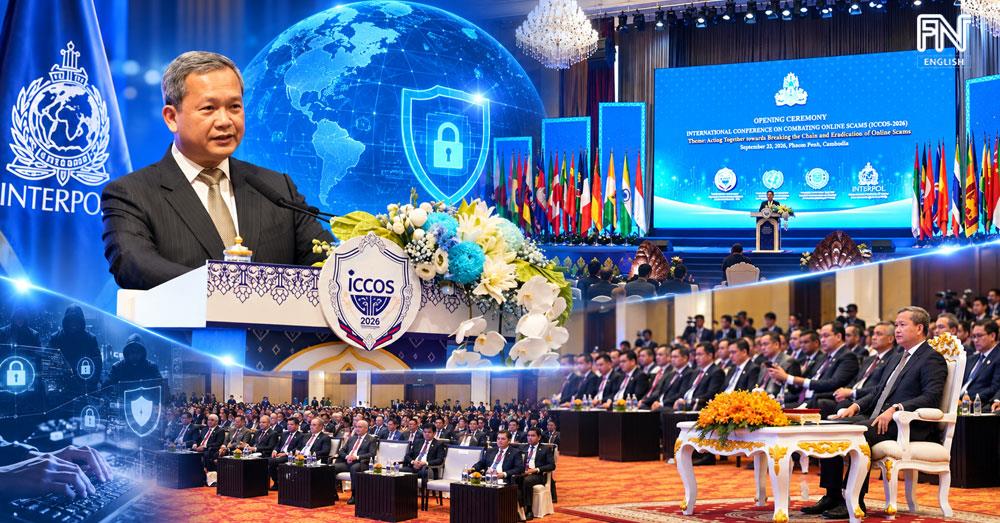

(Phnom Penh): Shutting down a building does not mean dismantling a scam network. Arresting hundreds of people working at computers does not necessarily mean capturing the masterminds behind the operation. And freezing several bank accounts does not mean cutting off the criminals’ entire flow of money.
Online scams have evolved into a transnational criminal ecosystem in which people, technology, money, facilitators and masterminds are linked together in a chain.
To explore ways to disrupt and dismantle this criminal ecosystem, Cambodia is hosting the International Conference on Combating Online Scams (ICCOS-2026) in Phnom Penh on September 23–24, under the theme “Acting Together towards Breaking the Chain and Eradication of Online Scams.”
The central question is no longer simply, “How many more scam centers must be shut down?” It is: Where must the world intervene to break the criminal chain that allows online scams to survive?
At the conference’s opening ceremony, Cambodian Prime Minister Hun Manet pledged that Cambodia would not become a safe haven for technology-enabled scams. He also emphasized that no country can address this transnational threat alone.
His remarks point to a fundamental challenge: Criminal networks operate across borders, while each country’s law-enforcement powers remain largely confined to its own jurisdiction.
To understand why shutting down a single site cannot end online scams, this analysis examines five interconnected parts of the criminal chain that allow these networks to operate, move, generate profits and re-emerge.
1. The Human Chain: Who Is a Criminal, and Who Is a Victim?
A scam center cannot operate without people. But not everyone working within a scam network is necessarily a willing participant in its crimes.
The human chain may begin with fraudulent job advertisements and extend through recruiters, intermediaries and managers to those who force victims to carry out scams.
Prime Minister Hun Manet stressed the need for authorities to distinguish between people who have been trafficked or coerced into committing scams and those who knowingly and voluntarily participate in criminal activities.
The success of an anti-scam operation, therefore, cannot be measured solely by the number of arrests.
More important questions must be asked: Who recruited these people? Who gave the orders? Who received the profits? And who needs protection as a victim?
Breaking the human chain means pursuing those who organize and direct the operation while protecting people who have been forced into the criminal enterprise.
2. The Technology Chain: Shut Down One Site, and the Network May Move Elsewhere
Online scams do not always require large buildings or centralized compounds.
When authorities disrupt their operations, criminal networks can split into smaller groups and use phones, computers, SIM cards, social media platforms and emerging technologies to continue operating from other locations.
Prime Minister Hun Manet warned that criminal groups may fragment and relocate when their operations are disrupted. He called for law enforcement to adapt through digital intelligence gathering, immigration screening and on-site inspections.
Closing a scam center may stop operations at one location, but it does not necessarily disable the wider network.
If its digital infrastructure remains operational, the network may simply relocate or change its methods rather than disappear.
3. The Money Chain: Follow the Money
The ultimate objective of online scams is money.
If proceeds from fraud can still move through bank accounts, money mules—people who receive and transfer funds on behalf of criminal networks— cryptocurrencies and informal money-transfer channels, the criminal enterprise retains the financial resources it needs to survive.
Against this backdrop, Prime Minister Hun Manet called for closer cooperation among financial intelligence units and anti-money-laundering authorities to trace illicit financial flows, identify ultimate beneficial owners, freeze virtual assets and disrupt underground banking networks.
The importance of cross-border cooperation is illustrated by Operation First Light 2026, an international anti-fraud operation coordinated by INTERPOL with the participation of 97 countries and territories. INTERPOL reported 5,811 arrests, approximately US$293 million in illicit assets intercepted, and more than 142,000 victims identified.
These figures demonstrate the reach of coordinated international enforcement. They also show why financial investigations must extend beyond individual scam sites.
The fight against online scams is not only about following the criminals. It is also about following the money: Where did it come from? Through whose hands did it pass? And who ultimately received it?
4. The Facilitator Chain: Look Beyond the Scam Center
A criminal network cannot function through its masterminds and frontline scammers alone.
It needs premises, recruiters, money movers, service providers and other facilitators who help sustain its operations and enable them to cross borders.
Prime Minister Hun Manet therefore argued that the law must reach beyond frontline operators to target masterminds, investors, recruiters, property owners and facilitators who enable the criminal enterprise.
The United Nations Office on Drugs and Crime (UNODC) has also highlighted how different forms of crime can become interconnected, including online scams, money laundering and human trafficking.
This means that shutting down one scam center may disrupt part of the operation without dismantling the system that supports it.
The focus must extend beyond the scam center to the wider scam ecosystem—the network of people, services and infrastructure that allows the crime to operate, generate profits and survive.
5. The Mastermind Chain: Arresting Frontline Operators Is Not the Same as Dismantling the Network
People working directly inside scam centers are often the most visible participants in these operations.
But those who organize the network, provide financing, direct operations, control financial flows and receive the ultimate profits may be based in other countries. They may also conceal their involvement behind companies, intermediaries and complex financial structures.
Arresting frontline operators can halt or disrupt an operation. But if the masterminds, financiers and ultimate beneficiaries remain beyond the reach of law enforcement, the network may rebuild or relocate.
In this context, Prime Minister Hun Manet called for real-time intelligence sharing, financial investigations, asset freezes, the exchange of digital forensic evidence and more streamlined extradition procedures.
Such cooperation is essential to prevent criminals from exploiting gaps between national jurisdictions.
Breaking the mastermind chain means going beyond the people visible inside scam centers to identify and pursue those who organize, direct, finance and profit from the networks behind them.
From National Crackdowns to International Cooperation
Taken together, the five chains reveal a central challenge facing ICCOS-2026: Can cross-border law enforcement move fast enough to keep pace with transnational criminal networks?
Criminals can transfer money, change SIM cards or crypto wallets, and relocate their operations in a short period of time.
By contrast, tracking down masterminds, freezing assets or obtaining evidence from another country often requires authorities to navigate different legal jurisdictions and international cooperation procedures.
To narrow this gap, Prime Minister Hun Manet outlined five priorities for international cooperation: real-time intelligence sharing; advanced financial investigations; greater legal and operational coordination; public-private partnerships; and victim protection.
The implication is clear: A national crackdown alone cannot defeat a criminal enterprise that operates across multiple countries.
Countering an international criminal network requires an international cooperation network capable of sharing intelligence, tracing money and taking coordinated action in time.
Conclusion: Breaking the Chain Requires More Than One Point of Intervention
The chain behind online scams cannot be broken at a single point. These crimes do not depend on one location or one group of people. They operate through an interconnected system.
Shut down a site without disrupting its technology, and the network may relocate. Arrest frontline operators without reaching the masterminds, and the network may recruit replacements. Freeze accounts without tracing the wider financial flows, and the money may find another route.
Breaking the chain, therefore, means more than dismantling a single scam center. It requires disrupting the connections among people, technology, money, facilitators and masterminds—simultaneously and across borders.
International partners are expected to adopt the Phnom Penh Declaration on September 24 as an expression of their shared commitment to combating technology-enabled scams.
But the real test will come after the declaration: To what extent can countries turn shared commitments into coordinated action?
Can intelligence be exchanged quickly enough to keep pace with criminals? Can illicit financial flows be traced across borders? And can investigations reach the masterminds who operate behind the networks?
The answer to the article’s central question is that the world cannot break the chain of online scams by targeting just one link. It must disrupt the points that allow criminal networks to recruit people, exploit technology, generate and move money, relocate operations and shield those directing them.
Defeating online scams is not simply about shutting down the places where the crimes occur. It is about dismantling the system that allows those crimes to survive, generate profits, move and re-emerge.