
(Phnom Penh): Scam centers can be shut down in a relatively short period of time. Suspects can be arrested, bank accounts frozen and cases sent to court.
But rebuilding a country’s reputation and international trust cannot be accomplished during a two-day conference.
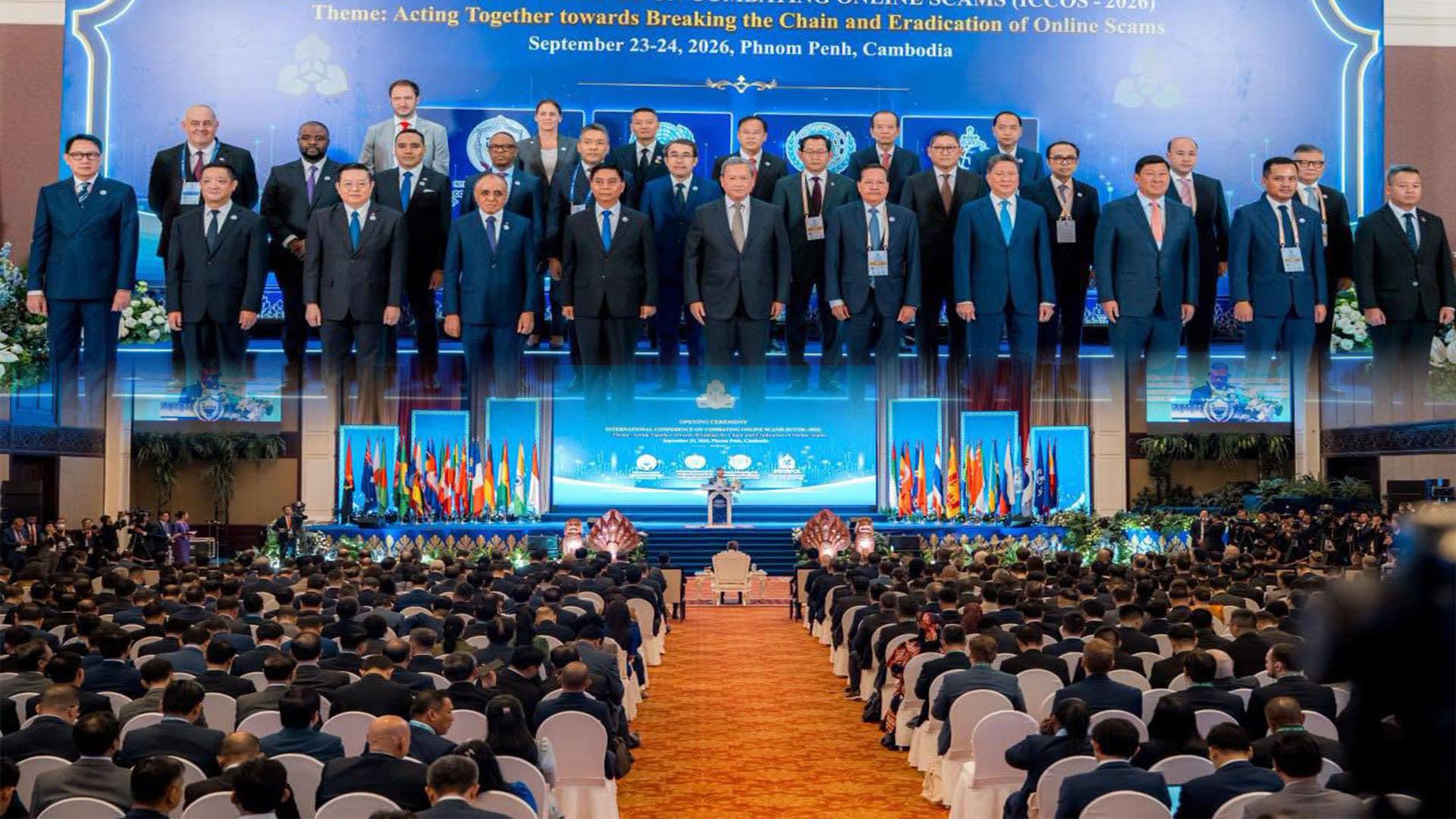
The International Conference on Combating Online Scams 2026, or ICCOS-2026, hosted by Cambodia on September 23–24, concluded with the adoption of the Phnom Penh Declaration, setting out 11 commitments to strengthen the fight against transnational online scams.
The question now is what Cambodia can expect after ICCOS-2026 — and whether the conference can become a starting point for rebuilding international trust and strengthening Cambodia’s reputation in the fight against online scams.
*A Conference Can Open the Way, but Results Build Trust
ICCOS-2026 gave Cambodia an opportunity to present the measures it has taken against online scams and to seek stronger international cooperation for the next phase of the campaign.
During the conference, Cambodia reported that authorities had inspected 832 suspected locations, taken action at 663 sites, and sent 446 cases involving 3,927 suspects to court.
Those figures indicate the scale of the crackdown. But rebuilding reputation and trust cannot be measured solely by the number of sites shut down or suspects arrested.
The more important questions are whether enforcement can be sustained, whether investigations can reach the organizers and ultimate beneficiaries of criminal networks, and whether dismantled networks can be prevented from re-emerging in new forms.
ICCOS-2026 may therefore open a path for Cambodia to rebuild trust, but sustained enforcement, transparency and verifiable results will determine whether that opportunity translates into long-term credibility.
*From Domestic Crackdowns to International Cooperation
Online scams are transnational crimes. Organizers, victims, technology infrastructure and financial flows may all be located in different countries. Cambodia can shut down sites and arrest suspects within its jurisdiction, but it cannot dismantle an entire cross-border criminal network on its own.
In his opening remarks at ICCOS-2026, Prime Minister Hun Manet called for stronger cooperation in five areas: real-time intelligence sharing, financial investigations, greater alignment of legal and operational frameworks, public-private partnerships, and victim protection.
That reflects one of the central messages of ICCOS-2026: no country can effectively confront a cross-border problem of this scale alone.
The challenge is now to turn that principle into operational cooperation.
At the conference, INTERPOL announced Task Force Shadow Storm, an initiative designed to bring together investigators from participating countries, including Cambodia, to work on actionable intelligence and support operations against technology-enabled criminal networks.
For Cambodia, this means that the next phase cannot stop at closing scam sites inside the country. International cooperation will be needed to pursue the organizers, trace illicit financial flows and dismantle networks operating across borders.
*Transparency: Rebuilding Reputation Requires Verifiable Results
At ICCOS-2026, Cambodia presented its enforcement measures and results, while some international partners offered positive assessments of its recent efforts against online scams.
Such recognition can be encouraging, but it does not by itself demonstrate that the problem has been resolved.
To rebuild trust, Cambodia will need to continue producing clear and verifiable results: How many criminal networks have been dismantled? How many organizers and beneficiaries have been prosecuted? How much criminal money and property has been frozen or recovered? And how many victims have been rescued and protected?
Making such results publicly available in a transparent and verifiable manner would help turn commitments into credibility — and credibility, over time, can contribute to rebuilding international trust and reputation.
*Follow the Money — Don’t Stop at Frontline Operators
The Cambodian government has said that major online scam compounds have been eliminated, while authorities have also acknowledged that criminal networks are adapting, breaking into smaller groups and exploiting new technologies.
This distinction is important: closing large compounds does not necessarily mean that the networks behind them have been fully dismantled.
If criminal operations shift to smaller locations or increasingly rely on AI and other digital technologies to operate remotely, enforcement focused primarily on physical sites and frontline operators will not be enough.
The key questions therefore go beyond “How many people have been arrested?” Investigators also need to ask: Who organizes the networks? Who finances them? Where does the money go? And who ultimately benefits?
This is the logic behind “Follow the Money.” The Phnom Penh Declaration emphasizes disrupting illicit financial flows, tracing criminal assets and recovering the proceeds of crime.
If Cambodia can move beyond arresting frontline operators and reach the organizers, financiers and ultimate beneficiaries, it would provide stronger evidence that enforcement is shifting from closing physical sites to dismantling the underlying criminal structures.
That, in turn, would be an important step toward rebuilding trust.
*Preventing Criminal Networks From Re-Emerging
Closing scam compounds is an important enforcement achievement, but it does not necessarily eliminate the operational capacity of the networks behind them.
ICCOS-2026 highlighted how criminal networks are adapting by becoming more decentralized and exploiting AI and other emerging technologies.
The major post-ICCOS challenge, therefore, is not simply “How many sites can Cambodia close?” It is also: “Can Cambodia prevent dismantled networks from re-emerging in new forms?”
If enforcement can prevent those networks from rebuilding their operations, the result would demonstrate not only the effectiveness of law enforcement but also Cambodia’s ability to sustain its campaign over time.
That would matter directly to the country’s efforts to rebuild international confidence.
*Conclusion: Reputation Is Rebuilt Through Results
ICCOS-2026 has given Cambodia international partners, a framework for cooperation and an opportunity to rebuild trust. But no conference, however significant, can restore a country’s reputation on its own.
The adoption of the Phnom Penh Declaration sets a direction; it does not mark the end of the journey.
For Cambodia, the next step is to turn commitments into action — and action into measurable, verifiable results.
So the question, “Can Cambodia rebuild its reputation?”, will not be answered by what was said during the conference. It will be answered by what happens after ICCOS-2026.
Will enforcement reach the organizers and beneficiaries behind the networks? Will illicit financial flows be disrupted? Will victims be effectively protected? And will dismantled networks be prevented from returning in new forms?
ICCOS-2026 can open the way for Cambodia to rebuild international trust. But transparency, accountability and verifiable results will ultimately determine whether that opportunity leads to lasting credibility and a stronger reputation.