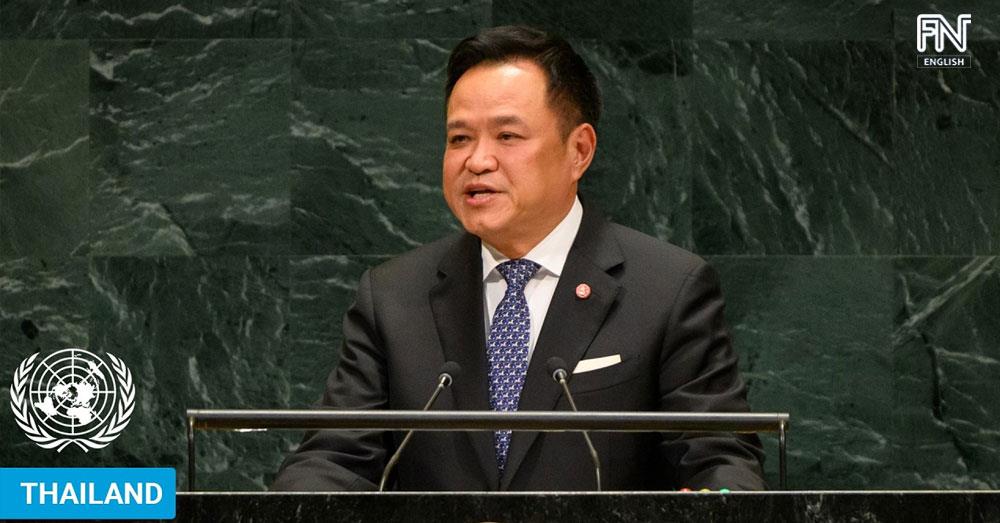

(Phnom Penh): At the United Nations General Assembly, Thai Prime Minister Anutin Charnvirakul emphasized bilateral dialogue, confidence-building and the peaceful resolution of disputes with Cambodia.
But that appeal raises a central question: If Thailand favors bilateral negotiations, why did it terminate MOU 2001, the bilateral framework established to address the two countries’ overlapping maritime claims?
And when Cambodia subsequently turned to compulsory conciliation under the United Nations Convention on the Law of the Sea (UNCLOS), why did Thailand criticize Phnom Penh for not giving bilateral dialogue a genuine chance?
Two Approaches to a Peaceful Settlement
At the UN General Assembly, Anutin said Thailand wanted to address its differences with Cambodia through bilateral dialogue and confidence-building. He also criticized Cambodia’s decision to initiate compulsory conciliation under UNCLOS, arguing that bilateral dialogue had not been given a genuine opportunity. At the same time, Thailand said it would participate in the conciliation process in good faith.
Cambodian Foreign Minister Prak Sokhonn, meanwhile, stressed that Cambodia and Thailand cannot move away from each other. Geography binds them as neighbors, he said, and the two countries therefore need to rebuild trust and resolve their disputes through dialogue, existing agreements and international law.
Cambodia’s position does not, in itself, close the door to bilateral negotiations. Nor does recourse to UNCLOS mean handing the power to determine the maritime boundary to a third party.
A conciliation commission is not a court and cannot impose a maritime boundary on Cambodia and Thailand. Its role is to hear the parties, examine their claims and objections, and make proposals aimed at facilitating an amicable settlement. Its final report, including its conclusions and recommendations, is not legally binding.
The key distinction, therefore, is not simply between negotiation and non-negotiation. It concerns the framework within which negotiations take place: Thailand emphasizes direct bilateral talks, while Cambodia has chosen a process in which international law and conciliation provide a structured basis for further negotiations.
The central question is therefore: What framework can best ensure that both sides operate under common legal principles while working toward an equitable solution?
If Thailand Favors Bilateral Talks, Why Terminate MOU 2001?
MOU 2001 was a bilateral framework agreed by Cambodia and Thailand to address their overlapping maritime claims. In 2026, Thailand unilaterally terminated the memorandum.
Thailand argued that the framework had produced little meaningful progress over roughly 25 years and was no longer suited to the changed circumstances. Bangkok maintained that terminating MOU 2001 did not mean ending negotiations with Cambodia, but rather seeking a new bilateral framework grounded in international law and UNCLOS principles.
That explanation, however, raises another question: If bilateral negotiation remains Thailand’s preferred approach, why was MOU 2001 not revised—or a replacement framework negotiated with Cambodia—before the existing bilateral framework was terminated?
The fact that a mechanism has failed to produce a settlement over a long period does not, by itself, establish that the mechanism was the cause of the deadlock. Stalemate can also arise from differences in legal positions, national interests and the inability of the parties to find mutually acceptable ground.
The issue, therefore, is not simply whether MOU 2001 produced enough results. It is also whether ending an agreed bilateral framework before a replacement was in place helped—or complicated—the effort to build confidence for future bilateral negotiations.
Does UNCLOS Mean Abandoning Bilateral Negotiations?
After MOU 2001 was terminated, Cambodia initiated compulsory conciliation under UNCLOS on June 2, 2026, concerning its maritime-boundary dispute with Thailand.
The process is not a court proceeding capable of drawing a binding boundary. The Conciliation Commission hears the parties, examines their claims and objections, considers relevant factual and legal questions, and seeks to facilitate an amicable settlement.
Its report, including its conclusions and recommendations, is not legally binding on either party.
But that does not mean the process ends with the report. Under Article 298 of UNCLOS, after the Conciliation Commission presents its report, the parties shall negotiate an agreement on the basis of that report.
In other words, compulsory conciliation does not eliminate bilateral negotiation. It ultimately leads the parties back to negotiations, but with the benefit of a structured conciliation process and a report addressing the dispute.
The real question, then, is not whether Cambodia and Thailand should negotiate bilaterally. It is whether those negotiations should proceed entirely through direct bilateral channels or with an international legal framework helping to structure the search for a settlement.
Big State, Small State: Are Bilateral Negotiations Always Equal?
Thailand has a larger economy, population and overall state capacity than Cambodia. Those differences do not automatically mean that bilateral negotiations will produce an unfair outcome.
They do, however, raise a broader question about asymmetry in bargaining power between states with different levels of material capacity.
International law cannot make two countries equal in economic size, population or military strength. What it can do is place states—large or small—under common rules, procedures and legal principles.
In that sense, the UNCLOS process does not make Cambodia materially equal to Thailand. Rather, it provides a common legal framework within which both sides can present their positions and pursue a settlement.
The deeper question, therefore, is not simply “bilateral talks or UNCLOS?” It is: What framework can best help ensure that an eventual settlement emerges from law, negotiation and mutual agreement rather than allowing differences in power to determine the outcome?
Land and Sea: Different Mechanisms, Shared Trust
The Cambodia–Thailand land-boundary dispute and maritime-boundary dispute are not the same legal case. The land boundary has its own agreements and mechanisms, while the maritime dispute is now proceeding through compulsory conciliation under UNCLOS.
Politically and diplomatically, however, the two are linked by one critical factor: trust.
When confidence deteriorates over land-boundary issues, it can make the political environment for maritime negotiations more difficult. Likewise, prolonged deadlock at sea can affect the broader relationship and confidence between the two countries.
Thus, although the land and maritime disputes are governed by different legal mechanisms, they cannot be completely separated from the wider political relationship.
What happens on land can affect confidence at the maritime negotiating table, while deadlock at sea can, in turn, affect trust between the two neighbors.
Conclusion: Peace Requires Both Negotiation and Law
The Cambodia–Thailand dispute should not be reduced to a simple choice between bilateral negotiations and UNCLOS.
Bilateral talks can be effective when both parties have confidence in the framework and respect the agreements governing the process. UNCLOS, meanwhile, cannot substitute for the political will of Cambodia and Thailand. Ultimately, the two countries must still negotiate with each other.
So when Thailand calls for a return to bilateral dialogue, the question should not only be: Why did Cambodia turn to UNCLOS?
Another question is equally relevant: If Thailand considers bilateral negotiation the appropriate path, why did it terminate MOU 2001 before a new bilateral framework was in place?
The real test of a peaceful settlement is not which side invokes “dialogue” more often. It is whether both sides can place their claims within law, agreed frameworks and verifiable procedures, and work toward a settlement in which differences in material power do not determine the outcome.
Lasting peace requires more than sitting across the negotiating table. It requires a framework in which both sides can have confidence that the settlement will rest on law and mutual agreement—not on disparities in power.